730 Days Later: Safety and Justice Lessons from Two Years of COVID-19

By: Matt Davis

Collaboration COVID Racial and Ethnic Disparities March 15, 2022

It’s been two years since the United States began to shut down to prevent the spread of COVID-19. As we continue in our mission to reduce jail populations across the United States, the Safety and Justice Challenge (SJC) asked some of our strategic allies to reflect on lessons learned from the pandemic.

Systems Adapted to Release More People and Take on New Challenges

Criminal justice systems across the country adapted to keep people safe. “They worked in partnership to reduce arrests and bookings, and they increased releases,” said Wendy Ware, vice president of the JFA Institute. Some jurisdictions made changes to their bail protocols. Others relied on technology to keep operating. Where possible, they also focused on behavioral health to improve reentry success.

But COVID-19 also further exposed racial inequities in jails across the country. “In many cases, we saw racial disparities increase across participating cities and counties as a larger percentage of White people were released from jail than Black people,” Wendy said. You can read Wendy’s December 2020 blog, “Five Things COVID-19 Taught Us About Safety and Justice.”

“The pandemic exposed and exacerbated existing inefficiencies and inequities in the justice system,” said Marc Levin, Chief Policy Counsel at the Council on Criminal Justice. “But it also inspired innovations such as remote check-ins for people under supervision that should remain a component of the system as we enter a ‘new normal.’”

Marc said it is now a critical task to deliver on the constitutional promise of a speedy trial. There have been “staggering delays stemming from court closures in systems that were already backlogged to some extent before COVID-19,” he said. Fortunately, “many SJC sites are leading the way in addressing this,” he said. “For instance, by diverting trivial cases, such as those involving warrants for unpaid fines and fees and low-level drug possession, as well as investing in holistic indigent defense so more individuals can be connected with treatment resources, mediation, and other off-ramps earlier in the process.”

Racial Disparities Persisted

Christopher James is a Racial Justice & Well-Being Associate with a Specialization in Criminal Justice at the W. Haywood Burns Institute. He also saw racial and ethnic disparities persist despite policy and practice changes during COVID-19, which led to overall population reductions. “This could mean that Black and Latinx populations which have been most susceptible to COVID-19 due to healthcare disparities have needs that are not sufficiently met by system changes,” he said. “In addition to that, many changes, such as allowing for hearings via Zoom or changes to the bond schedule, are being rolled back, and we must fight to show that these types of changes should remain to make the system and its processes more equitable for everyone.”

Christopher said legal systems were all capable of making many of the changes that took place during COVID-19. But it took the pandemic crisis to make them happen. He wants to keep the pressure up to keep valuable changes in place. “We must continue to hold systems accountable to keep these changes and not to wait until another crisis to begin thinking differently about what accountability can look like outside of secure custody,” he said.

“The arrival of the COVID-19 has only exposed the systemic inequities and racism in this country’s incarceration and detention policies,” said Ronald Simpson-Bey Executive Vice President, JustLeadershipUSA. “Even before the nation’s correctional facilities showed COVID-19 infection rates more than 150 times higher than the general population, correctional facilities were in a state of crisis.”

COVID-19 revealed prisons had “no real plan to deal with the outbreak,” Ronald said. In fact, most prisons do not have plans in place to deal with any kind of emergency. At the height of the crisis, Ronald wrote a blog about why jails need better emergency planning. Policymakers’ gross lack of foresight, care, and attention to protect people in prison and jails during this crisis, and all the ones that have preceded it, is reprehensible,” Ronald said. “The refusal to save the lives of the people behind bars, disproportionately Black and Brown, reflects the idea that these people are disposable.”

Ronald points out that people in jails and prisons are our mothers, fathers, teachers, and community members. They are human beings and their lives matter. Policymakers have fallen behind the curve, relying on “arbitrary standards” to release people and leave them waiting too long for release even when plans are in place, Ronald said.

Reframing Jail Populations as A Public Health Issue

“COVID-19 only affirmed a rapid need to decarcerate,” said Evie Lopoo, Project Manager at The Square One Project at Columbia University.  She added that the rapid spread of the virus in jails and surrounding communities showed the “profound” connection between the health of people in jails and prisons and the health of entire communities. “Reducing jail and prison populations is a matter of public health and should be framed as such,” she said.

County and City Governments Found a New Role in Making Change

“County governments have served on the front lines of the nation’s response to the pandemic,” said Larry Johnson, President of the National Association of Counties. Larry is also a County Commissioner in DeKalb County, Georgia. He said counties have been using new resources from the American Rescue Plan to shape their response. “We are investing in building healthier, safer counties where all our residents have opportunities to thrive,” he said. That means pursuing innovative practices with community partners to reduce the misuse and overuse of jails. It also means “improving outcomes for individuals involved in the justice system, especially residents with behavioral health conditions,” Larry said.

Kirby Gaherty is a Program Manager for Justice Initiatives at the Institute for Youth, Education and Families at the National League of Cities. The pandemic has meant “a lot of long days for the team at NLC,” she said. “We are happy to now see, after months of advocacy from members of the team, that cities are taking advantage of the American Rescue Plan to invest in much needed justice transformation projects like violence prevention strategies, alternative response models and more, in addition to other important investments.”

Kirby also said that much of her organization’s justice and public safety work shifted after the murder of George Floyd and the subsequent demonstrations. “While manifesting out of tragedy, the results were a much-needed refresh for our Justice Initiatives team here at NLC,” she said. “Our work with Mayors and Councilmembers across the country via the the Reimagining Public Safety Task Force resulted in two strong reports that we hope to advance through our SJC network and beyond. Unfortunately, narratives around violence and crime throw somewhat of a wrench in that work. But we are still hopeful to see cities make the changes that they committed to back in 2020.”

Moving Beyond What We Have Always Done

Kirby said the pandemic offered new perspectives for many people working on justice reform. It provoked a “new intentionality” around the work, she said. “It is unfortunate that it took a global pandemic slowing us down to get here,” she said. “But the results brought a stronger connection with local and national partners, more intentional engagement of people with lived experience and members of the community, and the ability to move beyond what we have always done.”


Building an Effective County Behavioral Health Care Continuum

By: Chelsea Thomson

Behavioral Health Collaboration February 17, 2022

Recognizing that too many people spend too much time in jails across America when their deeper need is for behavioral health treatment, counties are deploying innovative programs to help address this problem. To better support community members living with a behavioral health condition such as mental illness and/or substance use disorders, many counties are developing and implementing integrated behavioral health continuums of care.

Building an effective behavioral health care continuum targets the root causes of behavioral health emergencies by investing in comprehensive and accessible prevention, treatment, and real-time intervention. With almost one in four adults in the United States living with a behavioral health condition, county leaders understand the urgency to find approaches that balance community behavioral health needs and law enforcement response during an emergency.

The continuum of care helps people before, during, and after a behavioral health emergency by prioritizing a public health and person-centered approach. This reduces the overreliance on emergency rooms and the criminal legal system as de facto mental health providers.

The National Association of Counties is exploring the challenges and opportunities related to the behavioral health continuum of care in partnership with the Safety and Justice Challenge (SJC). This year we are producing a series of webinars and reports outlining the important work counties are undertaking in this space.

The first webinar in January focused on helping people before and after an emergency. Representatives from Orange County, NY, Johnson County, IA, and Hennepin County, MN discussed ways to assist people in the community through coordinated and wraparound services that often address social determinants of health. One panelist was Leah Kaiser, Director of Behavioral Health and Justice Strategy in Hennepin County—a community participating in SJC.

“Hennepin County includes Minneapolis. The impact of George Floyd in 2020 dramatically impacted our partnerships with law enforcement, with community providers, and with our communities,” Kaiser said. “We are really starting to reap the rewards that come from breaking down siloes to meet people’s needs.”

Kaiser discussed “intercept zero” of the sequential intercept model (SIM). The SIM details how people with behavioral health conditions come into contact with and move through the criminal legal system. Kaiser showed how practices such as care coordination, peer support and connections, and referrals to social services can help to address the underlying drivers of behavioral health conditions. It means deflecting people away from intercept one – when law enforcement or emergency services providers often respond to residents experiencing a behavioral health emergency.

“In our system redesign we’ve been centered on ‘what has been their experience when residents have a mental health emergency?’” Kaiser said. “Today, residents encounter a person, or multiple people, who do not have the right training and can do very little to help them resolve their crisis. The mismatch between training, response, and need is costly to both residents and the system at large. The result puts people on a path of repeated traumatic exposure, overuse of inappropriate interventions, and poor health outcomes.”

The system redesign in Hennepin County involved people from across the community, Kaiser said.

People facing a behavioral health emergency often have socioeconomic, health, and emotional needs across systems and are best served when those systems work together. That is why a recovery-oriented and cross-systems approach can stabilize a person in distress and equip them with the tools to effectively mitigate a future need before it turns into an emergency.

With differing needs, counties may prioritize pieces of the continuum but can best serve residents by supporting them throughout each step of their behavioral health condition. It is important to support community members during an emergency by providing them with someone to talk with, someone to respond, and somewhere to go—a framework created by SAMHSA—but services before and after are critical too. No one element of the continuum alone will resolve a problem.

The next webinar on February 22 will highlight counties that are using federal American Rescue Plan Act (ARPA) funds to support the behavioral health needs of their residents. Many counties are dedicating federal resources to programs and practices such as stabilization centers or providing mental health services in libraries and recreation centers. Counties are also deploying ARPA funds towards justice and public safety efforts.

As part of the SJC, NACo supports a dozen counties through the County Justice Peer Learning Network. Over the past two years, these counties have developed action plans and implemented practices to reduce the number of individuals living with a behavioral health condition in jails. They are bolstering their behavioral health continuums of care by increasing coordination across agencies and programs (Whatcom County, WA), launching a crisis triage center (Douglas County, KS), deploying a pilot mobile response unit pairing a paramedic and mental health worker (Dane County, WI), and expanding mental health diversion in the court system (Durham County, NC), among other accomplishments.

The future looks rich for a deeper discussion about behavioral health continuums of care. It should involve the right people in getting the right outcomes and keeping people out of jails who would be better served by treatment and support in the community.

A Deeper Look at Racial Disparity Data in Jails

By: Reagan Daly, Stephanie Rosoff

Data Analysis Incarceration Trends Racial and Ethnic Disparities January 19, 2022

Cities and counties participating in the Safety and Justice Challenge (SJC) significantly reduced their jail populations over the past few years – both prior to and following the COVID-19 pandemic. Despite that progress, racial and ethnic disparities in jails persist.

Today the SJC has selected four jurisdictions to join a new Racial Equity Cohort based on proposals that explicitly focus on racial and ethnic equity in the criminal justice system; center lived experiences of Black, Indigenous, Latinx, and other people of color; and emphasize the SJC Community Engagement Pillars of authenticity, accessibility and transparency, respect for diversity, and commitment to ongoing engagement.

The four cities and counties selected to participate in the Racial Equity Cohort are Cook County (IL), New Orleans (LA), Philadelphia (PA), and Pima County (AZ).

The funding will provide training and technical assistance focused on racial equity and authentic community engagement, peer-to-peer support from other cohort members, and qualitative and quantitative data and analytic support. The new funding and support announced is part of that commitment to learning and investing in more intentional and effective strategies to eliminate institutional and systemic racism within the justice system.

In that context, let’s take a deeper look at the data on racial disparities in jails and why there is such a great need for this work.

Jail Populations Can Be Successfully Reduced

Data collected by ISLG show significant declines in overall and pretrial jail populations, and reduced jail populations for people of color across SJC sites. Jail bookings are down, particularly for people charged with misdemeanors.

Since the start of the SJC, participating cities and counties collectively reduced their jail populations by 26% as of November 2021. This equates to almost 19,765 fewer people held in jail in SJC communities since we began collecting data. The decline in the confined pretrial/awaiting action population accounted for 52% of the overall decline in jail populations across SJC cities and counties.

Despite Improved Outcomes, Disparities Persist

Though jail populations are down across racial and ethnic groups, disparities persist in jail populations. While many people admitted to jail are released within hours or days of their booking, many cannot afford to post bail and may remain behind bars for weeks or even months. These and other burdens of jail fall disproportionately on communities of color.

Following the COVID-19 pandemic, jail populations declined dramatically across the country and in cities and counties participating in SJC. Though declines in jail populations and bookings were prevalent across racial and ethnic groups, the declines were more pronounced for White people than for Black, Latinx, and Indigenous people. As a result, racial and ethnic disparities persisted or worsened in many SJC communities between February 2020 and October 2020. The disparities were particularly deep for Black and Indigenous people.

More SJC Communities Reduced Jail Populations for White People

Though jail populations have rebounded somewhat since the early months of the COVID-19 pandemic, jail populations are still below February 2020 levels in many sites.

Still, in most sites the reductions for white people were greater than the reductions for people of color, resulting in persistent disparities.

From when communities joined the SJC through November 2021:

  • Jail population declines for Black people equalled or exceeded declines for White people in only 3 of 17 reporting sites.
  • White jail populations declined more than Latinx jail populations in all 12 reporting sites.
  • Indigenous jail populations out-declined White jail populations in 2 of 4 reporting sites.

Trends in Individual SJC Communities

Data on the four racial equity cohort sites–New Orleans, Cook County, Pima County, and Philadelphia–further illustrate the persistent disparities that exist, even among sites that have made significant progress in reducing overall jail populations.

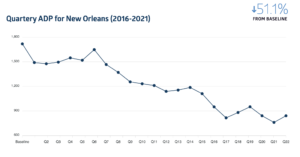
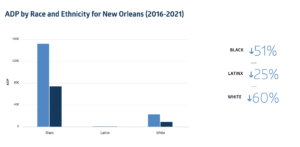
In New Orleans, Louisiana, the overall jail population declined by more than half since their baseline, but the reduction was more pronounced for white people (60% drop) relative to Black people (51% drop) and Latinx people (25% drop).

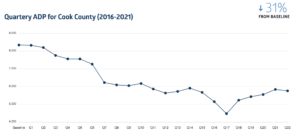
In Cook County, Illinois, the trends are similar. The t jail population ticked up slightly following the pandemic but remains significantly lower than baseline (down by 31%).. Still, the reductions in ADP for White people far outpaced reductions for Black and Latinx people.

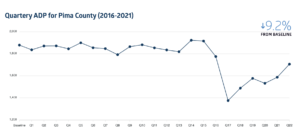
In Pima County, Arizona, race and ethnicity trends are unclear–local partners will be working on expanding their capacity to track this data as part of their reform work. Overall, however, the jurisdiction’s jail population trends show a 9% decline from their baseline and an upticksince the initial months of the pandemic.

Philadelphia, like Pima, does not yet fully report race population breakdowns, but has seen an overall jail population decline of 39%, up slightly from a pandemic-era low.

Work to Eliminate Disparities Continues

As cities and counties continue to implement strategies to safely reduce jail populations, more work remains to eliminate racial and ethnic disparities. The new SJC racial equity cohort in select sites across the country is an opportunity to further reduce harm and implement best practices.

The SJC has engaged the Institute for State and Local Governance (ISLG) at the City University of New York (CUNY) to track data across participating cities and counties.

A Dozen Blogs on Racial Justice to Mark MLK Day

By: Matt Davis

Community Engagement Racial and Ethnic Disparities January 17, 2022

Today is Martin Luther King, Jr. Day, but the commitment of the Safety and Justice Challenge to improving racial equity in the jail system runs year-round.

With that in mind, here are a dozen blogs on racial justice written by members of the effort and featured over the last year.

  1. Exploring the Difference Between Racial Equality and Racial Equity. Christopher James with the Haywood Burns Institute defined the terms of the debate: “To start treating, say, the Black community ‘the same as everyone else’ at this point in history will not go far enough in terms of achieving true equality,” he wrote.
  2. The Catalyzing Impact of George Floyd’s Death on Criminal Justice Reform. A year after the murder of George Floyd in Minneapolis, we asked how community leaders, organizers and activists have continued to champion criminal justice reform and call for an end to police violence.
  3. Here’s Why Jails Need Better Emergency Planning. Ronald Simpson Bey from Just Leadership USA reflected on the racial disparities in the jail system, and how they have impacted Black and Brown people, particularly through COVID. “We show that Black and Brown people are disposable in the United States when we fail to plan for emergencies,” he wrote.
  4. How Prisons and Jails Might Function if Addressing Trauma Was a First Priority. Nneka Jones Tapia with the Square One Project focused on healing the trauma of over-policing in Black and Brown communities, a topic rooted in the experience of seeing her father arrested for marijuana possession when she was growing up as a child in North Carolina. “As a child, you never forget the experience of police officers hauling your father off,” she wrote. “You do not forget having to interact with your father through a piece of glass. They are links in the chain of trauma that lie embedded within a person. And it radiates through communities.”
  5. Failing to Track Ethnicity Accurately. Troublingly, many jails across the United States are still failing to adequately track race and ethnicity, particularly of Latino people, says Nancy Rodriguez, a Professor at the University of California, Irvine.
  6. Overrepresentation of Indigenous People in Jails. We also spoke with Indigenous people about their experience with the jail system. “Systemic biases in America’s government and legal systems are rooted in historic genocide perpetrated against Native people,” said Dr. Selso Villegas. “We’re invisible to people because that’s the way many in society want it,” he said.
  7. Meaningfully Engaging People with Lived Experience. Aminah Elster is an SJC Fellow and Campaign and Policy Coordinator at the California Coalition for Women Prisoners. She wrote a piece about efforts by the District Attorney’s office in San Francisco to meaningfully incorporate people with direct experience of the criminal justice system in the office’s decision-making. She wrote, “efforts by criminal legal system leaders to engage community members with lived experiences of incarceration are often brief, centered on one-way, top-down information exchange or focused on asking for general input.”
  8. Pathways to Collective Healing: Law Enforcement and the Communities They Serve. Aviva Kurash with the International Association of Chiefs of Police wrote about a four-year Collective Healing initiative led by the association to focus on how police agencies can build and maintain trust and legitimacy with the communities they serve.
  9. Asking Ourselves: “Who’s Not Here in the Room?” Gwen Whiting is Director of Training and Leadership Development at Everyday Democracy. She’s worked with several cities and counties participating in SJC to embed racial equity, often through better community engagement. In this piece, she shares a key lesson for those across the country looking to do the same.
  10. Local Communities Are Better Placed Than Governments to Determine Public Safety. Renita Francois with the City of New York focused on community-centered design principles. She wrote about the Mayor’s Action Plan for Neighborhood Safety and its work in Brownsville, Brooklyn, home to the most densely concentrated area of public housing in the United States. Its work included offering a community poetry night called Poetic Justice, a roller-skating event called Swervin; an employment expo for residents; and a performance of “King Lear” followed by an interactive, guided conversation about caregiving and death.
  11. From the Barbershop to the Bakery, What Makes You Feel Safe? Emily Rhodes, a member of the Community Advisory Group in New Orleans, focused on community art projects designed to get residents discussing what they understand as public safety.
  12. A Twitter Chat on Reducing Racial Disparities. Marshall Project Staff Writer Jamiles Lartey hosted a Twitter chat on strategies for addressing racial equity in our criminal justice system as part of the Safety and Justice Challenge’s commemoration of Black History Month. From ending cash bail to empowering impacted communities in criminal justice reform, to replacing police with community response models for crimes better handled without a law enforcement response, the conversation emphasized ways to hold the system more accountable for racial disparities.

Challenges and Opportunity: Safely and Equitably Reducing the Use of Jails

By: Laurie Garduque

Collaboration Incarceration Trends December 16, 2021

The last two years have been turbulent for all our partners in the Safety and Justice Challenge (SJC), particularly for the cities and counties that have committed to reducing their jail population and eliminating racial and ethnic inequities as part of the SJC Network.

Communities participating in SJC range from the small (Missoula, MT) to the immense (Los Angeles, CA), and they vary demographically, politically, geographically, and in every other way you can imagine. But the COVID-19 pandemic touched all of them. It brought with it death and economic disruption, as it has everywhere. It also brought change and opportunity. By forcing local systems to adopt emergency measures to save lives—including suspending or discarding the routines, institutional habits, and assumptions that make jail incarceration so common—the pandemic experience has imparted valuable lessons.

The most obvious lesson, and perhaps the most important, is that we can do without incarceration, to a degree that many had not foreseen. All the cities and counties involved in the SJC reduced their jail populations during the pandemic, some quite dramatically. They got average jail populations down to the lowest levels in decades, and quickly, without endangering the public.

They achieved this largely through collaboration and using data in real-time to understand who is arrested and booked into jail. Local criminal justice systems are fragmented, and lots of agencies working independently play a part in filling jails. With strategies to reduce jail populations already underway and key decision-makers already working together, SJC communities were better positioned than most to respond to the crisis. Even before the pandemic, for example, there were more than a dozen multi-agency “jail population review” teams in place across the SJC Network, tasked with routinely looking at jail data and court records to identify people in custody who could be safely released. Adapting structures like this for COVID-19 purposes—using them to identify medically vulnerable people, say, or all people in jail charged with misdemeanors—was relatively easy.

Many cities and counties participating in SJC have also broadened their collaborations in ways that benefited them when the crisis hit. They were already working with public health officials and other agencies outside the criminal justice system; community advocates and representatives; and people who were directly impacted by the criminal justice system—all of whose cooperation, perspectives, and expertise were needed to cope with the pandemic.

In order to get and keep people out of jail facilities, where social distancing was difficult or impossible, and the danger of outbreaks was high, cities and counties participating in SJC used a variety of techniques. Police reduced or eliminated arrests for offenses like drug possession, sometimes issuing citations instead. Courts released individuals being held on low cash bail amounts or discarded cash bail altogether. Pretrial release and community supervision were expanded to include people charged with more serious offenses. Old warrants were quashed, and new ones were not ordered. And many of the people who were released got the support they needed—housing, food, medication, transportation, and service referrals—to remain in their communities.

Technology also helped. Many cities and counties used video conferencing for hearings to clear up cases while minimizing interactions. Probation and parole departments instituted online check-ins, helping to reduce revocations that often lead to jailing. Many of these practices, though intended to be temporary, are still in place, and many SJC communities are discussing ways of making them permanent.

Not all the news is good. Despite the overall reductions in jail populations, the racial disparities that preceded the pandemic have persisted. There are fewer people in jails, reducing the harm caused by incarceration, but among those who are in jails, people of color are still overrepresented. This has occurred even as the SJC has centered racial equity in its approach, committed to authentic community engagement, and focused on identifying and eliminating the drivers of racial and ethnic inequities.

Also left behind, for the most part, are people accused or convicted of violent felonies—a very large proportion of the incarcerated population, and one that cannot be ignored if we really mean to end mass incarceration.

At the same time, there are broad threats to the sustainability of the progress our partners have made, as well as the stability of the coalitions that achieved them. One of them is the perception that criminal justice reform generally, and pretrial detention reform specifically, have led to increases in crime, including the disturbing spikes in homicides many U.S. cities have witnessed in the past two years. We have good evidence to the contrary—including an analysis showing that no crime increases accompanied substantial jail population reductions in SJC communities during the initiative’s first two years; a more recent study drawing similar conclusions with regard to the even larger jail population cuts during the pandemic; and an assessment focusing on Cook County, which found no increase in criminal activity following bail reform there. Nevertheless, we think it would be a mistake to underestimate the potency of law and order rhetoric equating safety with punishment, which is what brought us mass incarceration in the first place.

All of which is to say, we still have work to do. It is, once again, a reminder that it is not enough to simply adopt best practices to reduce the jail population. Even amid crisis, careful attention must be paid to the racial disparities and working towards true equity. We look forward to what we can accomplish together in the next year.

Criminal Justice grantmaking ›
Criminal Justice strategy ›