
Research Report

Collaboration Incarceration Trends Pretrial Racial and Ethnic Disparities April 26, 2022

Population Review Teams: Evaluating Jail Reduction and Racial Disparities Across Three Jurisdictions

Joanna Weill, Amanda B. Cissner, and Sruthi Naraharisetti

Nearly one-third of those incarcerated across the U.S. are held in local jails, mostly held during the pretrial period, before they have been convicted of any crime. Among those detained in local jails, Black individuals are disproportionately represented, making up more than a third of the jail population in 2019.

Within this context of a national overreliance on jail, the John D. and Catherine T. MacArthur Foundation launched the Safety and Justice Challenge (SJC) in 2015. This effort supports local jurisdictions across the country in their search for safe and effective ways to reduce jail populations and eliminate racial and ethnic disparities.

Currently implemented in more than a dozen cities around the country, jail Population Review Teams (PRTs) are one strategy to reduce jail populations. Funded by the SJC and with guidance from ISLG, the Center for Court Innovation conducted a quantitative research study of the PRT model and its impacts in three sites through the spring of 2020: Lucas County, Ohio; Pima County, Arizona; and St. Louis County, Missouri. Although the sites did not design their PRTs to explicitly reduce racial disparities, this project helps them to measure the impact of PRTs and continue to work toward disparity reduction.

The analysis found:

  • A small impact on the jail population: Ultimately, the PRTs examined resulted in the release of a small proportion of the total jail population during the study period.
  • A larger impact, once a case is reviewed: For cases that make it to actual review by the PRT, about half go on to be released.
  • PRTs can increase disparities: In St. Louis County, White individuals are more likely than Black individuals to be eligible and recommended by the PRT.
  • Small disparity reduction at early PRT stages is not enough: In Lucas and Pima Counties, Black individuals were slightly more likely than White individuals to be eligible for the PRT, but these differences were not sustained past the eligibility stage.

Together, the findings across the three sites suggest that a jail reduction strategy is unlikely to reduce racial disparities if it does not explicitly consider race during the development of program policies. In addition, the PRTs included here impacted a small percentage of the overall jail population. However, feedback from the sites suggests that as a supplement to other local efforts or a driver of broad policy change, the PRT model shows promise in building collaboration, engaging local stakeholders across the system in meaningful discussion about overreliance on jail, and shining a light on potential areas for future efforts.

Additional Downloads

Deschutes County’s Clean Slate Program Shows Value of Front-End Diversion

By: John Hummel

Community Engagement Policing Pretrial September 28, 2021

The war on drugs has failed. More than 60 percent of people who are prosecuted for drug offenses reoffend. In Deschutes County, Oregon, our Clean Slate program provides a model for how communities can chart a better path.

Fifty-three percent of program participants have successfully completed the Clean Slate program, which requires not incurring a new arrest within one year. When compared to individuals that were eligible to enroll in the program but did not participate, only 38 percent were not cited for a new crime within 12 months. This impact is reflected again in that Deschutes County’s two-year recidivism rate hovers around 76 percent, but the two-year rate for Clean Slate participants is only 42 percent. Due to these successes, over 400 court appearances have been avoided and 253 people have been connected to much-needed medical care since the program’s inception in November 2017.

Front-end diversion efforts like Clean Slate—which occur before a court date, when a person has initial contact with law enforcement—can prevent overuse of jail and the negative consequences an arrest can have on a person’s life. We were able to develop the Clean Slate program and run the proof-of-concept pilot thanks to funding from the Safety and Justice Challenge Innovation Fund.

How the Program Works

When an officer interacts with a person on the street suspected of drug possession, rather than arrested them, they issue a citation to appear in court, and they give them a card with information about the Clean Slate program. Our office then calls that person and invites them to a Clean Slate orientation meeting which they can attend before their court date. At that meeting, the District Attorney or one of their deputies is there to welcome the person. After the welcome, the person has a confidential meeting with the public defenders, who also participate in the orientation process. After meeting with the District Attorney and the public defender, the individual meets with a substance use disorder professional who conducts an assessment. The person is then scheduled for an appointment with a primary care provider provider at one of the program’s participating federally qualified health centers. Once the patient shows up at that appointment, they are in the program and out of the criminal justice system.

Treating Substance Abuse Disorder in the Medical System, Not the Criminal Justice System

We have tried treating substance abuse disorder in the criminal justice system for the past 100 years, and we have failed miserably. It simply does not work. When someone is charged with possessing drugs, it is our belief that they either use recreationally or they are living with a substance use disorder and need the help of a medical professional.

The healthcare environment is very different from the criminal justice environment. Patients are free to talk openly and can communicate about what is going on with their lives. There are often underlying issues contributing to their substance abuse disorder. Sometimes it is a history of trauma or a mental health condition. There are also socioeconomic stressors that often play a role. Most people want to do better; they just do not know how to take the first step.

The leadership and providers at Mosaic Medical and La Pine Community Health Center were invaluable to this effort and worked intensely with us to develop the nuts and bolts of the program. They provide compassionate and competent care to our participants everyday.

Getting Law Enforcement on Board

Law enforcement officers have also been important partners. Many have embraced the program and encourage people suspected of possessing drugs to attend a Clean Slate orientation meeting.

Many officers on the street tell us they have come to have a better understanding of the people they interact with on a regular basis. They now realize that the people they are interacting with often have mental health issues, physical conditions, and trauma, which go together with drug addictions.

Handing a person a Clean Slate card and referring them to programs and resources can build a good working relationship between officers and the people they are citing. It shows the officer is not just there to throw a person into a jail cell but instead wants to see them succeed.

Humanizing People with Substance Abuse Disorder

People with a substance abuse disorder do not want or choose to have it. We are not giving them a break; we are giving them a chance to live the life they want to live.

By removing the criminal framework and demonstrating that there are healthcare providers here to help, we make it easier for people to stay employed and housed. Those are important ways for people to stay productive and engaged in society.

Our participants tell us they did not know programs like Clean Slate existed and that they did not think they had the resources to go through such a program. They feel like it is their opportunity to succeed and change their life. They also tell us that the medical staff they work with are helpful and kind, and that there is a lack of judgment which also helps them succeed.

One participant told us: “This program saved my life: I would have been dead by now. I reconnected with my family, have not been arrested, gained weight, got healthier, have fewer sick days at work. It is a miracle, and my whole life has changed.”

Lessons Learned

Police officers told us that the personal commitment of the prosecutor’s office to encourage them to refer to Clean Slate was important in securing their support. We also learned the importance of securing stakeholder support during the process of designing the program. And of course, we relied on data collection to validate the program’s success.

Jail detention has tremendous costs for the people in jail, their families, and their community. This program has reduced those costs and is a worthwhile investment in people’s futures.

We encourage other Safety and Justice Challenge jurisdictions to draw on the lessons from the Clean Slate Program to lower the use of jails and help people living with substance abuse disorder improve their lives.

The Clean Slate Program is also the subject of a case study by the Urban Institute which is available here. And you can watch a video about the program featuring participants and law enforcement, here.


Connecting People to Care in A Municipal Setting: Learning from Long Beach, California

By: Gigi Zanganeh

Community Engagement Diversion Pretrial August 16, 2021

We can learn a lot from the city of Long Beach in California about how best to keep people from falling through the cracks in our criminal justice systems. That’s the crux of an extensive new case study by the Urban Policy Institute on a Connection to Care (C2C) program focused on the city’s municipal jail.

John D. and Catherine T. MacArthur Foundation funded the initiative and the case study through its Safety and Justice Challenge.

The Safety and Justice Challenge seeks to reduce jail populations in communities around the country. Many participating cities and counties have jails that can hold thousands of people, but Long Beach’s municipal jail holds just 200 people who are often released in fewer than 72 hours before going to a county facility. They are in many cases people without housing who cycle in and out of the city’s jail and back onto the streets. They often struggle with behavioral health issues like substance abuse disorders and mental health diagnoses. And they are arrested for low-level crimes on a repeated basis.

Long Beach’s initiative is simple, yet, at the same time, quietly revolutionary. It doesn’t involve high-priced consultants or elaborate new care models. It is often as simple as getting people a taxi from the city jail in Long Beach to drug treatment or to a homeless shelter when they are released. Yet in some cases the C2C model pioneered in Long Beach has been sufficient to help people who have languished in the same destructive cycle for decades, getting them off the streets and into supportive services.

More than anything else, the program encourages people in the criminal justice system who have historically been operating in silos to talk to each other. It gets them to collaborate and work together in new, mutually beneficial ways.

In the case of this program, two of the biggest challenges to overcome were signing a contract with a taxi firm to provide rides, which took several months; and figuring out how to release people from the city jail to coincide with intake at the shelters and rehabilitation centers.

In other places, people are given a bus pass or a metro card when they are released from city jails. The idea is to get people on their way, and in many cases to get them to drug treatment or supportive housing. But some people do not follow through, instead falling through the cracks.

The C2C pilot was one element of a broader collaborative strategy developed by the City of Long Beach. The goal was to work more effectively with people who were repeatedly arrested, often because of a lack of housing. In 2015 the city developed the Public Safety Continuum, a collaboration between the Long Beach Police Department, the Long Beach Fire Department, and other municipal government partners including the city prosecutor’s office and Long Beach Department of Health and Human Services. Its research led to the city creating the Justice Lab at the start of 2018, to improve approaches for people who were cycling in and out of jails.

Foundational to the Justice Lab’s overarching strategy was the creation of the Multidisciplinary Team (MDT), which the Justice Lab manager oversees. It brings together city and county safety, social service, and behavioral health departments monthly to better coordinate the provision of mental health, substance abuse, and homelessness services for high-frequency users (HFUs) of the system.

The nine-month C2C pilot was a key strategy to enhance the city’s continuum of responses, and a way of addressing a critical gap in that continuum. Since 2015, Long Beach had been cultivating a range of responses to the needs of people coming into frequent contact with the city’s justice system, human services, and behavioral health systems. It based this effort on the Sequential Intercept Model, which helps jurisdictions systematically address how community-based responses can serve people with mental and substance use disorders involved in the justice system.

The foundational intervention for engaging HFUs at the jail intercept is the “clinician in jail” pilot program, which began in April 2018. The program embeds a mental health professional in the Long Beach City Jail to assist people incarcerated there and connect them to services to prevent additional jail bookings. The clinician is employed by the Guidance Center, a community-based mental health services provider. During the initial six-month pilot, the clinician met with 297 people and provided 214 referrals, primarily to mental health services (33 percent of referrals), substance abuse services (19 percent), and homelessness services (32 percent; Long Beach Justice Lab 2019).

The Long Beach Police Department, which operates the jail, committed to funding the clinician program during its second year. However, despite the good work the clinician did, the actual rate of connection to referred services upon release was disappointingly low because of challenges like the lack of transportation at the point of release. The C2C pilot was conceived to address this gap. And the results were impressive, even through COVID-19.

147 rides were provided in the program’s first ten months, primarily to emergency shelters and behavioral health treatment centers.

You can download and read the case study, Connection to Care in a Municipal Jail Setting, by clicking here. It includes client success stories and more detail on overcoming challenges.

The Multidisciplinary Team meetings provided a forum for strategic and client-level collaboration. Perhaps the greatest testament to the strength of the C2C collaboration was the partnership’s ability to reallocate resources and become more successful in engaging clients even as the city’s pandemic response disrupted the pilot’s jail-based components.

By replicating Long Beach’s step-by-step work, other jurisdictions can use data to understand their own challenges and develop the collaborative relationships and add priority system capacity to better meet them.

What Can We Learn from the Misdemeanor Diversion Program in Durham County, North Carolina?

By: Kelly Andrews

Diversion Incarceration Trends Pretrial August 3, 2021

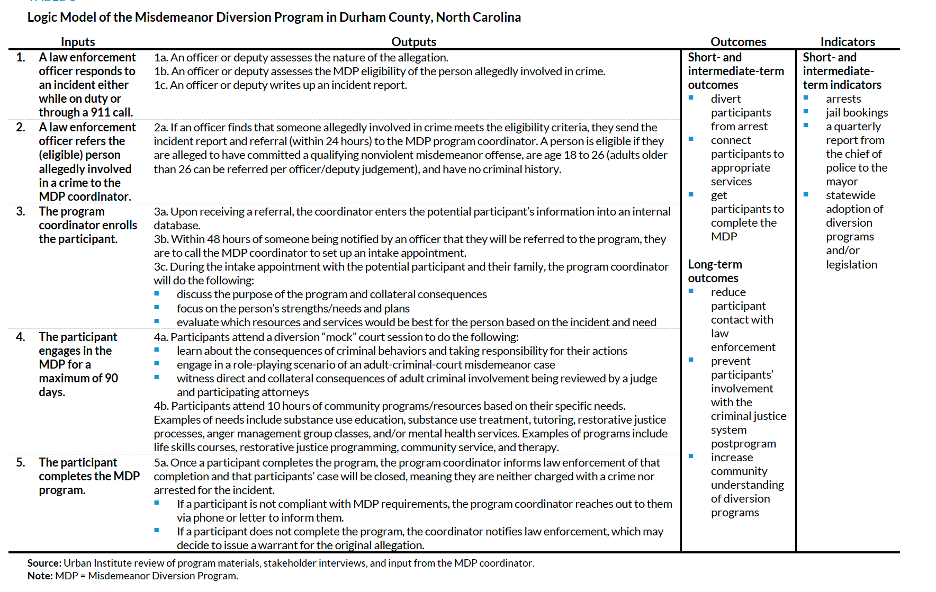
A successful misdemeanor diversion program at a Safety and Justice Challenge site in Durham County, North Carolina, can serve as inspiration for jurisdictions across the country as they seek to reduce jail populations and preserve public safety.

The diversion program shows collaboration between law enforcement and community groups in Durham County, and is the subject of an initial process evaluation by the Urban Institute, which you can download here.

The Urban Institute has not yet completed an accompanying outcome evaluation to see how the perceived impacts reported by relevant stakeholders align with measurable impacts available through local metrics —it is forthcoming in fall of 2021. But the county has been tracking its own numbers and it estimates that just under 800 people have gone through the program since 2014, with 99 percent of participants completing it. Of those, about 95 percent remain out of trouble after a year. Again, the Urban Institute—which is renowned for its rigorous, independent research—has yet to verify those numbers as an independent evaluator of the program. But in the meantime, the county is displaying them on its public-facing website as early evidence of the program’s success.

The Misdemeanor Diversion Program (MDP) began in 2014 to keep children out of the criminal justice system, because North Carolina had such antiquated laws related to minors. Until the ‘Raise the Age’ legislation passed in December, 2019, the state was automatically charging 16 and 17-year-olds as adults in the justice system and giving them adult criminal records.

The program allows law enforcement officers in Durham County to redirect people accused of committing their first misdemeanor crime(s) to community-based services in lieu of citation or arrest. What is unique about the program is that it occurs prearrest and pre-charge, meaning someone law enforcement officers may believe has committed a crime is not arrested or charged and does not formally enter the justice system in any way.

The program expanded to benefit adults up to 26, with older adults at law enforcement discretion. And other jurisdictions have replicated it across the state. It was based on a simple foundational principle: The need to avoid involvement in the justice system, where possible. It aimed to be as unrestrictive as possible while providing participants with the support necessary to move forward positively.

In the first week, the program got just two referrals. But a key element of the program’s success came in 2016 when the Durham Police Chief at the time created an executive order, taking discretion away from Durham Police officers and making referral of eligible individuals to the program mandatory for the Department.

The need for a program like the MDP in Durham County was well articulated by county stakeholders and participants who participated in the process evaluation. All stakeholders feel that people—youth in particular—do not need to be arrested and deserve “a second chance,” as some put it, if they do not pose a threat to public safety. Members of local law enforcement also believe the program has been useful and impactful. However, many local stakeholders believe that the community still needs more prearrest diversion opportunities whenever possible.

The program is cost effective and began with a grant, but it is now part of the county’s regular budget, demonstrating that it is replicable in other jurisdictions, with the right support and buy-in from local authorities.

Racial equity was also discussed during the conception of the program—given the disproportionate numbers of Black people in the county’s jail. Around three quarters of participants in the diversion program have been people of color.

Through interviews, we found that community stakeholders and program participants believe the MDP is impactful, particularly in that it diverts people from being charged with a crime and entering the justice system. Interviewees also generally believe the program was deeply needed in Durham County because too many people were being unnecessarily arrested and incarcerated.

Our process evaluation yielded four key takeaways for jurisdictions interested in replicating the MDP. First, buy-in from law enforcement is critical because it is needed to start the diversion process. Second, support from local leaders, such as elected officials, will help develop local law enforcement buy-in and support. Third, qualified program staff with deep community connections are essential. And fourth, a philosophy of keeping people out of the justice system altogether will lead to increased participant satisfaction and reduce collateral consequences associated with any justice involvement.

None of the interviewed stakeholders expressed resistance to the program, but several noted that when it was being developed, there was notable resistance from law enforcement agencies and law enforcement associations. Most of that resistance involved concern among local law enforcement officers that the program could take away their ability to determine whether an arrest could be made in certain situations, an ongoing concern during the early years of program implementation. In addition, numerous officers believed this type of program would infringe on their ability to perform their duty and would override their power to use discretion. Over time—through trainings, interactions with the program staff and participants, and changes in law enforcement leadership—law enforcement agencies generally became more supportive of the program.

Several stakeholders strongly support the program but believe it does not “do enough” (in the words of one interviewee) to reduce countywide arrests and incarceration. They want it to expand eligibility requirements to include more offenses, including additional misdemeanor charges and some felony charges. Simply put, many stakeholders feel the program has positively impacted participants but that too few people have been able to participate, leaving more people involved in the local justice system than necessary.

Some stakeholders criticized the program for making eligibility requirements too restrictive and not allowing enough access the program, which they consider essential to diverting people from the criminal justice system pre-charge. Many interviewees believe other communities would benefit from implementing similar programs to divert people from the justice system.

We encourage people to read the full process evaluation and to develop their own diversion programs based on what has been learned in North Carolina.

The Push for Racial Equity in Criminal Justice Starts with Asking Ourselves: “Who’s Not Here in the Room?”

By: Gwen Whiting

Community Engagement Pretrial Racial and Ethnic Disparities January 26, 2021

As technical assistance providers to the MacArthur Foundation’s Safety and Justice Challenge, my colleagues and I have worked with several key sites across the country to embed racial equity as an integral part of addressing America’s over-reliance on jails, often through better community engagement, particularly in Black and brown communities.

Our work over the last three years has had some success, and we’re excited to build on it. And a key lesson has been to ask often, when we’re working with decision-makers: Who isn’t here in the room? Why not? And how can we bring them in?

Very often, in our long careers, my colleagues and I have found ourselves brought into rooms of criminal justice decisionmakers who do not look a great deal like the communities in which they’re working. It’s not always constructive to ask a room full of white people in suits to look around themselves and ask “who’s missing?” But there are constructive ways to bring more diversity into the system, and to start that conversation moving.

If a person who’s waiting on their court date were to come into that room of decisionmakers, they’re going to ask themselves: “Do I see people I can trust, to whom I can tell my story without judgment? Do I see people who’ll be supportive of me and help me with my family situation?”

People are fearful, and they don’t know what’s going to happen. When we talk about building trust in communities, we need to honor that fear, and try to understand it.

I started doing this work when the Rodney King incident happened in Los Angeles. I was working with the Department of Justice on its 15 member National Church Burning Response Team when President Bill Clinton was in the White House. We traveled around the U.S. to communities where houses of worship had burned.  Being a part of that experience and my background in conflict management and resolution has afforded me a good sense of what people who are in vulnerable situations are feeling.  There is a lack of trust for systems and players who are perceived to hold power and resources. In this instance my role as a conciliation specialist was to pave the way for federal officers from agencies like the Federal Bureau of Investigtion and the bureau of Alcohol, Tobacco, and Firearms, along with local and state officers, to properly do investigations.

The unjust history and their personal stories are there when you go into communities. Understand: It’s just a lot. The stories that they hold. You need to pay attention to that, it’s not just coming in and saying “we want to work with you” and “we want to help.” When we talk about organizing, we talk about building that trust.

Using our dialogue to change approach, there are checklists we’ll work with, when we’re helping sites to build coalitions to tackle their issues: Does your coalition include people with different racial and ethnic backgrounds, different religious or philosophical views, and different political views? People with lived experience in the criminal justice system? Different ages? People with disabilities? Different professions? From different neighborhoods? People with different viewpoints on criminal justice? Different education levels? Folks with diverse gender identities and socioeconomic status?

Sometimes, it’s simply a question of prompting ourselves as decisionmakers to ask how we are showing up in our communities. What unconscious biases might be impacting our behaviors and decision-making?

As an African American – a Black woman, I have a vivid memory of being brought into a courtroom to observe as a judge was conducting pre-trial arraignment in a major city. Most of the defendants who came into the courtroom were Black or brown, and the judge referred to them by number, not by name. They were often asked if they could make bail, and many of them couldn’t. Then a young white defendant came in. She had been before the same judge, it turned out, although the judge still referred to her by her number. Still, she was sent straight to drug diversion. There was no question of her being asked about bail or staying in jail. I remember my own bias surfacing, and scoffing as I thought, “of course the young white woman is going to diversion.”

I don’t know the details of the young lady’s case. And it may well have been that the judge made the right call in sending her to diversion. The point is that for Black and brown people, our knowledge of the criminal justice system is shaped in the context of the history of our communities, and the history of the United States. When we see something like what I saw, we don’t always have time to think about the ins-and-outs. There’s a reaction to something we feel we’ve seen before.

The incident stuck with me, and I often talk about it with white criminal justice decisionmakers when we talk about how they show up in their communities, and the impact that they’re having.

There’s also a researched and proven tendency that in communities where there are more Black and brown folks, white decisionmakers can tend to micromanage, a little more, than they might do if they are working in communities where more people look like they do.

When it comes to the Safety and Justice Challenge, the sites that have been most successful in tackling racial inequity in the system have tackled it head-on, naming it as an issue and recognizing the role that power dynamics play in addressing it.

Some justice system leaders show up to our trainings curiously willing to ask the hard questions about why so many Black and brown people continue to show up in our jail system and why so many Black and brown people are being arrested.

Such sites have hired Black and brown community engagement managers who know the communities in which they work, and understand what it looks like to build trust, and what that means. These people have the voice of the communities in which they’re working. And that’s where the push for racial equity really starts to move things in the right direction.