What Has Changed in The Three Years Since George Floyd’s Death?

By: Chandra Tyler, Wilford Pinkney Jr., Rev. Dr. Michelle Anne Simmons, Lisa Varon

Community Engagement Racial and Ethnic Disparities May 24, 2023

It has been three years since George Floyd’s death at the hands of Minneapolis Police Officer Derek Chauvin on May 25, 2020. Mr. Floyd’s murder energized an international movement for racial justice with many pledging to change the role of law enforcement and more.

But what has changed? We asked individuals involved with the MacArthur Foundation’s Safety and Justice Challenge (SJC) to reflect on the landscape for criminal justice reform.

Clockwise from top left: Chandra Tyler, Safety and Justice Challenge Equity Inclusion Consultant for Mecklenburg County; Wilford Pinkney Jr., Director of the Office of Violence Prevention at the City of St. Louis; Rev. Dr. Michelle Anne Simmons, Founder and Executive Director of Why Not Prosper, Inc.; Lisa Varon, Deputy Director of the Office of Criminal Justice at the City of Philadelphia.

Chandra Tyler, Safety and Justice Challenge Equity Inclusion Consultant for Mecklenburg County

As we approach the three-year anniversary of George Floyd’s brutal death, I sit in deep reflection with both heaviness and hope. The devastating tragedy on May 25, 2020, which ignited an enormous blaze of protests, policy changes and social movements, appeared to be the long overdue awakening that so many fought and prayed for. Fast-forward to present day. America’s sense of urgency and progressive efforts has slowly lost its fire.

“It feels more like a Superbowl commercial. It came and it went,” Gemini Boyd, a member of the Mecklenburg County Community Engagement Task Group recently told me.

Though disappointing, these are the moments that remind us why we continue this race. Mecklenburg County Criminal Justice Community Engagement Task Group is just getting started. With intentionality and vision, we are mending the relationships between community and systems, pouring into our youth, and identifying gaps and resources needed to build a viable, sustainable, and equitable greater Mecklenburg County community. Through our 3 E’s: Engagement, Education, and Empowerment, our mission is to lead with collaboration and improve policy and practice changes in the criminal justice system. In honor of George Floyd and countless others, we press on. The marathon continues!

Wilford Pinkney Jr., Director of the Office of Violence Prevention at the City of St. Louis

The murder of George Floyd was a catalyzing moment. It created a window of opportunity, but sustaining the momentum is the challenge. The key to sustaining reform is collaboration, a comprehensive approach and sustainable infrastructure.

Since 2020, St. Louis has enacted numerous policies related to reimagining public safety. We did not have to look far for solutions. Numerous reports were published in the last nine years that created a comprehensive picture and outline for a strategic focus. The reports promoted collaboration and pointed to the need for a comprehensive approach to address existing inequities in order to create safe and healthy communities. The challenge was not ideas; it was action. Collaborations were created in 2020 that started the process of better aligning resources and redesigning systems, structures, and policies. We started building the infrastructure for a new system of public safety.

In 2021 Tishaura Jones was elected mayor on a platform of using national models of public safety and rejecting the false choice between being “tough” on crime and addressing the root causes of violence. This approach garnered support from diverse stakeholders ranging from the elected leaders and community organizations to residents in the cities most impacted neighborhoods. Under Mayor Jones’ leadership the Office of Violence Prevention (OVP) was created by ordinance and seeded with ten million dollars which ensures it is a permanent part of the city’s government structure.

The mayor’s comprehensive approach to public safety also includes policies aimed at designing safer streets, offering down payment assistance and guaranteed basic income to low-income residents, and year-round jobs for youth. St. Louis has the model for sustaining reform, a committed chief executive, a strategic focus, support from a diverse group of stakeholders, and sustainable strategies.

Rev. Dr. Michelle Anne Simmons, Founder and Executive Director of Why Not Prosper, Inc.

George Floyd’s death brought people’s awareness of racism back to life. People have a new lens on since it happened, and it’s still an intense change in how we are all looking at the world. There needs to be a differentiation between the understanding of racism and this focus on diversity, equity, and inclusion (DEI) training, though, because it’s different. The city of Philadelphia has done a lot to intentionally focus on DEI. And funding has shifted because of it. But there does need to be that deep commitment to focusing on racism.

In Philadelphia, specifically, the advocates and the organizers are taking no stuff. We’ve got commissions for jail, the police, parole, the prisons, and probation. Because the funding is there and people are sick and tired of the historical racism, all those things are coming together. And you can’t miss out on the anti-violence work either. People are more aware of things now. I feel our justice partners are coming around. They’re used to the same old systems. But they’re starting to pull back the curtain on racism and realize how they can change things. They’re just beginning to pull the curtain apart and say, “Now let me see what this is about, and how I might help.”

Lisa Varon, Deputy Director of the Office of Criminal Justice at the City of Philadelphia

In the three years since the murder of George Floyd, there has been a shift to focus on community strength instead of community suffering. In Philadelphia, an innovative sustainability plan is in place to bring in more meaningful community involvement and to continuously engage justice stakeholders in actionable reform efforts. To date, the city of Philadelphia has made an annual commitment north of two million dollars in the General Fund to support a wide range of initiatives and related personnel, that supplement the series of investments made through SJC. This work has three major components: experiential learning opportunities for criminal legal system stakeholders, several capstone-focused workgroups (all with a racial equity focus), and the eventual merging with the county Community Justice Advisory Board (CJAB). 

The experiential learning opportunities are an imaginative way of breaking down some of the silos that exist in the various criminal legal systems sectors. The learning opportunities look like robust pieces of training in racial equity and implementing reforms, site visits to local community-based organizations, and chances to explore the criminal legal system by learning how people travel through the legal system and identifying where people are most likely to get caught up in the system. 

As previously mentioned, sustainability efforts in Philadelphia have already begun. There are five SJC-focused workgroups that are continuing to propel this work forward: jail reduction strategy, data, community engagement/ racial and ethnic disparities, pretrial, and the common pleas case processing workgroups. All these groups have two things in common: dedication to the sustainability of promising practices and a commitment to have racial equity built into the reforms the groups hope to produce.  

Lastly, when we think of how far we have come in criminal legal system reform in the three years since the death of George Floyd, the most important thing to do is look forward. The work of the SJC will only be ending in name in Philadelphia. Strategic workgroups will continue to convene through the Philadelphia CJAB with the expectation that they will produce actionable recommendations for change in the local system. In addition, we are maintaining our commitment to bring the necessary City resources to sustain these efforts and outcomes as a long-term investment strategy in our community.


Behavioral Health IMPACT: Addressing Mental Health Disparities in Local Jails

By: Ashley Krider

Behavioral Health Incarceration Trends May 23, 2023

Since 2015, Policy Research, Inc. (PRI) has partnered with MacArthur’s Safety and Justice Challenge (SJC) to reduce the number of individuals involved, or at risk of involvement with, the criminal legal system who have mental illness, substance use, and other complex needs. Studies highlight the importance of concentrating on this population as communities work to tackle the misuse and overuse of jails and create more equitable systems:

As part of the Safety and Justice Challenge, PRI created the IMPACT Network to provide technical assistance to participating communities on issues related to the over-incarceration of individuals with mental illness and substance use disorders. The IMPACT Network communities engage in a peer-to-peer learning model to accelerate best and promising practices in behavioral health reform and jail diversion, with a commitment to pursuing community-driven, race-conscious solutions to reduce harm to populations overrepresented in, or disparately impacted by, the criminal legal system.

The SJC IMPACT Network began in 2021 with a group of 11 jurisdictions.

Over the past two years, these communities have participated in topical technical assistance meetings focused on behavioral health data tracking and evaluation, equity within the intersection of the criminal legal system and behavioral health, developing early diversion strategies, building a robust jail continuum of care, and other critical topics.

The communities participating in the IMPACT Network focus on a variety of strategies to decrease inappropriate incarceration of people with behavioral health needs.

Allegheny County, PA

Allegheny County’s Justice Related Services (JRS) provides assessment, treatment placement, and service coordination to court-involved individuals with mental health or co-occurring diagnoses. They are also focusing on balancing risk and needs during decision making for people with behavioral health needs, developing alternative response to certain 911 calls, and building out a broader continuum of peer supports for court-involved people.

Orange County, CA

In April 2022, the Orange County District Attorney’s Office launched their Focused Intervention Route to Services and Treatment (FIRST Point) pre-filing diversion pilot program. The pilot program connects people who have committed low-level crimes with services to address mental health and substance use issues to ensure a criminal proceeding does not inhibit future work and education opportunities.

San Juan County, NM

San Juan County has worked closely with community stakeholders and cross-agency representatives through their Sequential Intercept Mapping (SIM) process, identifying gaps in services available to individuals with behavioral health needs. As part of their post-SIM work, the county plans to identify a system for data collection that will assist stakeholders in tracking the county needs and build planning capacity toward creation of a mental health drop-in center.

In early 2023, PRI expanded the IMPACT Network by adding six additional communities: Doña Ana County, NM; Solano County, CA; Sarpy County, NE; Douglas County, NE; Issaquah, WA; and Natrona County, WY, for a total of 17 jurisdictions. This new group of counties brings to the IMPACT Network communities from the West and Midwest, including several smaller and more rural jurisdictions.

We are excited to further diversify the IMPACT Network and continue this important work toward the goals of reimagining systems, reducing the footprint of local jails, and increasing equity.

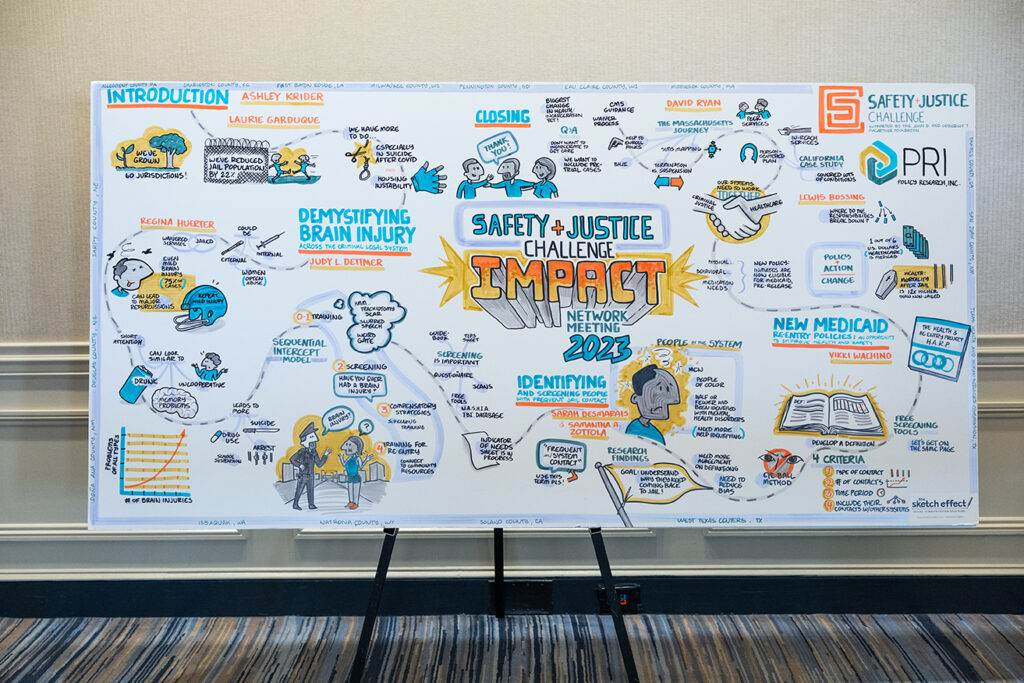
A visual representation of the IMPACT network from the SJC’s 2023 convening.


We Can Reduce Jail Populations and Keep Communities Safe

By: Laurie Garduque

Crime Data Analysis Incarceration Trends April 6, 2023

A recent uptick in violent crime across the country has alarmed many Americans. But even as communities work to address the root causes of violence and the effects of incarceration, new data from our Safety and Justice Challenge shows there is no link between reducing jail populations and increases in crime. Communities can feel confident in efforts to reform the local criminal justice system and safely reduce the jail population.

Since 2013, MacArthur has invested over $323 million in local justice reform, including tracking progress and analyzing the effectiveness of reform strategies. We have built close partnerships with research leaders in the criminal justice field, including grantee City University of New York’s Institute for State & Local Governance (ISLG) and the JFA Institute, to examine data from cities and counties participating in the Safety and Justice Challenge.

From this deep engagement with data and our relationships with diverse experts and people with lived experience, we have learned many valuable lessons. And the findings of two new reports—“Jail Populations, Violent Crime, and COVID-19: Findings from the Safety and Justice Challenge” by ISLG and “The Impact of COVID-19 on Crime, Arrests, and Jail Populations” by the JFA Institute—are among the most useful and insightful, and reinforce with data what we have heard from people involved in the justice system.

These analyses looked at what happens when cities and counties across the country focus on criminal justice reforms that make the system more fair, just, and equitable. They found that in communities participating in the Safety and Justice Challenge, there is no relationship between reforms that reduce reliance on jails and recent upticks in violent crime across the United States.

Reducing Jail Populations While Keeping Communities Safe

Since the Safety and Justice Challenge began, participating cities and counties have collectively reduced their jail population by 20 percent. This has resulted in about 15,000 fewer people in jail on any given day, allowing individuals, who are legally presumed to be innocent, to instead remain with their families, communities, and hold onto their jobs while their cases were pending.

JFA Institute’s close examination of the data found that even considering the effects of the COVID-19 pandemic, which temporarily reduced jail populations dramatically nationwide, most Safety and Justice Challenge cities and counties continued to outperform the nation as a whole in reducing jail populations, without jeopardizing community safety. As COVID-19 mitigation efforts wane, these communities have shown that progress can be sustained. Many of the emergency measures taken to reduce the jail populations during the pandemic, and that have remained in place in the months since, do not have an impact on public safety.

Meanwhile, ISLG’s analysis looks at how often individuals released from jail return to custody while their criminal case is still pending. The findings, which use individual-level jail admissions data from 2015 through April 2021, show that reforms focused on releasing people from jail before their trial did not drive recent increases in violent crime. The report found:

  • There is no correlation between declines in jail incarceration and increases in violent crime through COVID-19.
  • Most individuals released on pretrial status were not rebooked into jail. This has remained consistent over the years.
  • Of the small percentage of the individuals rebooked into jail, it was very rare that they returned with a violent crime charge and exceedingly rare that they returned with a homicide charge.

The evidence is clear: cities and counties should push forward with making the criminal justice system more equitable and fair. The decreased use of jails has no impact on crime, particularly violent crime, and communities should look beyond incarceration to address safety concerns. To claim that reforms jeopardize community safety ignores the data and unnecessarily puts the lives of incarcerated individuals and their families at risk.

Digging Into The Data on Jail Populations, Violent Crime, and COVID-19

By: Sana Khan

COVID Crime Data Analysis Incarceration Trends March 21, 2023

New research findings directly address recent claims about the role of criminal legal reforms in violent crime trends.

In response to the rapid spread of COVID-19, jails across the country implemented emergency strategies to reduce jail populations and mitigate the virus’s spread. Since the onset of the COVID-19 pandemic in 2020, public data show that violent crime and homicides have increased nationally. These increases have put a spotlight on criminal legal reform efforts, with growing public discourse in some political and media circles suggesting that reforms are causing these increases.

These claims often speculate that people released due to efforts to reduce jail populations are responsible for new violent acts committed. They make for attention-grabbing headlines but are not backed by any evidence-based research. They do not acknowledge the concurrent complex web of pandemic-related social and economic strains, or the fact that homicides increased in many major cities that did not enact progressive jail reform efforts.

The recent uptick in violent crime is real, but the increase is reflected across the country. This includes jurisdictions with progressive and traditional prosecutors, and cities and counties pursuing jail reform and those maintaining the status quo.

Digging Into the Data

Data collected from cities and counties participating in the Safety and Justice Challenge (SJC), a multi-year initiative funded by John D. and Catherine T. MacArthur Foundation, is the basis for one of the only analyses exploring these questions in depth on a national, multi-site scale.

To explore whether increases in violent crime were related to both the pandemic and criminal legal reforms, The CUNY Institute for State & Local Governance (ISLG) analyzed pre and post pandemic jail data on individuals released from jail on pretrial status, defined as people released from physical jail custody while their trial is ongoing, pending the disposition of one or more booking charges. The analysis shows how many individuals released from jail on pretrial status were returned to jail custody within six months (referred to as a rebooking).

The findings from this analysis, using individual-level jail admissions data from March 2015 to April 2021, show that reforms focused on releasing people from jail on pretrial status did not appear to drive recent increases in violent crime. In contrast, ISLG found that for SJC cities and counties:

  • There is no apparent correlation between declines in jail incarceration and increases in violent crime through COVID-19.
  • Most individuals released on pretrial status were not rebooked into jail. This has remained consistent over the years.
  • Of the small percentage of the individuals rebooked into jail, it was very rare to return with a violent crime charge and exceedingly rare to return with a homicide charge.

It is likely that many complex social and economic factors related to the pandemic contributed to the overall increases in violence, and particularly in homicides, that occurred across cities in 2020. However, findings from this analysis suggest that evidence-driven criminal legal reforms were not among those factors.

There is no apparent correlation between declines in jail incarceration and increases in violent crime through COVID-19

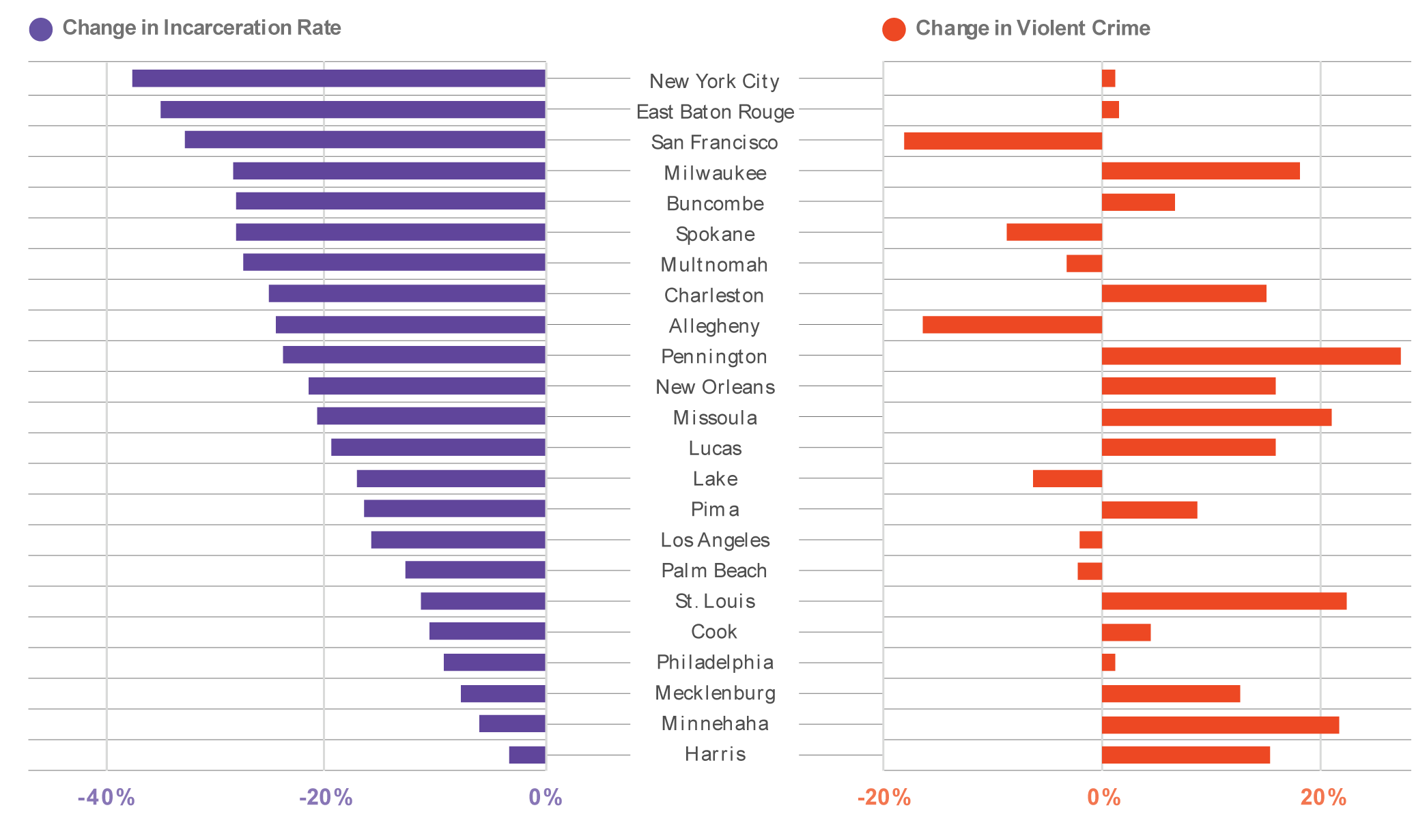
Following the implementation of SJC strategies to reduce local jail populations, SJC cities and counties’ incarceration rates declined at a faster pace compared to the national average, yet trends in violent crime were similar to the national trend. Violent crime was down across SJC sites and the nation between 2017-2019, only increasing during the pandemic in 2020.

Further, when looking at data for individual SJC cities and counties, all 23 SJC cities and counties decreased their incarceration rate between 2019 and 2020, when the pandemic emerged. However, changes in violent crime varied across cities and counties, and larger decreases in the jail population were not always associated with increases in violence.

Percent Change in Incarceration and Violent Crime Rates in SJC Sites, 2019-2020

Most individuals released on pretrial status were not rebooked into jail and very rarely were they rebooked on a violent crime charge, which remained consistent over the years

Using data from local jails in SJC cities and counties, ISLG followed people released on pretrial status and measured whether they were rebooked into jail within six months of the release.

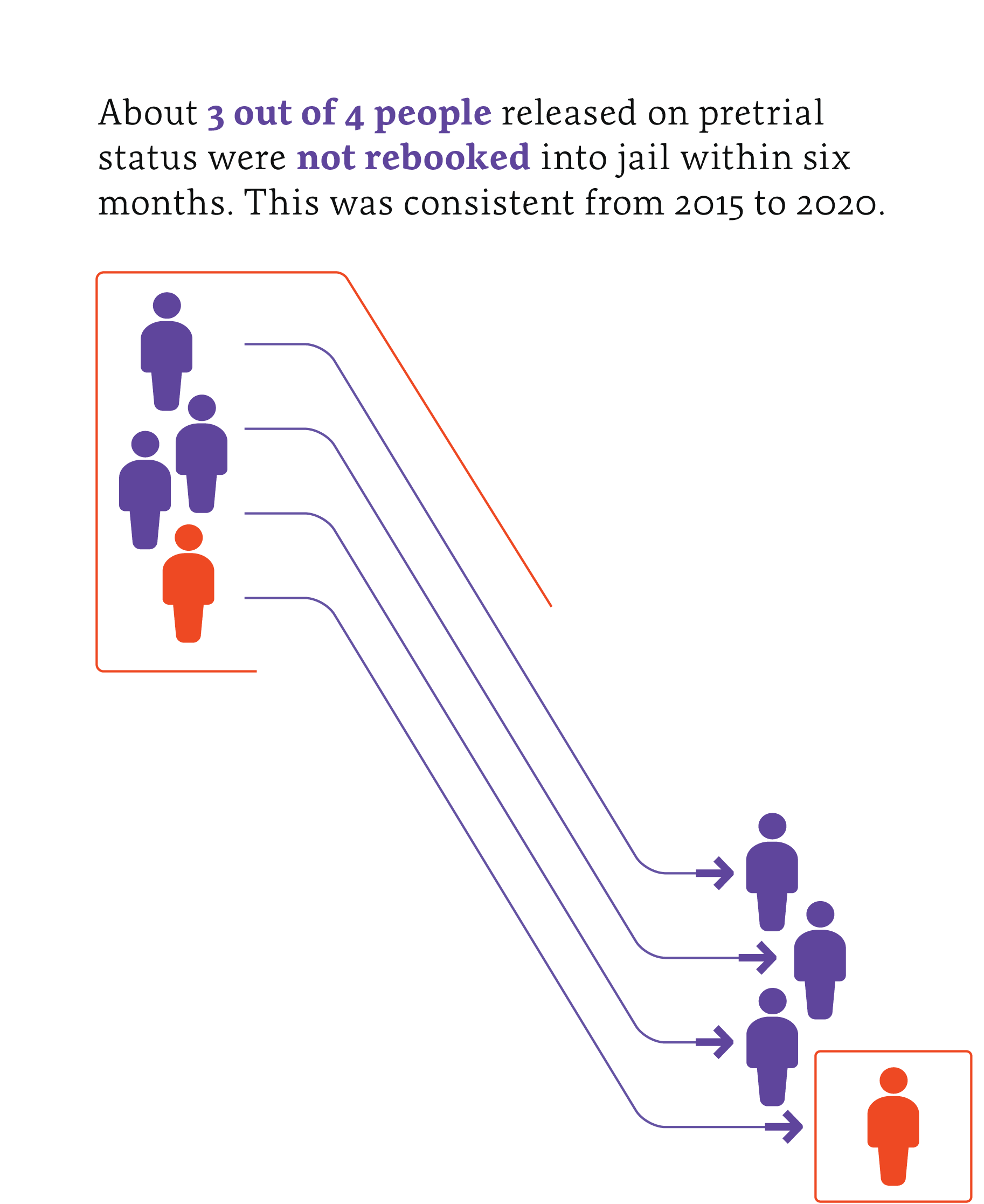
This analysis showed that across five years from 2015 to 2020, about three out of four people released on pretrial status were not rebooked into jail. In other words, people released from jail

were no more likely to return to jail after the implementation of SJC or CO

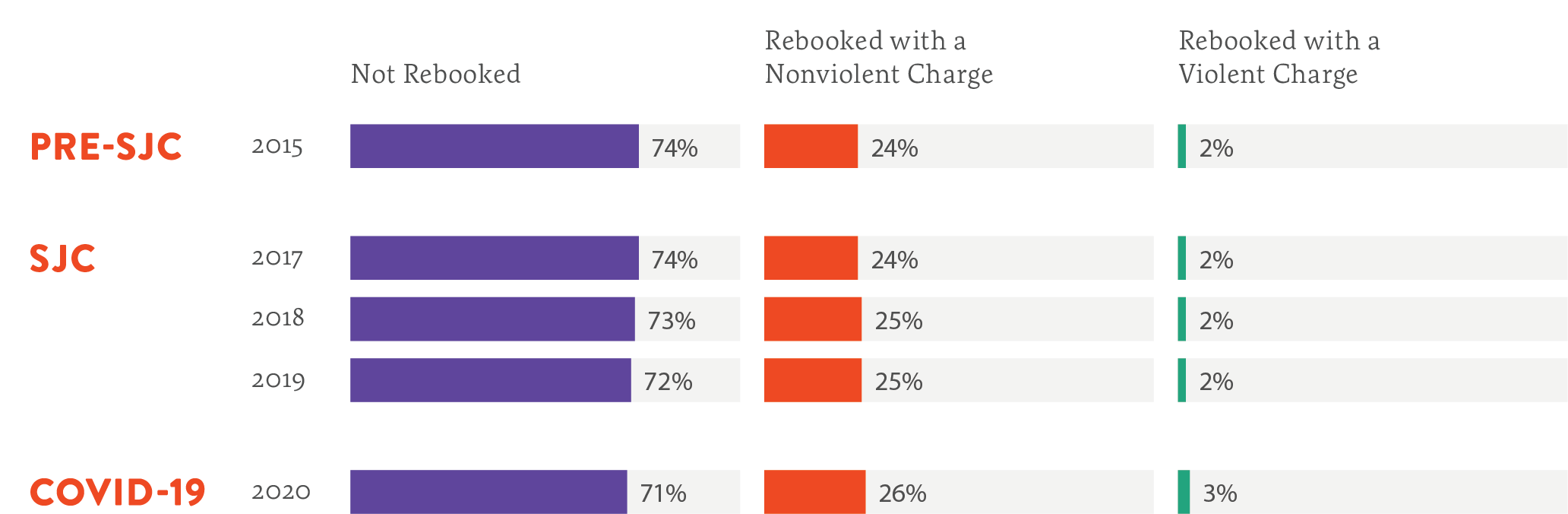
VID-19-related strategies for reducing jail populations. Over time, a very small share (two to three percent) of people released on pretrial status were rebooked within six months for a violent charge, a rate consistent before SJC implementation in 2015, during SJC implementation from 2017 to 2019, and through COVID-19 in 2020.

Two to three percent of people released on pretrial status were rebooked on a violent crime charge. Violent Crime Charge Rebooking Outcomes of Individuals Released on Pretrial Status within six months (Average Across SJC Cities and Counties), 2015 to 2020.

While violent crime may have increased in some SJC cities and counties overall, people who were released from jail while their criminal cases were pending were not the cause of these increases. The overwhelming majority of people released on pretrial status between 2015 and 2020 (over 96 percent) did not return to jail on a violent crime charge.

The rebooking rate for homicides specifically was even rarer: over 99% of people released on pretrial status were not rebooked on a homicide charge within six months. This was consistent from 2015 to 2020.

The Need for Evidence-Based Research instead of Attention-Grabbing Headlines

This study adds to the growing evidence that advancing equitable and thoughtful criminal legal reform is possible without compromising public safety. To suggest otherwise without evidence undermines the harms of incarceration on individuals, their families, and communities. Such discourse also distracts from genuine attempts to understand the true causes of rising violent crime, particularly homicides. More research is needed to unpack the increases in violence during a time of even more pronounced disparity in the U.S. as we recover from the COVID-19 pandemic.

Lessons About Criminalizing Women’s Poverty from A Study of the Buncombe County, North Carolina Jail

By: Tara Dhanraj Roden

Women March 1, 2023

A recent research project by the Vera Institute of Justice offers lessons for jail systems around the country on the dangers of criminalizing women’s poverty.

The picture for women in America’s jails remains troubling. Women in the United States only make up 4% of the world’s population, but the United States itself incarcerates 30% of the world’s population of women behind bars.

A stark example of the challenge in Buncombe County is that most of the women who were incarcerated at the Buncombe Country Detention Center in 2020 hadn’t even been convicted of a crime. More than two-thirds of women on average were jailed pretrial; fewer than 10% were serving a sentence. Many could go home if they had the money, but they remained in jail because they couldn’t afford to post bail.

In Buncombe County, the women’s jail incarceration rate increased tenfold from 1970 to 2019. Since joining the MacArthur Foundation’s Safety and Justice Challenge, Buncombe County’s jail population has increased, making the report’s recommendations all the more timely and urgent. Although the total Buncombe County Detention Facility population dropped by about 35 percent from spring 2019 to spring 2020, from 420 people to 272 people—largely due to swift action and collaboration between the detention center, law enforcement, court partners, and other key stakeholders in the early stages of the COVID-19 pandemic—the population rebounded and surpassed pre-COVID numbers in 2022. It is important to note that the jail population has started to decrease in the last few months as the county has made progress in identifying and implementing strategies that better address the drivers of incarceration. Although women make up a relatively small portion of the jail population—approximately 16 percent from 2017 to 2019, declining to about 11 percent in 2020, and then increasing through 2022—their circumstances and needs remain distinct and warrant particular attention.

The research project was part of the broader jail reduction work of the Safety and Justice Challenge Network, with findings based on administrative data from the jail and virtual surveys and interviews with 40 incarcerated women, representing nearly all the women who were held in the jail in September 2021.

Of the 40 women surveyed in the Buncombe County Detention Center, all but one said they struggled with drug or alcohol use. All but two said they were survivors of some form of violence, including domestic assault or physical, sexual, or emotional abuse.

In uncovering the paths that led to women’s incarceration in the county detention center, we concluded that many of them were there because their poverty had been criminalized. More than 20% of women who were admitted to the jail in 2020 were charged with a property crime, like larceny, burglary, or trespassing—low-level charges rooted in surviving the pressures of poverty.

In line with national patterns, women’s pathways into the jail in Buncombe County are shaped by economic instability, policies that criminalize acts of survival, and acts related to substance dependency.

Another theme that emerged was poor jail conditions and the costs associated with detention. Most of the women stated that they have no source of income when in detention. They shared that the average amount of money needed to cover necessities was $70 a week. The most common costs were for phone calls, hygiene products, and medical visits. Several women said they went for two weeks or more without toothpaste, shampoo, or clean underwear, which we believe may have been exacerbated by COVID. Women reported that the jail provides “indigent kits”—basic hygiene kits—but these cost $2 each, which is out of reach for people who are indigent.

One woman described:

“$20 for an ibuprofen. I’ve ordered the indigent kit for $1.98 and I’m $7 in the hole and I haven’t received anything. . . . I have no soap, no toothpaste.”

Another woman commented:

“Have to beg for these terrible pads. This happened this morning. I waited for an officer. She said, ‘It’s about to be shift change so ask someone else.’ I needed new underwear.”

In December 2021, jail staff stated that the indigent kit fee was eliminated. According to jail officials, the policy is that no incarcerated person is denied basic hygiene items due to lack of funds in their account.

On top of this is the county’s $20 charge for a medical visit to a nurse or doctor. As a result, women struggle on their own with ongoing medical conditions, pain, and lack of medication—which can result in health crises or hospital visits, a costly consequence of the initial, prohibitive fee. According to jail officials, the medical fee was waived during the height of COVID-19 and has since been reduced to $10.

Our study makes several recommendations to reduce the criminalization of poverty in Buncombe County. They include better housing options, alternatives to arrest and jail for certain charges, and creating a policy where the District Attorney’s office declines to prosecute certain low-level charges, especially those related to poverty or that pose no public safety risk. The study also recommends reforming bail practices, and codifying and expanding on COVID-era practices, such as the use of unsecured bail and warrant grace periods. It also recommends assessing the ability to pay before setting bail. The County can improve jail conditions, eliminate costs, and ensure better interagency coordination and communication to ensure women receive frequent and clear communication about their case status.

The study also recommends expanding time out of cells for women, and allowing in-person visits with family, especially children. It recommends expanding access to in-person and virtual programming, beyond substance use treatment. Buncombe County must ensure medical visits, phone calls, video calls, and virtual programming are free to incarcerated women.

Buncombe County’s Community Engagement Workgroup established a subcommittee to oversee county implementation of recommendations. There is a clear opportunity for jurisdictions like Buncombe County to invest in supportive community-based services, to reduce future criminal legal system involvement, and prevent it in the first place for many people, especially women.