Focusing on Latinos in the U.S. Criminal Justice System

By: Nancy Rodriguez

Data Analysis Incarceration Trends Racial and Ethnic Disparities June 12, 2023

Three new policy briefs have major implications for Latinos in the justice system, including in American jails, based on data and research from sites supported by the John D. and Catherine T. MacArthur Foundation’s Safety and Justice Challenge. The briefs explore how to better track Latino involvement in criminal justice systems, the role of language accessibility in criminal justice systems, and the value of adopting a nuanced approach to immigration enforcement policies at the local level.

A Review of Data Collection Practices and Systems-Involvement

The first brief, “Exploring Latino/a Representation in Local Criminal Justice Systems,” is a review of data collection practices and systems-involvement in local criminal justice systems, with a focus on Latino/a representation. It examines how local agencies in participating sites capture racial and ethnicity information. It also explores the involvement of Latinos/as in local criminal justice systems, including racial and ethnic disparities at the front door, in pretrial outcomes, and in criminal case outcomes. Its findings shed light on the development of much-needed data-driven reforms to the system to further racial equity.

Today, nearly one in five people in the U.S. self-identify as being of Latino origin. Remarkably, despite the size and diversity of the Latino population in the U.S., we do not know how many Latinos are arrested. That’s because we are still not collecting the data in enough detail.

How Latino and Hispanic ethnicity data is stored in local criminal justice systems is inconsistent and inhibits system-wide understanding of racial and ethnic disparities across local jurisdictions.

Even where fields exist to capture ethnicity information within a database, the data is not always consistently collected for all cases passing through key criminal justice system points. Even where agencies have the capacity to capture Latinos’ ethnicity, low rates of reporting and high proportions of missing data impedes accurate measurement of Latino outcomes.

At the front door to the justice system—arrest and jail booking—Latinos in all four sites—Charleston County, South Carolina; Harris County, Texas; Multnomah County, Oregon; and, Palm Beach County, Florida—make up a smaller proportion of those arrested or booked compared to their countywide population. Conversely, Black and Indigenous individuals were over-represented in arrests and jail bookings, relative to their countywide populations.

Latino and White rates of justice involvement were similar—and in many cases rates of Latino involvement were lower than that of Whites. However, Black individuals—particularly young Black individuals—were subject to substantially elevated rates of arrest, jail booking, and court convictions (and dismissals), demonstrating a considerable concentration of justice system contact for the Black community.

The brief makes several policy recommendations to address these disparities and disproportionalities. They include improving data collection practices, developing a standard set of categories to facilitate clear standards for data sharing and data translation between systems, encouraging regular examination of outcomes by race, ethnicity, and age group, and promoting community engagement and collaboration to identify ways to reflect the Latino/a population more accurately in local justice systems.

Establishing, Implementing, and Maintaining a Language Access Program

The second brief focuses on language accessibility in criminal justice systems, specifically focusing on the SJC. Language barriers can negatively impact legal representation and outcomes for non-English speakers in criminal cases.

Title VI of the Civil Rights Act of 1964 requires federally funded agencies to provide meaningful access to their programs and activities. This brief surveyed several local criminal justice systems and discovered significant gaps in the availability of language services for those who are LEP despite the provisions of Title VI. The report finds that while organizations and agencies within local criminal justice systems often receive federal funding, and are therefore mandated to provide language services, specific practices and the extent to which services are made available in these systems remains relatively unknown.

Key findings from the report include:

  • Data around language needs and services is inconsistently collected. Less than half of respondents reported collecting data on how frequently language services are utilized, and about half reported making efforts to address language access complaints beyond a case-by-case basis (e.g., regular reviews of complaints and outreach to specific language minority groups).
  • Despite the existence of bilingual and/or multilingual staff, most are not formally equipped to provide interpretation services. Approximately 94 percent of respondents reported that they have bilingual and/or multilingual employees. However, less than half of these employees are certified translators, and less than half offer pay differentials to employees who use their language skills on the job.
  • Translated content is lacking in digital spaces, written materials, and public signage. Less than half of respondents said their official website contains translated content, and less than half reported that public notices are translated into a language other than English. Despite more than half of all respondents reporting that they have translated materials, there are some languages for which no written translation is provided by any of the respondents. 

The report recommends that every individual who meets local criminal justice systems has access to services in their primary language. It makes the following policy recommendations:

  • Facilitate the hiring and training of bilingual and/or multilingual staff and interpreters and prioritize pay differentials for staff that are certified to use their language skills on the job.
  • Consistently collect and analyze data to better understand the language needs of local populations and assess whether the language capacities of the organization are sufficient to meet the identified language needs.
  • Ensure that all written content is translated, or can be quickly translated if needed.

It is important to note that language accessibility in criminal justice systems is not only about providing interpreters. It also involves the ability of individuals who are deaf or hard of hearing and those who have cognitive disabilities (e.g., intellectual disability) to communicate effectively with criminal justice system actors. In addition, individuals must be able to understand the legal process and make informed decisions about whether they want an attorney or to represent themselves without being coerced by others.

Immigration Enforcement Policies and Detainer Trends in SJC Sites

The third policy brief outlines the landscape of immigration policies across four SJC sites— Harris County, Texas, Los Angeles County, California, New York City, New York, and Cook County, Illinois—and illustrates how jail populations intersect with immigration enforcement policy.

Key findings include:

  • Specific attention on immigration is required to address racial inequities in local justice systems. The findings indicate that pursuing policies designed to lower jail incarceration and improve racial equity do not by default include an assessment of how immigration policies impact the system involvement of Latinos/as and undocumented persons.
  • Jurisdictions restrict and permit collaboration with US Immigration and Customs Enforcement (ICE) to varying and inconsistent degrees. While 70 percent of sites enacted limitations on some type of immigration enforcement cooperation, nearly 78 percent of jurisdictions lack a formal policy on ICE detention contracts; the absence of clear policy may permit further collaboration.
  • A majority of jurisdictions lack formal policies regarding the use of state and local resources to enforce federal immigration law. The majority of sites have no formal policy. However, 18 percent of sites restrict the use of funds for immigration enforcement, while 6 percent of sites expressly permit the use of local resources.

The brief includes policy recommendations for SJC sites:

  • Restrict the use of state and local resources to execute policies that enforce federal immigration law and contribute to racial disparities.
  • Limit local data sharing and collaboration with ICE.
  • Limit the outsourcing of local jail beds for immigration detention purposes.
  • Identify how local immigration policies are impacting the system involvement of Latino/as and undocumented populations

Nuanced criminal justice reform is needed around immigration policies at the local level. Future research should examine the intersection of immigration policies and the policing of Latino communities to offer insight into the treatment and justice system outcomes of Latinos/as and undocumented immigrants.

Collectively, I hope these three policy briefs will form the basis for deepening the national conversation about racial equity in the criminal justice system—particularly through a Latino/a lens.

What Has Changed in The Three Years Since George Floyd’s Death?

By: Chandra Tyler, Wilford Pinkney Jr., Rev. Dr. Michelle Anne Simmons, Lisa Varon

Community Engagement Racial and Ethnic Disparities May 24, 2023

It has been three years since George Floyd’s death at the hands of Minneapolis Police Officer Derek Chauvin on May 25, 2020. Mr. Floyd’s murder energized an international movement for racial justice with many pledging to change the role of law enforcement and more.

But what has changed? We asked individuals involved with the MacArthur Foundation’s Safety and Justice Challenge (SJC) to reflect on the landscape for criminal justice reform.

Clockwise from top left: Chandra Tyler, Safety and Justice Challenge Equity Inclusion Consultant for Mecklenburg County; Wilford Pinkney Jr., Director of the Office of Violence Prevention at the City of St. Louis; Rev. Dr. Michelle Anne Simmons, Founder and Executive Director of Why Not Prosper, Inc.; Lisa Varon, Deputy Director of the Office of Criminal Justice at the City of Philadelphia.

Chandra Tyler, Safety and Justice Challenge Equity Inclusion Consultant for Mecklenburg County

As we approach the three-year anniversary of George Floyd’s brutal death, I sit in deep reflection with both heaviness and hope. The devastating tragedy on May 25, 2020, which ignited an enormous blaze of protests, policy changes and social movements, appeared to be the long overdue awakening that so many fought and prayed for. Fast-forward to present day. America’s sense of urgency and progressive efforts has slowly lost its fire.

“It feels more like a Superbowl commercial. It came and it went,” Gemini Boyd, a member of the Mecklenburg County Community Engagement Task Group recently told me.

Though disappointing, these are the moments that remind us why we continue this race. Mecklenburg County Criminal Justice Community Engagement Task Group is just getting started. With intentionality and vision, we are mending the relationships between community and systems, pouring into our youth, and identifying gaps and resources needed to build a viable, sustainable, and equitable greater Mecklenburg County community. Through our 3 E’s: Engagement, Education, and Empowerment, our mission is to lead with collaboration and improve policy and practice changes in the criminal justice system. In honor of George Floyd and countless others, we press on. The marathon continues!

Wilford Pinkney Jr., Director of the Office of Violence Prevention at the City of St. Louis

The murder of George Floyd was a catalyzing moment. It created a window of opportunity, but sustaining the momentum is the challenge. The key to sustaining reform is collaboration, a comprehensive approach and sustainable infrastructure.

Since 2020, St. Louis has enacted numerous policies related to reimagining public safety. We did not have to look far for solutions. Numerous reports were published in the last nine years that created a comprehensive picture and outline for a strategic focus. The reports promoted collaboration and pointed to the need for a comprehensive approach to address existing inequities in order to create safe and healthy communities. The challenge was not ideas; it was action. Collaborations were created in 2020 that started the process of better aligning resources and redesigning systems, structures, and policies. We started building the infrastructure for a new system of public safety.

In 2021 Tishaura Jones was elected mayor on a platform of using national models of public safety and rejecting the false choice between being “tough” on crime and addressing the root causes of violence. This approach garnered support from diverse stakeholders ranging from the elected leaders and community organizations to residents in the cities most impacted neighborhoods. Under Mayor Jones’ leadership the Office of Violence Prevention (OVP) was created by ordinance and seeded with ten million dollars which ensures it is a permanent part of the city’s government structure.

The mayor’s comprehensive approach to public safety also includes policies aimed at designing safer streets, offering down payment assistance and guaranteed basic income to low-income residents, and year-round jobs for youth. St. Louis has the model for sustaining reform, a committed chief executive, a strategic focus, support from a diverse group of stakeholders, and sustainable strategies.

Rev. Dr. Michelle Anne Simmons, Founder and Executive Director of Why Not Prosper, Inc.

George Floyd’s death brought people’s awareness of racism back to life. People have a new lens on since it happened, and it’s still an intense change in how we are all looking at the world. There needs to be a differentiation between the understanding of racism and this focus on diversity, equity, and inclusion (DEI) training, though, because it’s different. The city of Philadelphia has done a lot to intentionally focus on DEI. And funding has shifted because of it. But there does need to be that deep commitment to focusing on racism.

In Philadelphia, specifically, the advocates and the organizers are taking no stuff. We’ve got commissions for jail, the police, parole, the prisons, and probation. Because the funding is there and people are sick and tired of the historical racism, all those things are coming together. And you can’t miss out on the anti-violence work either. People are more aware of things now. I feel our justice partners are coming around. They’re used to the same old systems. But they’re starting to pull back the curtain on racism and realize how they can change things. They’re just beginning to pull the curtain apart and say, “Now let me see what this is about, and how I might help.”

Lisa Varon, Deputy Director of the Office of Criminal Justice at the City of Philadelphia

In the three years since the murder of George Floyd, there has been a shift to focus on community strength instead of community suffering. In Philadelphia, an innovative sustainability plan is in place to bring in more meaningful community involvement and to continuously engage justice stakeholders in actionable reform efforts. To date, the city of Philadelphia has made an annual commitment north of two million dollars in the General Fund to support a wide range of initiatives and related personnel, that supplement the series of investments made through SJC. This work has three major components: experiential learning opportunities for criminal legal system stakeholders, several capstone-focused workgroups (all with a racial equity focus), and the eventual merging with the county Community Justice Advisory Board (CJAB). 

The experiential learning opportunities are an imaginative way of breaking down some of the silos that exist in the various criminal legal systems sectors. The learning opportunities look like robust pieces of training in racial equity and implementing reforms, site visits to local community-based organizations, and chances to explore the criminal legal system by learning how people travel through the legal system and identifying where people are most likely to get caught up in the system. 

As previously mentioned, sustainability efforts in Philadelphia have already begun. There are five SJC-focused workgroups that are continuing to propel this work forward: jail reduction strategy, data, community engagement/ racial and ethnic disparities, pretrial, and the common pleas case processing workgroups. All these groups have two things in common: dedication to the sustainability of promising practices and a commitment to have racial equity built into the reforms the groups hope to produce.  

Lastly, when we think of how far we have come in criminal legal system reform in the three years since the death of George Floyd, the most important thing to do is look forward. The work of the SJC will only be ending in name in Philadelphia. Strategic workgroups will continue to convene through the Philadelphia CJAB with the expectation that they will produce actionable recommendations for change in the local system. In addition, we are maintaining our commitment to bring the necessary City resources to sustain these efforts and outcomes as a long-term investment strategy in our community.

Behavioral Health IMPACT: Addressing Mental Health Disparities in Local Jails

By: Ashley Krider

Behavioral Health Incarceration Trends May 23, 2023

Since 2015, Policy Research, Inc. (PRI) has partnered with MacArthur’s Safety and Justice Challenge (SJC) to reduce the number of individuals involved, or at risk of involvement with, the criminal legal system who have mental illness, substance use, and other complex needs. Studies highlight the importance of concentrating on this population as communities work to tackle the misuse and overuse of jails and create more equitable systems:

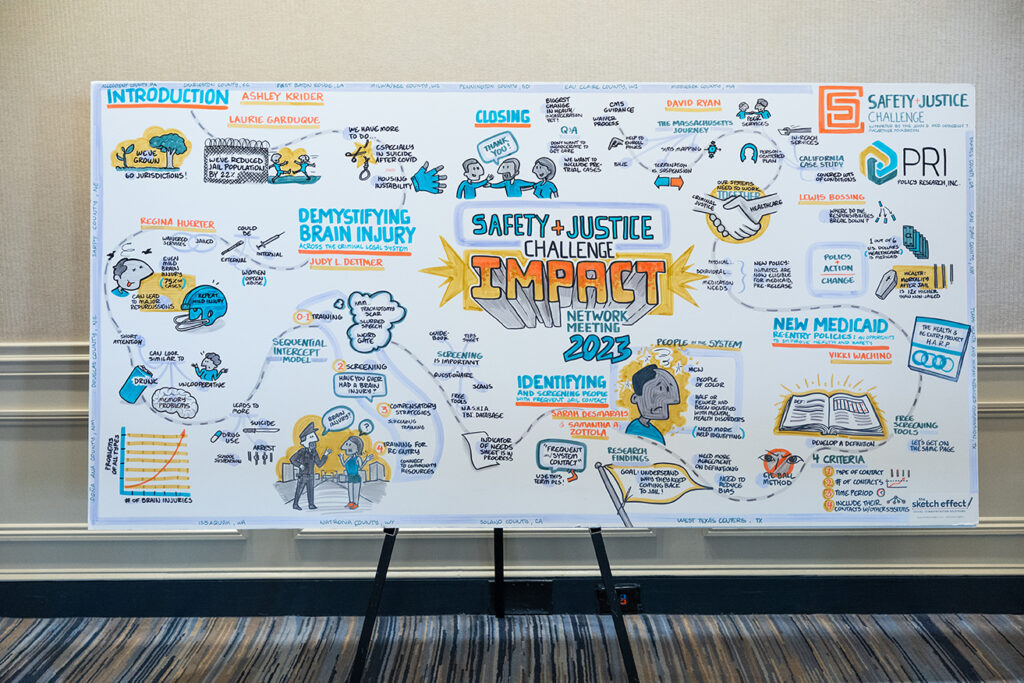
As part of the Safety and Justice Challenge, PRI created the IMPACT Network to provide technical assistance to participating communities on issues related to the over-incarceration of individuals with mental illness and substance use disorders. The IMPACT Network communities engage in a peer-to-peer learning model to accelerate best and promising practices in behavioral health reform and jail diversion, with a commitment to pursuing community-driven, race-conscious solutions to reduce harm to populations overrepresented in, or disparately impacted by, the criminal legal system.

The SJC IMPACT Network began in 2021 with a group of 11 jurisdictions.

Over the past two years, these communities have participated in topical technical assistance meetings focused on behavioral health data tracking and evaluation, equity within the intersection of the criminal legal system and behavioral health, developing early diversion strategies, building a robust jail continuum of care, and other critical topics.

The communities participating in the IMPACT Network focus on a variety of strategies to decrease inappropriate incarceration of people with behavioral health needs.

Allegheny County, PA

Allegheny County’s Justice Related Services (JRS) provides assessment, treatment placement, and service coordination to court-involved individuals with mental health or co-occurring diagnoses. They are also focusing on balancing risk and needs during decision making for people with behavioral health needs, developing alternative response to certain 911 calls, and building out a broader continuum of peer supports for court-involved people.

Orange County, CA

In April 2022, the Orange County District Attorney’s Office launched their Focused Intervention Route to Services and Treatment (FIRST Point) pre-filing diversion pilot program. The pilot program connects people who have committed low-level crimes with services to address mental health and substance use issues to ensure a criminal proceeding does not inhibit future work and education opportunities.

San Juan County, NM

San Juan County has worked closely with community stakeholders and cross-agency representatives through their Sequential Intercept Mapping (SIM) process, identifying gaps in services available to individuals with behavioral health needs. As part of their post-SIM work, the county plans to identify a system for data collection that will assist stakeholders in tracking the county needs and build planning capacity toward creation of a mental health drop-in center.

In early 2023, PRI expanded the IMPACT Network by adding six additional communities: Doña Ana County, NM; Solano County, CA; Sarpy County, NE; Douglas County, NE; Issaquah, WA; and Natrona County, WY, for a total of 17 jurisdictions. This new group of counties brings to the IMPACT Network communities from the West and Midwest, including several smaller and more rural jurisdictions.

We are excited to further diversify the IMPACT Network and continue this important work toward the goals of reimagining systems, reducing the footprint of local jails, and increasing equity.

A visual representation of the IMPACT network from the SJC’s 2023 convening.


We Can Reduce Jail Populations and Keep Communities Safe

By: Laurie Garduque

Crime Data Analysis Incarceration Trends April 6, 2023

A recent uptick in violent crime across the country has alarmed many Americans. But even as communities work to address the root causes of violence and the effects of incarceration, new data from our Safety and Justice Challenge shows there is no link between reducing jail populations and increases in crime. Communities can feel confident in efforts to reform the local criminal justice system and safely reduce the jail population.

Since 2013, MacArthur has invested over $323 million in local justice reform, including tracking progress and analyzing the effectiveness of reform strategies. We have built close partnerships with research leaders in the criminal justice field, including grantee City University of New York’s Institute for State & Local Governance (ISLG) and the JFA Institute, to examine data from cities and counties participating in the Safety and Justice Challenge.

From this deep engagement with data and our relationships with diverse experts and people with lived experience, we have learned many valuable lessons. And the findings of two new reports—“Jail Populations, Violent Crime, and COVID-19: Findings from the Safety and Justice Challenge” by ISLG and “The Impact of COVID-19 on Crime, Arrests, and Jail Populations” by the JFA Institute—are among the most useful and insightful, and reinforce with data what we have heard from people involved in the justice system.

These analyses looked at what happens when cities and counties across the country focus on criminal justice reforms that make the system more fair, just, and equitable. They found that in communities participating in the Safety and Justice Challenge, there is no relationship between reforms that reduce reliance on jails and recent upticks in violent crime across the United States.

Reducing Jail Populations While Keeping Communities Safe

Since the Safety and Justice Challenge began, participating cities and counties have collectively reduced their jail population by 20 percent. This has resulted in about 15,000 fewer people in jail on any given day, allowing individuals, who are legally presumed to be innocent, to instead remain with their families, communities, and hold onto their jobs while their cases were pending.

JFA Institute’s close examination of the data found that even considering the effects of the COVID-19 pandemic, which temporarily reduced jail populations dramatically nationwide, most Safety and Justice Challenge cities and counties continued to outperform the nation as a whole in reducing jail populations, without jeopardizing community safety. As COVID-19 mitigation efforts wane, these communities have shown that progress can be sustained. Many of the emergency measures taken to reduce the jail populations during the pandemic, and that have remained in place in the months since, do not have an impact on public safety.

Meanwhile, ISLG’s analysis looks at how often individuals released from jail return to custody while their criminal case is still pending. The findings, which use individual-level jail admissions data from 2015 through April 2021, show that reforms focused on releasing people from jail before their trial did not drive recent increases in violent crime. The report found:

  • There is no correlation between declines in jail incarceration and increases in violent crime through COVID-19.
  • Most individuals released on pretrial status were not rebooked into jail. This has remained consistent over the years.
  • Of the small percentage of the individuals rebooked into jail, it was very rare that they returned with a violent crime charge and exceedingly rare that they returned with a homicide charge.

The evidence is clear: cities and counties should push forward with making the criminal justice system more equitable and fair. The decreased use of jails has no impact on crime, particularly violent crime, and communities should look beyond incarceration to address safety concerns. To claim that reforms jeopardize community safety ignores the data and unnecessarily puts the lives of incarcerated individuals and their families at risk.

Digging Into The Data on Jail Populations, Violent Crime, and COVID-19

By: Sana Khan

COVID Crime Data Analysis Incarceration Trends March 21, 2023

New research findings directly address recent claims about the role of criminal legal reforms in violent crime trends.

In response to the rapid spread of COVID-19, jails across the country implemented emergency strategies to reduce jail populations and mitigate the virus’s spread. Since the onset of the COVID-19 pandemic in 2020, public data show that violent crime and homicides have increased nationally. These increases have put a spotlight on criminal legal reform efforts, with growing public discourse in some political and media circles suggesting that reforms are causing these increases.

These claims often speculate that people released due to efforts to reduce jail populations are responsible for new violent acts committed. They make for attention-grabbing headlines but are not backed by any evidence-based research. They do not acknowledge the concurrent complex web of pandemic-related social and economic strains, or the fact that homicides increased in many major cities that did not enact progressive jail reform efforts.

The recent uptick in violent crime is real, but the increase is reflected across the country. This includes jurisdictions with progressive and traditional prosecutors, and cities and counties pursuing jail reform and those maintaining the status quo.

Digging Into the Data

Data collected from cities and counties participating in the Safety and Justice Challenge (SJC), a multi-year initiative funded by John D. and Catherine T. MacArthur Foundation, is the basis for one of the only analyses exploring these questions in depth on a national, multi-site scale.

To explore whether increases in violent crime were related to both the pandemic and criminal legal reforms, The CUNY Institute for State & Local Governance (ISLG) analyzed pre and post pandemic jail data on individuals released from jail on pretrial status, defined as people released from physical jail custody while their trial is ongoing, pending the disposition of one or more booking charges. The analysis shows how many individuals released from jail on pretrial status were returned to jail custody within six months (referred to as a rebooking).

The findings from this analysis, using individual-level jail admissions data from March 2015 to April 2021, show that reforms focused on releasing people from jail on pretrial status did not appear to drive recent increases in violent crime. In contrast, ISLG found that for SJC cities and counties:

  • There is no apparent correlation between declines in jail incarceration and increases in violent crime through COVID-19.
  • Most individuals released on pretrial status were not rebooked into jail. This has remained consistent over the years.
  • Of the small percentage of the individuals rebooked into jail, it was very rare to return with a violent crime charge and exceedingly rare to return with a homicide charge.

It is likely that many complex social and economic factors related to the pandemic contributed to the overall increases in violence, and particularly in homicides, that occurred across cities in 2020. However, findings from this analysis suggest that evidence-driven criminal legal reforms were not among those factors.

There is no apparent correlation between declines in jail incarceration and increases in violent crime through COVID-19

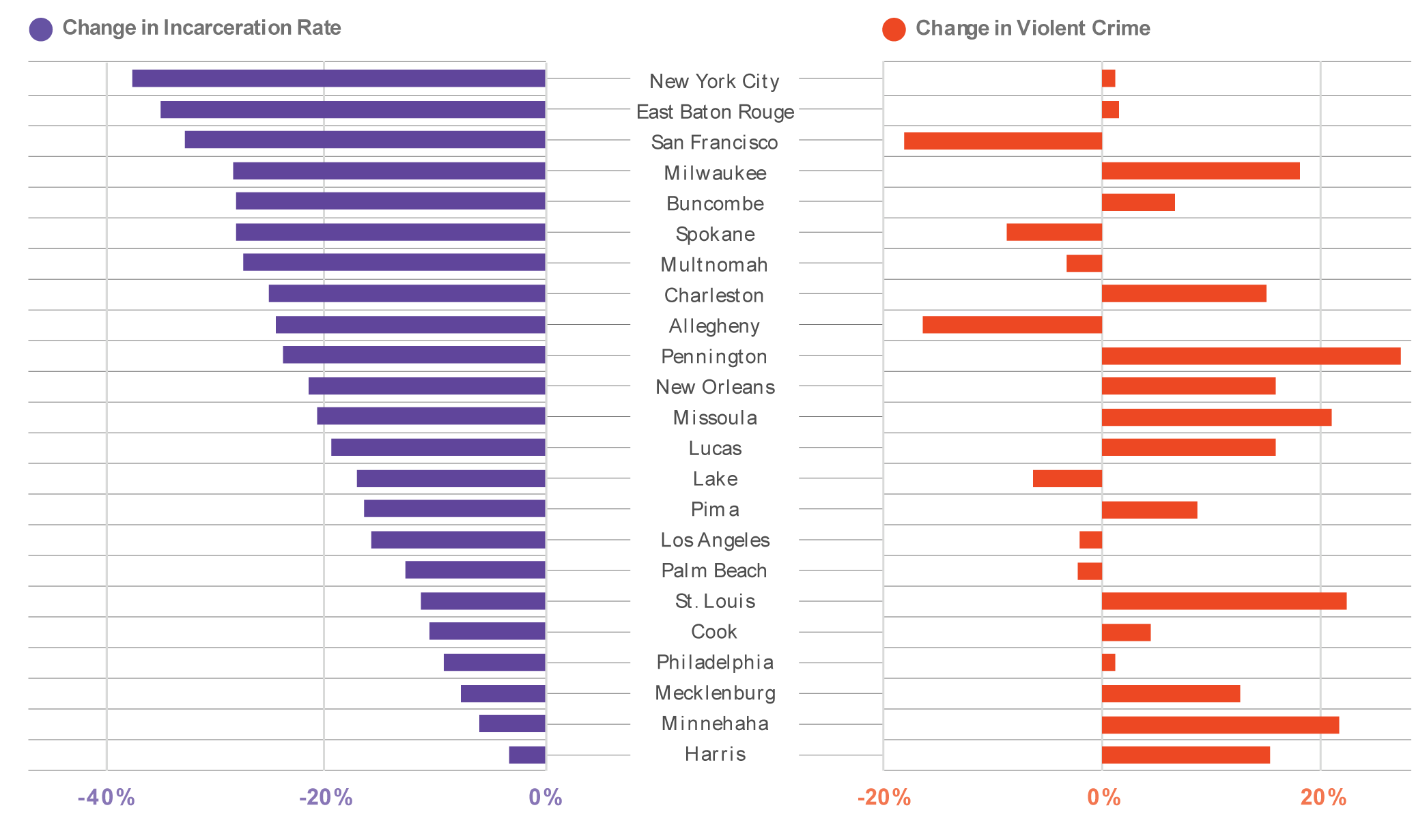
Following the implementation of SJC strategies to reduce local jail populations, SJC cities and counties’ incarceration rates declined at a faster pace compared to the national average, yet trends in violent crime were similar to the national trend. Violent crime was down across SJC sites and the nation between 2017-2019, only increasing during the pandemic in 2020.

Further, when looking at data for individual SJC cities and counties, all 23 SJC cities and counties decreased their incarceration rate between 2019 and 2020, when the pandemic emerged. However, changes in violent crime varied across cities and counties, and larger decreases in the jail population were not always associated with increases in violence.

Percent Change in Incarceration and Violent Crime Rates in SJC Sites, 2019-2020

Most individuals released on pretrial status were not rebooked into jail and very rarely were they rebooked on a violent crime charge, which remained consistent over the years

Using data from local jails in SJC cities and counties, ISLG followed people released on pretrial status and measured whether they were rebooked into jail within six months of the release.

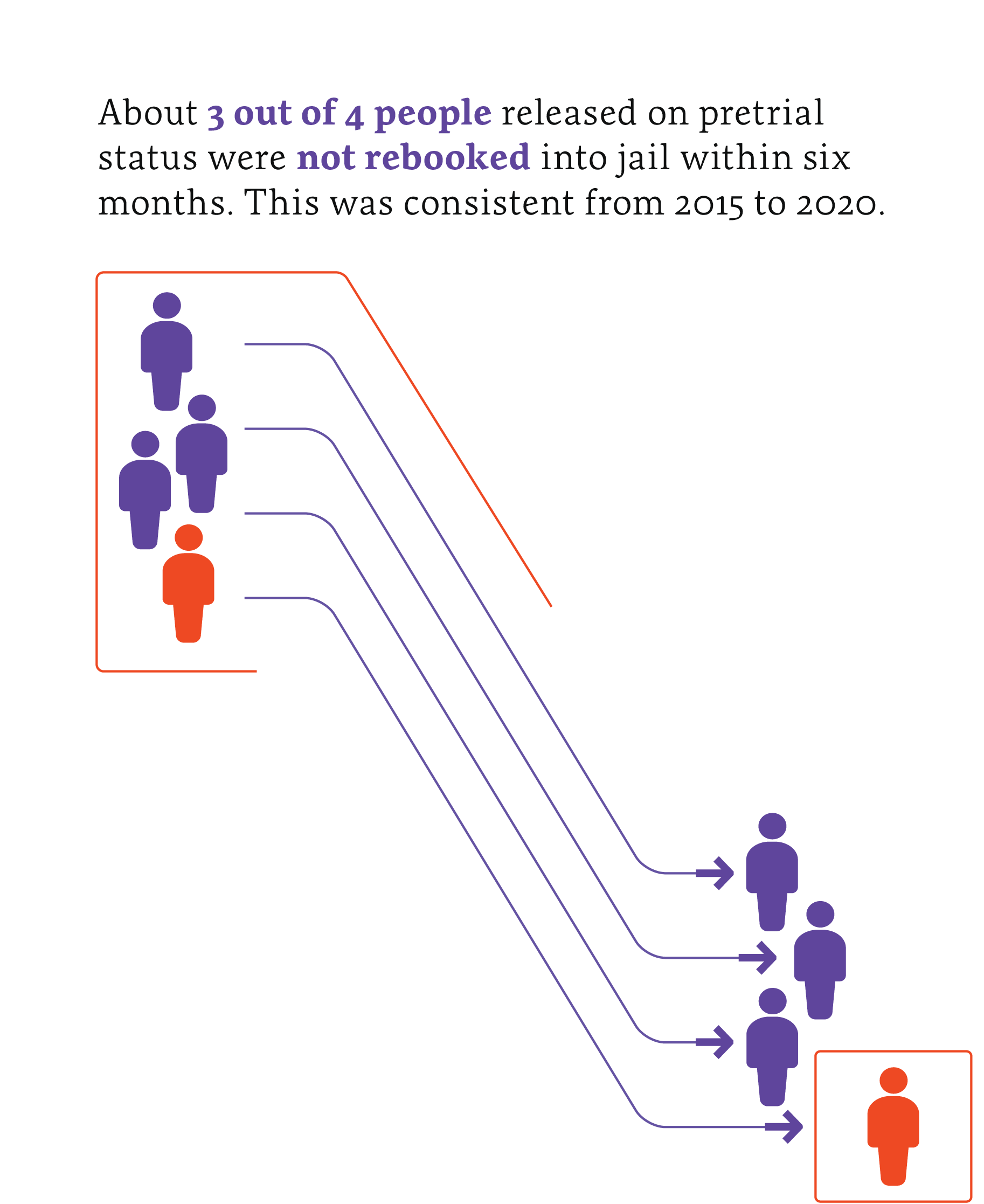
This analysis showed that across five years from 2015 to 2020, about three out of four people released on pretrial status were not rebooked into jail. In other words, people released from jail

were no more likely to return to jail after the implementation of SJC or CO

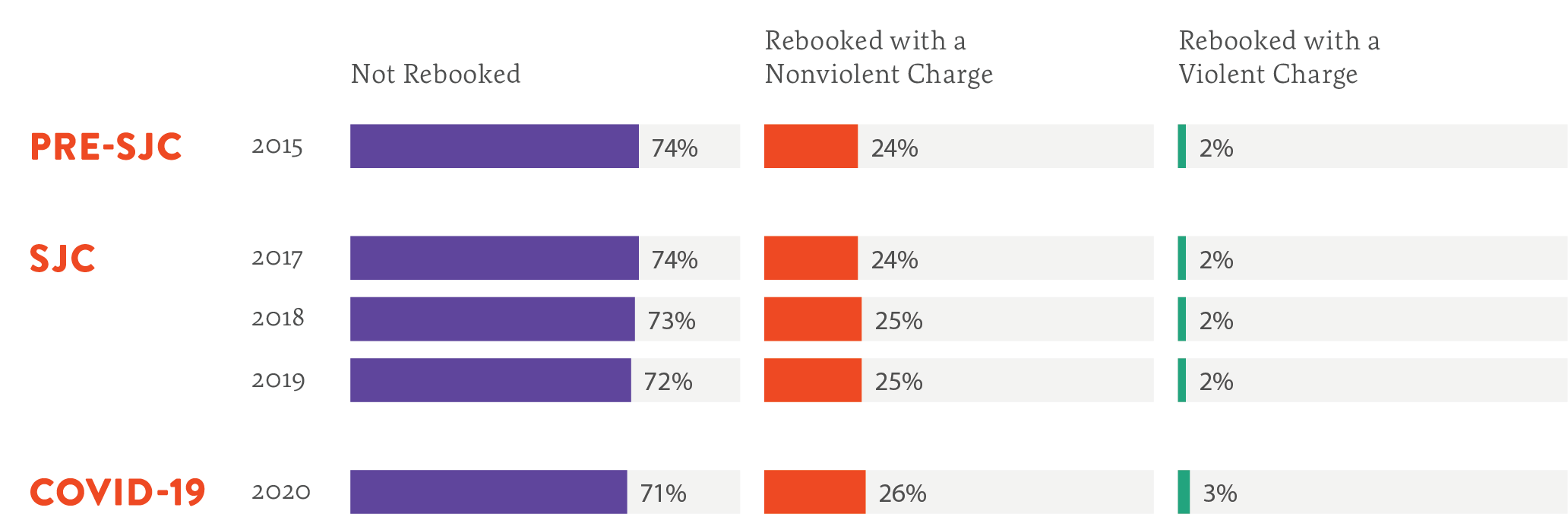
VID-19-related strategies for reducing jail populations. Over time, a very small share (two to three percent) of people released on pretrial status were rebooked within six months for a violent charge, a rate consistent before SJC implementation in 2015, during SJC implementation from 2017 to 2019, and through COVID-19 in 2020.

Two to three percent of people released on pretrial status were rebooked on a violent crime charge. Violent Crime Charge Rebooking Outcomes of Individuals Released on Pretrial Status within six months (Average Across SJC Cities and Counties), 2015 to 2020.

While violent crime may have increased in some SJC cities and counties overall, people who were released from jail while their criminal cases were pending were not the cause of these increases. The overwhelming majority of people released on pretrial status between 2015 and 2020 (over 96 percent) did not return to jail on a violent crime charge.

The rebooking rate for homicides specifically was even rarer: over 99% of people released on pretrial status were not rebooked on a homicide charge within six months. This was consistent from 2015 to 2020.

The Need for Evidence-Based Research instead of Attention-Grabbing Headlines

This study adds to the growing evidence that advancing equitable and thoughtful criminal legal reform is possible without compromising public safety. To suggest otherwise without evidence undermines the harms of incarceration on individuals, their families, and communities. Such discourse also distracts from genuine attempts to understand the true causes of rising violent crime, particularly homicides. More research is needed to unpack the increases in violence during a time of even more pronounced disparity in the U.S. as we recover from the COVID-19 pandemic.