Why Isn’t the Media Reporting on Falling Crime Rates? The Negative Consequences for Reform

By: James Austin

Crime Data Analysis September 28, 2023

As summer concludes, it’s increasingly clear that there was no so-called crime wave. The FBI reported that over-all crime dropped by 10% in the first quarter of 2023 as compared to the first quarter in 2022. In particular, the number of murders dropped by 17%. A national expert in criminal justice data, Jeff Asher, published a piece about it in The Atlantic. Looking at the first six months of 2023 as compared to 2022, the murder rate fell by double digits across America. It was “astonishing”, he wrote.

Yet with few exceptions the media either seems unaware or is uninterested in these downward murder rates because they don’t tend to grab readers’ attention in quite the same way that rising ones do. Drumbeats of murder stories continued in cities across the country. Reporting on downward trends was rarer. The New York Times did run a story citing the drop in shootings in New York City. The 25 percent fall is in line with other falls across the country. But this is an important story to tell as it has significant consequences for the public’s perception of how safe criminal justice reforms are like the Safety and Justice Challenge, a project of the John D. and Catherine T. MacArthur Foundation, that have significantly reduced jail populations across the country over recent years.

First let’s examine murder rates and why they increased in 2020 and are declining again. Historically, murder rates since 1931 have ranged from 10 to 5 per 100,000 population (see graph below, figure 1). The historic average is 6.7. So, the recent increases since 2020 actually reflect the historic average. Assuming the first six months of 2023 hold, the 2023 rate will dip down to 5.7 – well below the historic average.
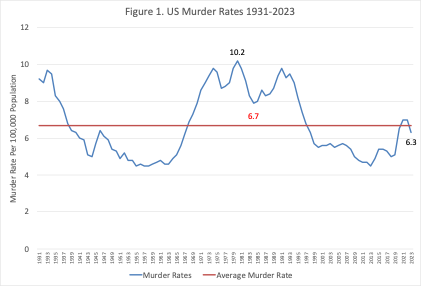
Figure 1: US Murder Rates 1931-2023

We have developed a statistical model that accurately projects future crime rates. The model uses several demographic and economic factors that have been shown to be associated with changes in the crime rates.

One of the most important factors in the model is the inflation rate—as the inflation rate goes up and down, so too does the murder rate. There is a lagged effect, as it takes a little time for lower and higher inflation rates to impact people’s behavior.

When COVID-19 hit in 2020 there was an associated increase in the inflation rate reaching a high of over 9 percent (see graph below, figure 2). Not unexpectedly, the crime rates soon began to climb, although never coming close to the high rates of the 1990s when inflation was over ten percent. Today the inflation rate has dropped to 3 percent and so, too, the crime rate has begun to recede. Assuming the inflation rate continues to decline and other factors in our model do not change, crime rates and murders will continue to slowly decline.
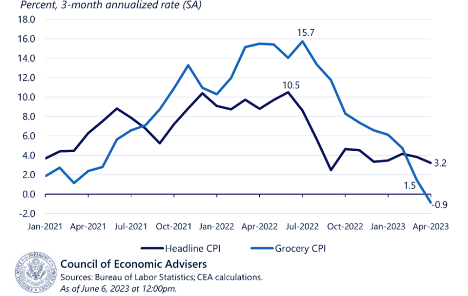
Figure 2. Grocery and Headline Inflation, January 2021 to June 2023

Unfortunately, the media and other pundits wrongfully assigned the post-COVID-19 murder rate increases to progressive criminal justice reforms. Bail reform, lenient prosecutors and judges, and police reforms were all cast as the causes of increases in homicides. Yet how does one explain why homicides are now declining with these same reforms still in place?

The tone of crime coverage is important because it shapes public sentiment which in turn can shape public policy. Polls show that the public believes that crime is up, even when the data above show it is down. As sociologists W. I. Thomas and Dorothy Thomas stated almost a century ago, “If men define situations as real, they are real in their consequences.”

Public sentiment influences policy makers and their decisions to support or resist criminal justice reforms. The research is very clear that we can reduce jail populations and keep communities safe. But when the media tends to report more on rising and not falling crime rates, it creates significant challenges.

While much has been achieved with the Safety and Justice Challenge, there are signs that some of these results could slip away in part because of erroneous public perceptions and the lack of media reporting about declining crime trends. It will be important for SJC sites, which are showing the same crime drops, to make their case to the public and the local media about what is really going on.

Table 1. SJC Major City Murders 2022 vs 2023

City 2023 2022 Change % Change As Of
Charleston, SC 5 4 1 25% 10-Jul-23
Charlotte, NC 24 19 5 26% 31-Mar-23
Chicago, IL 317 345 -28 -8% 9-Jul-23
Houston, TX 142 186 -44 -24% 31-May-23
Las Vegas, NV 67 67 0 0% 7-Jul-23
Los Angeles, CA 145 187 -42 -22% 1-Jul-23
Memphis, TN 172 123 49 40% 6-Jul-23
Milwaukee, WI 80 114 -34 -30% 11-Jul-23
Nashville, TN 60 56 4 7% 8-Jul-23
New Orleans, LA 127 154 -27 -18% 12-Jul-23
New York, NY 212 231 -19 -8% 9-Jul-23
North Las Vegas, NV 6 12 -6 -50% 31-May-23
Philadelphia, PA 203 281 -78 -28% 9-Jul-23
Pittsburgh, PA 16 18 -2 -11% 31-Mar-23
Portland, OR 36 39 -3 -8% 31-May-23
San Francisco, CA 28 26 2 8% 9-Jul-23
Spokane, WA 5 9 -4 -44% 8-Jul-23
St Louis, MO 82 86 -4 -5% 30-Jun-23
Toledo, OH 17 28 -11 -39% 1-Jul-23
Totals 1,744 1,985 -241 -12%

We Can Reduce Jail Populations and Keep Communities Safe

By: Laurie Garduque

Crime Data Analysis Incarceration Trends April 6, 2023

A recent uptick in violent crime across the country has alarmed many Americans. But even as communities work to address the root causes of violence and the effects of incarceration, new data from our Safety and Justice Challenge shows there is no link between reducing jail populations and increases in crime. Communities can feel confident in efforts to reform the local criminal justice system and safely reduce the jail population.

Since 2013, MacArthur has invested over $323 million in local justice reform, including tracking progress and analyzing the effectiveness of reform strategies. We have built close partnerships with research leaders in the criminal justice field, including grantee City University of New York’s Institute for State & Local Governance (ISLG) and the JFA Institute, to examine data from cities and counties participating in the Safety and Justice Challenge.

From this deep engagement with data and our relationships with diverse experts and people with lived experience, we have learned many valuable lessons. And the findings of two new reports—“Jail Populations, Violent Crime, and COVID-19: Findings from the Safety and Justice Challenge” by ISLG and “The Impact of COVID-19 on Crime, Arrests, and Jail Populations” by the JFA Institute—are among the most useful and insightful, and reinforce with data what we have heard from people involved in the justice system.

These analyses looked at what happens when cities and counties across the country focus on criminal justice reforms that make the system more fair, just, and equitable. They found that in communities participating in the Safety and Justice Challenge, there is no relationship between reforms that reduce reliance on jails and recent upticks in violent crime across the United States.

Reducing Jail Populations While Keeping Communities Safe

Since the Safety and Justice Challenge began, participating cities and counties have collectively reduced their jail population by 20 percent. This has resulted in about 15,000 fewer people in jail on any given day, allowing individuals, who are legally presumed to be innocent, to instead remain with their families, communities, and hold onto their jobs while their cases were pending.

JFA Institute’s close examination of the data found that even considering the effects of the COVID-19 pandemic, which temporarily reduced jail populations dramatically nationwide, most Safety and Justice Challenge cities and counties continued to outperform the nation as a whole in reducing jail populations, without jeopardizing community safety. As COVID-19 mitigation efforts wane, these communities have shown that progress can be sustained. Many of the emergency measures taken to reduce the jail populations during the pandemic, and that have remained in place in the months since, do not have an impact on public safety.

Meanwhile, ISLG’s analysis looks at how often individuals released from jail return to custody while their criminal case is still pending. The findings, which use individual-level jail admissions data from 2015 through April 2021, show that reforms focused on releasing people from jail before their trial did not drive recent increases in violent crime. The report found:

  • There is no correlation between declines in jail incarceration and increases in violent crime through COVID-19.
  • Most individuals released on pretrial status were not rebooked into jail. This has remained consistent over the years.
  • Of the small percentage of the individuals rebooked into jail, it was very rare that they returned with a violent crime charge and exceedingly rare that they returned with a homicide charge.

The evidence is clear: cities and counties should push forward with making the criminal justice system more equitable and fair. The decreased use of jails has no impact on crime, particularly violent crime, and communities should look beyond incarceration to address safety concerns. To claim that reforms jeopardize community safety ignores the data and unnecessarily puts the lives of incarcerated individuals and their families at risk.

Research Report

COVID Crime Incarceration Trends March 21, 2023

The Impact of COVID-19 on Crime, Arrests, and Jail Populations

The JFA Institute

Beginning in March 2020, local and state criminal agencies became concerned that people arrested and booked into local county jails would be unduly exposed to the COVID-19 virus. To address these concerns, a variety of policies were enacted to reduce the number of persons held in jails. These polices were designed to 1) mitigate the number of people being arrested and booked into local jails and 2) reduce the length of stay (LOS) for those admitted to jail. Concurrently, public safety concerns were raised that by lowering the jail populations, crime in the community would increase. To address these concerns, the JFA Institute (JFA), through resources provided by the John D. and Catherine T. MacArthur Foundation's Safety and Justice Challenge (SJC) program, began tracking and analyzing six cities and counties participating in SJC (jurisdictions) and their jail and crime data in real time to monitor the impact of these mitigation activities. In October 2020, the study was expanded to five other jurisdictions and data collected data through December 2020. This report serves as a second expansion to include data through the year 2021, though with a slightly altered set of the eleven jurisdictions."

Research Report

COVID Crime Incarceration Trends March 21, 2023

Jail Populations, Violent Crime, and COVID-19

Sana Khan, Emily West, Stephanie Rosoff, CUNY Institute for State & Local Governance

In response to the rapid spread of COVID-19 in 2020, jails across the U.S. implemented emergency strategies to reduce jail populations and mitigate the virus’s spread. This included releasing people pretrial while they awaited their case resolution. At the same time, public data show that violent crime and homicides have increased nationally. These increases have put a spotlight on criminal legal reform efforts, with growing public discourse in some political and media circles suggesting that reforms are causing these increases. While the recent uptick in violence is real, this analysis shows that, on average, cities and counties implementing jail population reform efforts successfully reduced jail populations without jeopardizing community safety. To explore whether increases in violent crime were related to the pandemic and criminal legal reforms, the CUNY Institute for State & Local Governance (ISLG) analyzed violent crime, incarceration, and rebooking data from sites participating in the Safety and Justice Challenge (SJC), a nationwide initiative to safely reduce jail populations. This data provided comprehensive information on individuals booked into and released from jail over time, allowing ISLG to capture trends in rebooking outcomes in sites with varying geographies, populations, and jail sizes. The rebooking analysis covers data through April 2021, which is more recent than many well-established data sources.

Additional Downloads

Digging Into The Data on Jail Populations, Violent Crime, and COVID-19

By: Sana Khan

COVID Crime Data Analysis Incarceration Trends March 21, 2023

New research findings directly address recent claims about the role of criminal legal reforms in violent crime trends.

In response to the rapid spread of COVID-19, jails across the country implemented emergency strategies to reduce jail populations and mitigate the virus’s spread. Since the onset of the COVID-19 pandemic in 2020, public data show that violent crime and homicides have increased nationally. These increases have put a spotlight on criminal legal reform efforts, with growing public discourse in some political and media circles suggesting that reforms are causing these increases.

These claims often speculate that people released due to efforts to reduce jail populations are responsible for new violent acts committed. They make for attention-grabbing headlines but are not backed by any evidence-based research. They do not acknowledge the concurrent complex web of pandemic-related social and economic strains, or the fact that homicides increased in many major cities that did not enact progressive jail reform efforts.

The recent uptick in violent crime is real, but the increase is reflected across the country. This includes jurisdictions with progressive and traditional prosecutors, and cities and counties pursuing jail reform and those maintaining the status quo.

Digging Into the Data

Data collected from cities and counties participating in the Safety and Justice Challenge (SJC), a multi-year initiative funded by John D. and Catherine T. MacArthur Foundation, is the basis for one of the only analyses exploring these questions in depth on a national, multi-site scale.

To explore whether increases in violent crime were related to both the pandemic and criminal legal reforms, The CUNY Institute for State & Local Governance (ISLG) analyzed pre and post pandemic jail data on individuals released from jail on pretrial status, defined as people released from physical jail custody while their trial is ongoing, pending the disposition of one or more booking charges. The analysis shows how many individuals released from jail on pretrial status were returned to jail custody within six months (referred to as a rebooking).

The findings from this analysis, using individual-level jail admissions data from March 2015 to April 2021, show that reforms focused on releasing people from jail on pretrial status did not appear to drive recent increases in violent crime. In contrast, ISLG found that for SJC cities and counties:

  • There is no apparent correlation between declines in jail incarceration and increases in violent crime through COVID-19.
  • Most individuals released on pretrial status were not rebooked into jail. This has remained consistent over the years.
  • Of the small percentage of the individuals rebooked into jail, it was very rare to return with a violent crime charge and exceedingly rare to return with a homicide charge.

It is likely that many complex social and economic factors related to the pandemic contributed to the overall increases in violence, and particularly in homicides, that occurred across cities in 2020. However, findings from this analysis suggest that evidence-driven criminal legal reforms were not among those factors.

There is no apparent correlation between declines in jail incarceration and increases in violent crime through COVID-19

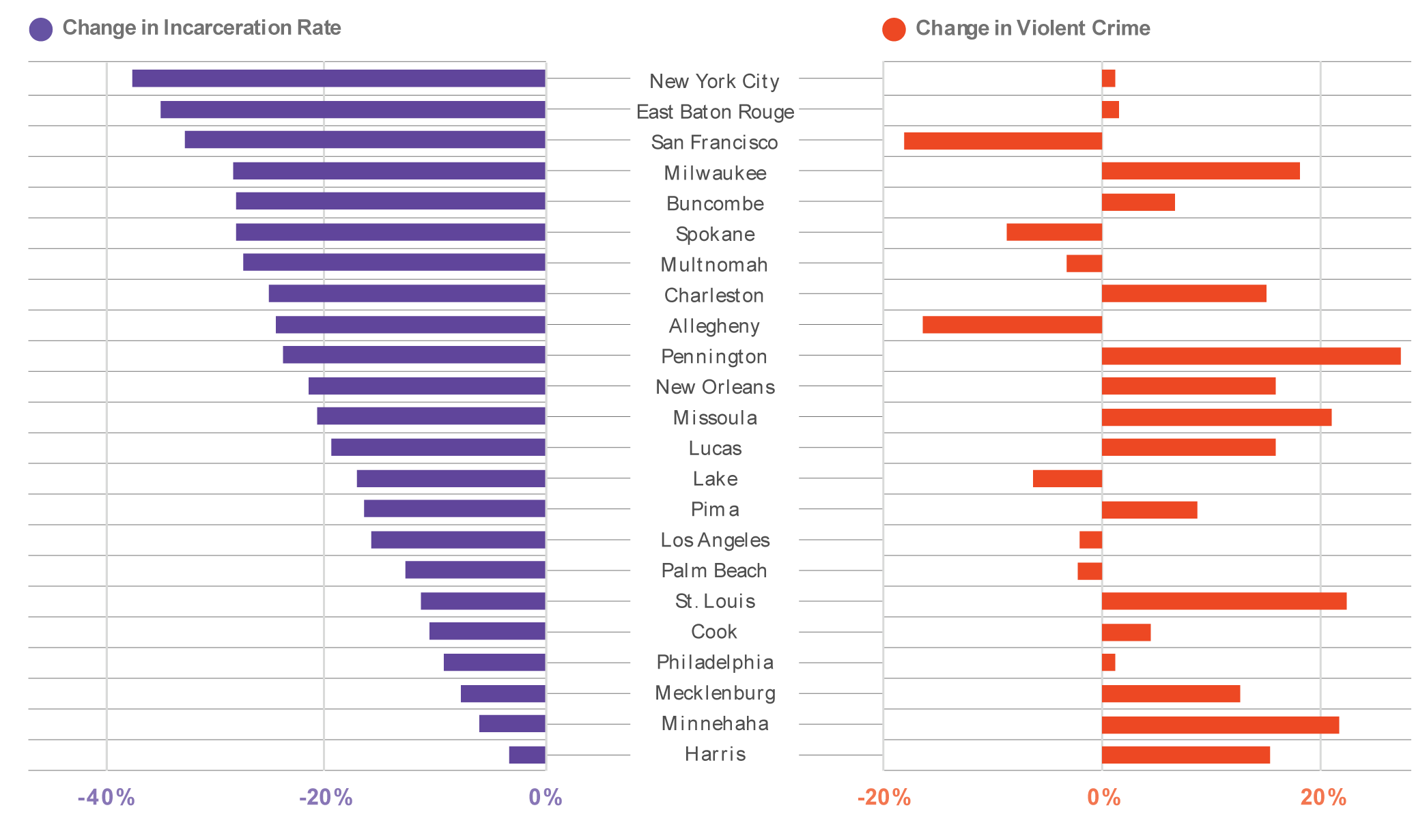
Following the implementation of SJC strategies to reduce local jail populations, SJC cities and counties’ incarceration rates declined at a faster pace compared to the national average, yet trends in violent crime were similar to the national trend. Violent crime was down across SJC sites and the nation between 2017-2019, only increasing during the pandemic in 2020.

Further, when looking at data for individual SJC cities and counties, all 23 SJC cities and counties decreased their incarceration rate between 2019 and 2020, when the pandemic emerged. However, changes in violent crime varied across cities and counties, and larger decreases in the jail population were not always associated with increases in violence.

Percent Change in Incarceration and Violent Crime Rates in SJC Sites, 2019-2020

Most individuals released on pretrial status were not rebooked into jail and very rarely were they rebooked on a violent crime charge, which remained consistent over the years

Using data from local jails in SJC cities and counties, ISLG followed people released on pretrial status and measured whether they were rebooked into jail within six months of the release.

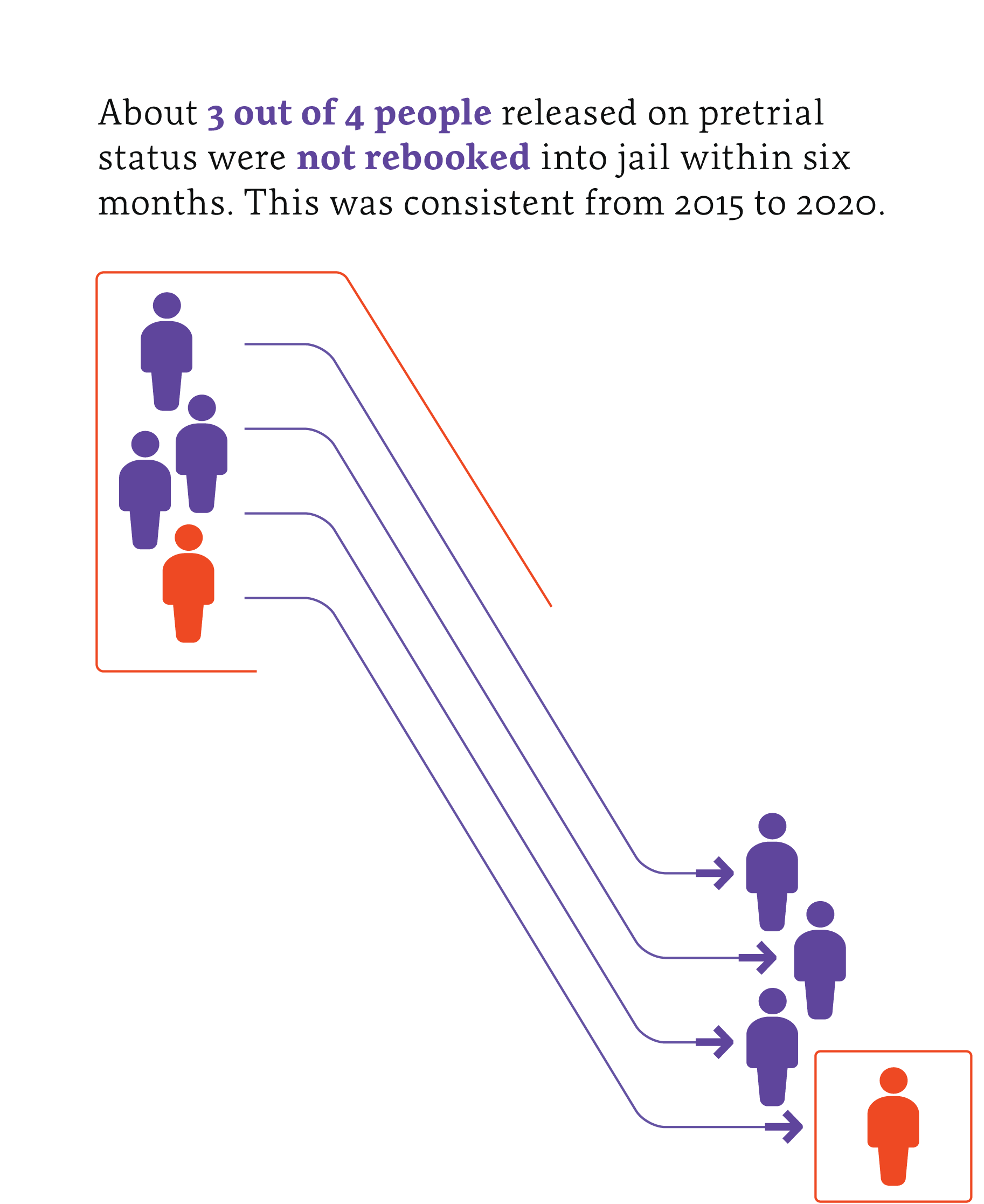
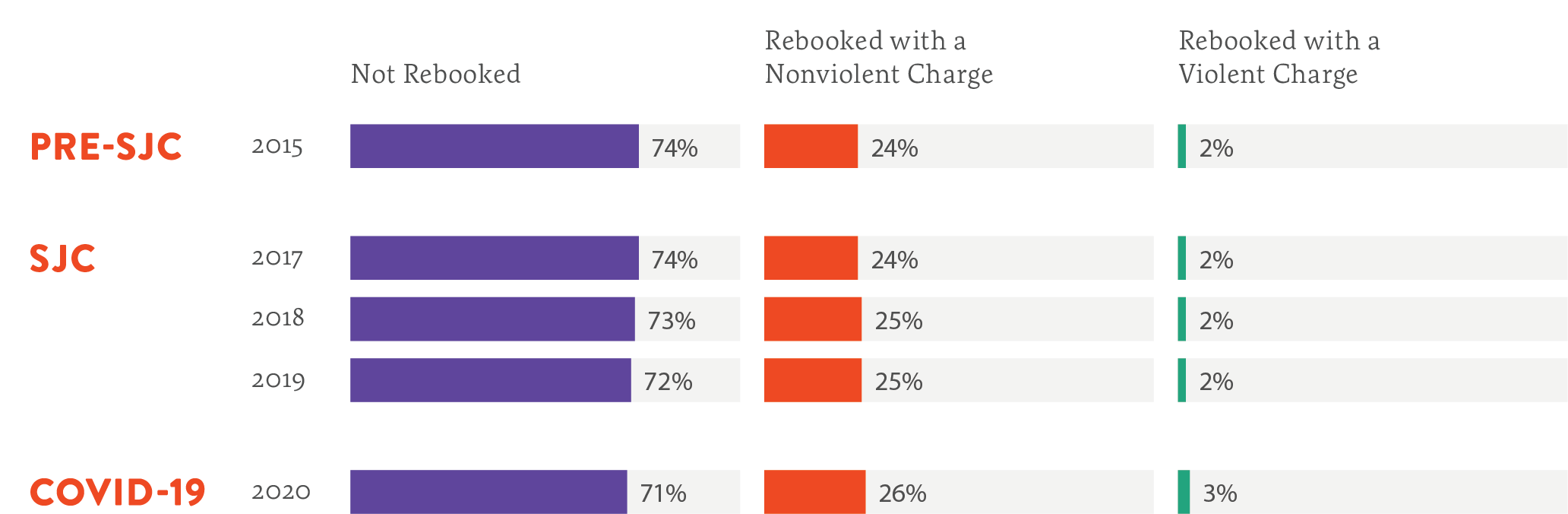
This analysis showed that across five years from 2015 to 2020, about three out of four people released on pretrial status were not rebooked into jail. In other words, people released from jail

were no more likely to return to jail after the implementation of SJC or CO

VID-19-related strategies for reducing jail populations. Over time, a very small share (two to three percent) of people released on pretrial status were rebooked within six months for a violent charge, a rate consistent before SJC implementation in 2015, during SJC implementation from 2017 to 2019, and through COVID-19 in 2020.

Two to three percent of people released on pretrial status were rebooked on a violent crime charge. Violent Crime Charge Rebooking Outcomes of Individuals Released on Pretrial Status within six months (Average Across SJC Cities and Counties), 2015 to 2020.

While violent crime may have increased in some SJC cities and counties overall, people who were released from jail while their criminal cases were pending were not the cause of these increases. The overwhelming majority of people released on pretrial status between 2015 and 2020 (over 96 percent) did not return to jail on a violent crime charge.

The rebooking rate for homicides specifically was even rarer: over 99% of people released on pretrial status were not rebooked on a homicide charge within six months. This was consistent from 2015 to 2020.

The Need for Evidence-Based Research instead of Attention-Grabbing Headlines

This study adds to the growing evidence that advancing equitable and thoughtful criminal legal reform is possible without compromising public safety. To suggest otherwise without evidence undermines the harms of incarceration on individuals, their families, and communities. Such discourse also distracts from genuine attempts to understand the true causes of rising violent crime, particularly homicides. More research is needed to unpack the increases in violence during a time of even more pronounced disparity in the U.S. as we recover from the COVID-19 pandemic.