

Community Engagement Incarceration Trends August 6, 2019
Local organizers have galvanized an entire region in favor of shutting down the Workhouse, a place they see as emblematic of official indifference towards the plight of needy residents.
The first time Inez Bordeaux told her story in front of a crowd, she was nervous.
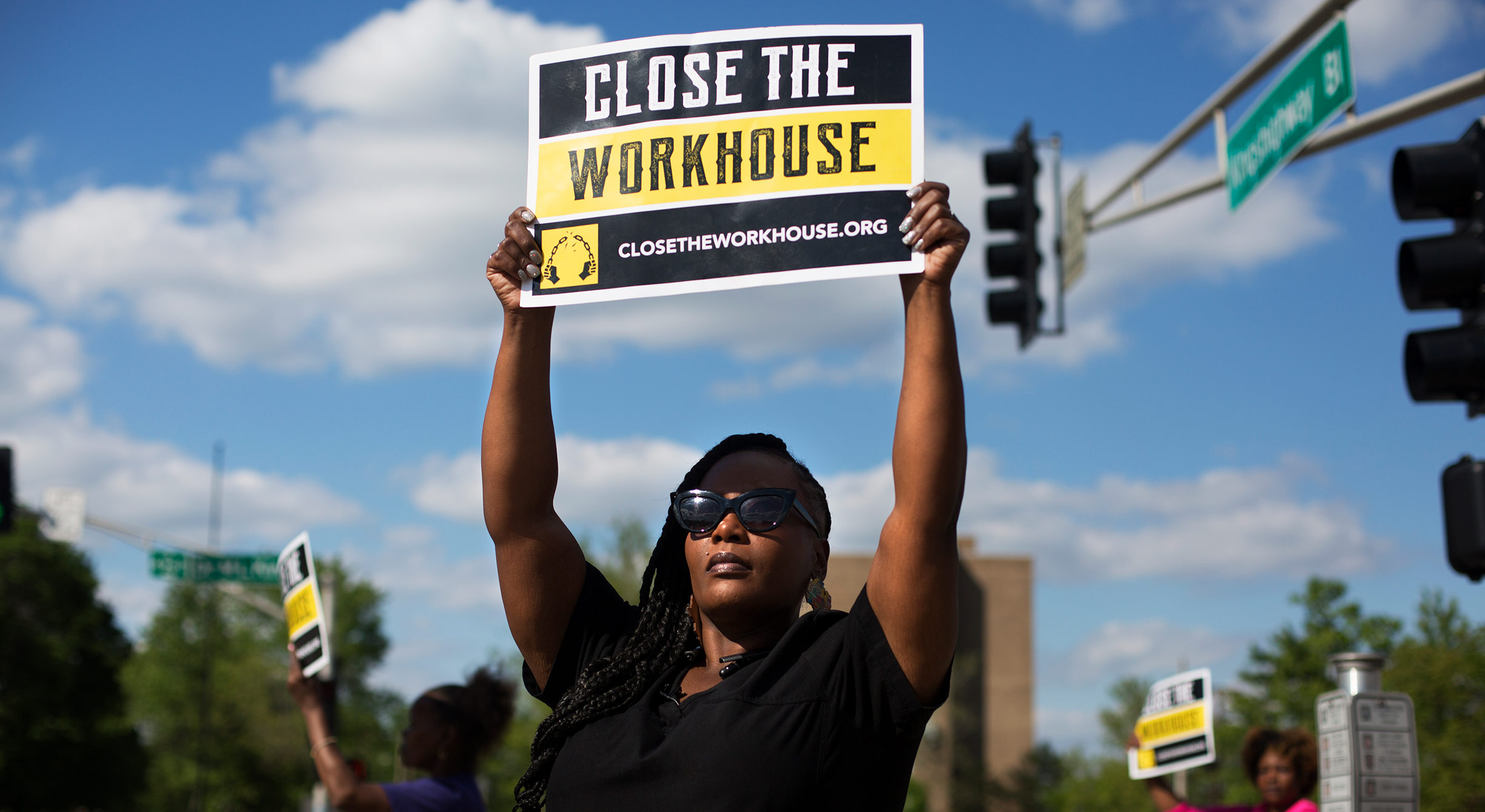
It was April 2018 and dozens of people were packed into a small music venue in St. Louis to raise money for a campaign called Close the Workhouse. The fundraiser doubled as a launch party for the campaign, which is focused on building political pressure to shut down the city’s medium-security jail, known as the Workhouse.
“The very existence of the Workhouse shows me that this city is willing to throw people away,” said Bordeaux, a nurse and mother of four who spent 30 days in the Workhouse in 2016.
She took a deep breath as she described the roaches and rats in the group cell she shared with other women. Water leaked from the ceilings, she said, and black mold grew across the walls. City officials have maintained that the facility is clean and well-functioning.
“Being in a place that’s not fit for animals—let alone humans—and being treated like you’re less than nothing changes you in a way that leaves a stain on you,” she told the crowd. “It’s irreversible.”
Months earlier, nonprofit law firm ArchCity Defenders had filed a lawsuit against the city over conditions at the Workhouse, calling them “unspeakably hellish” and “inhumane”—allegations the city disputes.
The lawsuit came after a July 2017 heatwave, during which people locked inside the 53-year-old brick building screamed for help. As temperatures soared, organizers raised money to bail people out of the Workhouse. Then, they started planning a campaign to shut it down.
But the organizing that led to Close the Workhouse actually started years earlier, in 2014, after Ferguson police officer Darren Wilson killed 18-year-old Michael Brown.
Many people around the country know that Brown’s death led to an uprising in the Ferguson suburb of St. Louis in 2014. But the activists who started out protesting in the streets back then have not stopped working. Five years later, they continue to demand accountability as they build political power.
“We started with policing and we went straight to politics,” said Michelle Higgins, the lead organizer for Close the Workhouse. “We decided that people who have power need to be held accountable by the people who put them in power.”
I spoke with Higgins about her work while reporting on Close the Workhouse for 70 Million, an open-source podcast about justice reform efforts across the country, which receives funding from the John D. and Catherine T. MacArthur Foundation’s Safety and Justice Challenge.
Along with prominent St. Louis organizer Kayla Reed, Higgins co-directs Action St. Louis—a black-led millennial activist collective. Last year, the group helped unseat Bob McCulloch, the St. Louis county prosecutor who declined to bring charges against Officer Wilson. McCulloch held the prosecutor seat for 28 years before his loss to former Ferguson councilman Wesley Bell. Bell campaigned on a criminal justice reform platform—much like St. Louis Circuit Attorney Kim Gardner, who took office in 2017 and has been working with the Vera Institute of Justice to implement data-driven reforms to reduce incarceration and racial disparities.
As policymakers started moving toward reform, Action St. Louis teamed up with other grassroots groups and nonprofits to host community discussions on ways to reimagine public safety. And they made it a priority to center the ideas of people directly affected by the system, Higgins said.
“And that’s where we got Close the Workhouse,” she said. “It’s something we’ve all wanted to see. But it’s not something that we came up with because it’s trendy, it looks good and it rolls well off the tongue—impacted people were at the center of launching this campaign because they are the ones who brought this demand.”
What’s more, they want the city to take the jail’s annual $16 million budget and reinvest it in community programs and social services.
Inez Bordeaux has grown into one of the campaign’s main organizers since speaking at the fundraiser last year. She has shared her story countless times—both on the streets and in the halls of power.
Twice a week, she coordinates volunteers and heads out to busy St. Louis intersections to hand out fliers and tell people why she wants to shut down the jail. And last November, she stood in front of a group of aldermen, which are the equivalent of city council members, and told them all about her time inside the Workhouse.
“That 30 days has radicalized me, it has changed me,” she said emphatically, standing behind a podium inside St. Louis City Hall. “And so when I say that I want the Workhouse to be closed—don’t misunderstand me. I’m not asking. It is not a request. I am demanding it.”