In New Orleans From The Barbershop To The Bakery: What Makes You Feel Safe?

By: Emily Rhodes

Community Engagement Policing February 17, 2021

Amidst the ongoing national conversation about public safety and policy priorities, the voices of those most impacted must be centered in order to see real change.

To that end, the New Orleans Safety and Justice Challenge Community Advisory Group (CAG) devised a creative way to shift that conversation from City Hall and budget-planning board rooms into the streets where our neighbors live, work, and play.

The mission of the CAG is to support and participate in the successful implementation of the Safety and Justice Challenge strategies and hold public agencies and officials accountable to reducing the jail population and increase equity within the criminal system. We have always recognized that a plan or strategy without the community’s voice will not be sustainable nor successful. In our three years of existence alongside the city’s Safety and Justice Challenge commitments, we have sought numerous opportunities to bridge the gap that often exists between policy makers and their constituents, those most impacted and those making decisions at a distance.

As the pandemic has ravaged New Orleans physically, economically, and culturally, and the centuries-long movement for racial justice gained fresh steam this summer, we wanted to put our Safety and Justice Challenge Community Engagement funds to use in a way that would open the door for the essential conversations that would create a healthy, safe, and equitable city for current and future generations. We wanted to channel the energy of both the national protests for justice and the continuous efforts to safely reduce the jail population in the context of a global health crisis in an accessible and engaging way. We knew that debates over criminal system reform can easily break down without really uncovering what real people need to feel safe. Who is the system really serving if we do not have the chance to share our experiences with those in power?

In 2020, the city of New Orleans spent $313 million on “public safety,” but those dollars do not always align with the things that make people who live here feel safe. And the field of public safety is so professionalized that it often excludes many of the people whose very safety it is tasked with upholding. We wanted to close some of that disconnect by broadening the tent of voices that are involved in the discussion of what public safety means in New Orleans. Inspired by The Black Thought Project in Oakland, California, we envisioned inviting the community into the process of reimagining safety through an interactive public art installation.
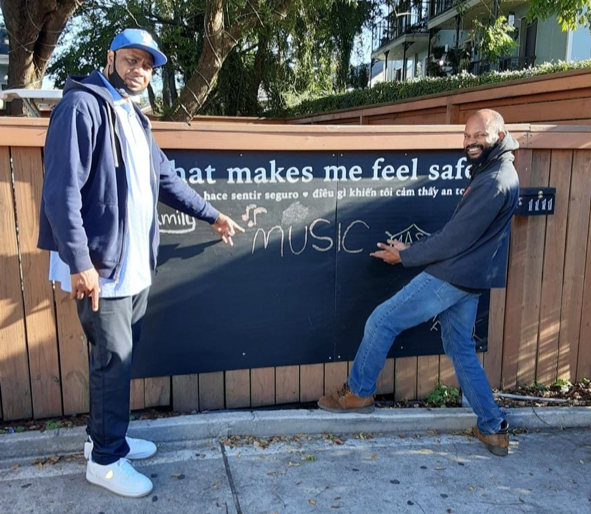
Derrick Tabb, owner of the Treme Hideaway, and CAG Member Michael Pellet leave their mark at a community chalkboard in New Orleans

We hired local barber and artist Ronnie Dents to oversee the design and installation of community chalkboards in seven locations around the city. We used grant money to pay Black-owned local businesses suffering from pandemic losses to host the boards and grassroots community groups to monitor the boards for hate speech, as well as chalk and supplies. All came together to amplify the diversity of our voices in response to the question of “what makes me feel safe?”

Local artist Ronnie Dents installing a Community Chalkboard in New Orleans East
Photo credit: Quincy Coby

Local businesses hosting the chalkboards include barbershops (HeadQuarters and Juju Bag), restaurants (Neyow’s Creole Cafe, Treme Hideaway, Two Sistas ‘N Da East), a bakery (Mr. B’s) and a neighborhood market (Burnell’s Lower 9th Ward Market).  We have also partnered with community organizations to monitor the boards: Community Book Center, Lower 9th Ward Homeownership Association, Guardians Institute, Southern Solidarity, VAYLA and Roots of Music.
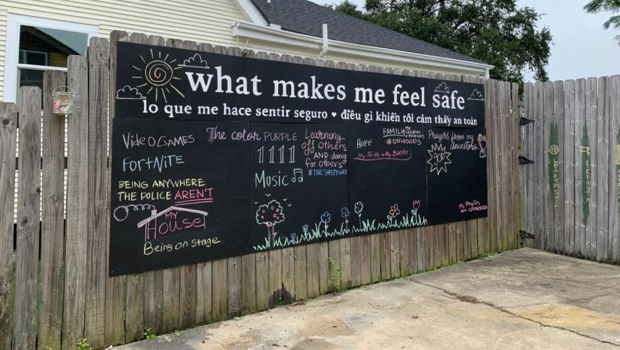
A community chalkboard at the JujuBag Restaurant and Barbershop

The answers shared on the boards have been as diverse as “being anywhere the police aren’t” to “the color purple” and even reflections on religion and spirituality. “The most fulfilling part of the project has been the conversations that have been had as a result of the prompt,” says Dents. “I look forward to what thoughts and attitudes and actions come as a result of answering this very important question.”

The timing of the project to coincide with local elections in November and December was intentional. We wanted to create an opportunity for conversation, even in a socially-distanced way, for neighbors, business owners, and community members that could frame criminal system reform in a community-rooted way. Ultimately our hope is that campaigning and elected officials would listen to the citizens of New Orleans and be spurred on by what residents actually value around safety and justice.

Our Community Advisory Group is a diverse and representative group of New Orleans residents who volunteer our time and energy to hold the city’s stakeholders accountable to the Challenge strategies. We are looking forward to seeing more answers from the community about what makes them feel safe, as this project plays out over the coming months.

The people of New Orleans are speaking up about how we can keep each other safe. Will our public officials listen?

Emily Rhodes is a member of the Community Advisory Group, New Orleans Safety and Justice Challenge and works for the Center for Employment Opportunities in New Orleans.

—Natalie Sharp is the Community Advisory Group Coordinator and works at Travis Hill School, which has a school located inside of New Orleans’ juvenile detention center and adult jail.

 

Pre-Arrest Diversion – An Effective Model Ready for Widespread Adoption

By: Greg Frost

Collaboration Diversion Policing November 23, 2020

With the growing recognition of the need to create alternatives to arrest and prosecution for low-level offenses, many innovative diversion alternatives are emerging. While there are effective post-arrest (or post-booking) diversion programs, changing the traditional criminal justice system in meaningful ways takes bold leadership and vision.

Tallahassee and Leon County, Florida, leaders have taken the bold step to create a community partnership that diverts first-time misdemeanor offenders to a pre-arrest behavioral health intervention program. The Pre-arrest Diversion Program (PAD) is now seen as a successful alternative to arrest and a law enforcement tool for improving public safety and community-police relations.

One of the factors that makes PAD unique is that it’s pre-arrest. The PAD program started in 2013 as the first program in Florida — and based on extensive research, possibly the first in the nation — to give law enforcement officers the formal discretion to divert a misdemeanor offender away from the traditional criminal justice system without first making an arrest, either a physical arrest or issuing a citation-in-lieu of physical arrest. Even though incarceration and prosecution may be avoided by post-arrest diversion, in most states the offender still has an arrest record with the arresting agency. It is well documented that having an arrest record jeopardizes current and future employment, compromises student loans, and blocks access to certain housing opportunities. Because the PAD program is pre-arrest, successful diversion and program completion means the offender does not have an arrest record. Program participation is tracked through an online application available to all law enforcement agencies.

The PAD program expands the concept of Florida’s successful Juvenile Civil Citation program to adults. Also known as an adult civil citation program, the PAD model provides an alternative to arrest for many low-level misdemeanor offenses that result from an error in judgment, out of control emotions, or someone simply making a mistake. Eligible offenses approved for diversion by Tallahassee and Leon County law enforcement officers include disorderly conduct, trespass, criminal mischief, petit theft, underage possession of alcohol, possession of marijuana under 20 grams, possession of drug paraphernalia, non-domestic simple battery, and non-domestic simple assault.

Based on the offender not having an arrest record and cooperating fully with the law enforcement officer, as well as consideration of the victim’s input, the officer has the discretion to offer diversion into the PAD program. An offender can voluntarily choose not to participate in the PAD program and instead opt for their day in court. If diversion is accepted, the offender enters an intervention program operated by DISC Village – a non-profit behavioral health agency in Tallahassee. During program intake at DISC Village each person receives a behavioral health assessment and is screened for drug use. Based on the results, an individualized intervention plan is developed. The participant then has 90 days to complete the intervention plan, as well as a mandatory 25 hours of community service. Participants pay the behavioral health company $350 for the intervention services. This is approximately the same cost as court fines and fees if they were to be criminally prosecuted. Payment plans and waivers are available for those who cannot afford the PAD fee. No one is denied participation for the inability to pay. Failure in the program results in the participant being arrested and prosecuted for the original offense.

Avoiding a criminal arrest record has proven to be a great incentive, and the evidence-based intervention services provided by DISC Village have significantly impacted recidivism for participants. Since the PAD program started in March of 2013, law enforcement officers with the Tallahassee Police Department and the Leon County Sheriff’s Office have diverted over 1,000 offenders. Of the nearly 80% of diverted offenders who successfully complete the program, only 6% were subsequently rearrested. Data used to determine the rearrest rate was provided by the Florida Department of Law Enforcement to the program’s evaluator at Western Carolina University. The statewide data reflected arrests for PAD participants in any Florida jurisdiction following participation in the program.

Improving public safety by reducing recidivism is a primary goal of the PAD program. A 6% rearrest rate is a significant reduction when compared to offenders prosecuted through the criminal justice system.  While there is little formal research related to recidivism for first-time misdemeanants, in Leon County prior to the PAD program the estimated recidivism rate for this category of offenders was 40%. A long-term study conducted by the Oregon Criminal Justice Commission found the average rearrest rate was approximately 45% for first-time misdemeanor offenders processed through Oregon misdemeanor courts.

There are many benefits for using pre-arrest diversion. The offender and law enforcement receive the most obvious – improved efficiency for the officer and the offender has an opportunity to avoid an arrest record and receive intervention services. The program also reduces the workload for the already overloaded misdemeanor court system. During FY15, over 65,000 adults with no prior record were arrested in Florida and charged with a misdemeanor offense. If PAD programs were adopted throughout the state a significant portion of these individuals could have been directly diverted by law enforcement.  The unnecessary and long-lasting harm that arrest records cause people who are not a true threat to public safety, could have been avoided and scarce criminal justice resources used for more important cases.

Long-term reform is only possible when community leaders decide to break away from the cycle of arrest and rearrest that results from the current revolving-door approach of the criminal justice system. There are many people for whom incarceration is necessary because they are a true threat to public safety. However, as most law enforcement officers will confirm, there are many times when a crime is committed as a result of heated emotions or poor judgment… we all make mistakes. Under these circumstances, a community is better served if officers are given the discretion to divert away from the criminal justice system, and instead of making an arrest the offender receives intervention services that improve public safety.

There is no doubt that in Tallahassee and Leon County, due to bold community leadership, law enforcement officers have an effective tool for handling first-time misdemeanor offenders. Lives of hundreds of people have remained intact because they avoided an arrest record, public safety has improved through reduced recidivism, law enforcement relations with the community improved because officers have an alternative to arrest, and the community partnership has no cost for the local government. With these types of outcomes, the PAD program is a model ready for widespread adoption.

This post originally appeared on the blog of the International Association of Chiefs of Police. 

Advancing Reform: SJC Sites Make Significant Changes to Law Enforcement and Behavioral Health Services Funding

By: Ashley Krider

Community Engagement Policing November 2, 2020

Prompted by recent cries for police reform across the U.S., many jurisdictions have made or promised significant changes to law enforcement funding, frequently allocating additional funding to behavioral health and community services. Many sites are exploring or expanding community-based emergency first response as an alternative to police response to individuals experiencing crisis and those with mental health needs.

As technical assistance providers to the Safety and Justice Challenge, Policy Research, Inc. (PRI) has compiled an ongoing list of examples of this shift across the country, to serve as a resource to other communities who may be considering their own reform.

Here are some examples of changes in SJC sites:

  • Baltimore, Maryland: In June, the City Council approved a $22.4 million (less than 5%) cut to the Police Department’s $550 million 2021 budget, including nearly $7 million from overtime spending.
  • Portland, Oregon: In late 2019, the city announced a similar program to CAHOOTS, Portland Street Response (PSR), which takes police off of low-priority 9-1-1 calls and instead sends a new branch of first responders, trained in behavioral health, to address issues related to people experiencing homelessness or mental health crises. In June, the Portland City Council approved $4.8 million funding for PSR, along with a 3% reduction (about $15 million) to the Portland Police Bureau budget.
  • Los Angeles, California: In June, the Los Angeles City Council voted to cut $150 million (of an $1.8 billion total budget) from the city’s police department budget, halting a planned increase in funding. The $150 million will be redirected toward community-building projects and health and education initiatives in minority communities. ­In July, the city council announced plans to expand a pilot program to create a new police bureau focused on community policing, relying on guidance from community leaders, representatives from city hall, and others.
  • New York City, New York: In July, the New York City Council approved shifting roughly $1 billion away from the $6 billion annual Police Department budget. The budget also shifts school safety and homeless outreach away from police. New York City’s Crisis Management System (CMS) program deploys teams of credible messengers who mediate conflicts on the street and connect high-risk individuals to services that can reduce the long-term risk of violence. In the last three years, the Crisis Management System has contributed to a 15% decline in shootings in the 17 highest violence precincts in New York City. In early June, Mayor Bill de Blasio announced that he plans to increase CMS spending by ten million dollars, hire additional workers, and expand programs to Soundview, Jamaica, Crown Heights, Flatbush, and Canarsie.
  • Albuquerque, New Mexico: In June, the Mayor announced the formation of a new department, Albuquerque Community Safety, designed to relieve stress on the city’s police. Instead of the police or fire departments responding to 9-1-1 calls related to homelessness, addiction, and mental health, the new division will deploy unarmed personnel made up of social workers, housing and homelessness specialists, and violence prevention coordinators. Mayor Keller stated that the department’s creation will start with a focus on “restructuring and reallocating resources” that the city is already investing in different areas, saying he anticipated “tens of millions of dollars that will move” with the department’s creation.
  • Philadelphia, Pennsylvania: In June, the City Council approved a 2021 fiscal year budget that reduced police department funding by $33 million and allocated $45 million into affordable housing, arts funding, and social services addressing poverty.
  • San Francisco, California: In July, the Mayor announced a $120 million cut from the city police and sheriff’s departments over the next two years, redirecting funding toward addressing disparities in the Black community including in housing, mental health and wellness, workforce development, economic justice, education, advocacy, and accountability.
  • Durham, North Carolina: In June 2019, the city council voted against hiring 18 new patrol officers after a public campaign led by Durham Beyond Policing. The city is now exploring a new “community safety and wellness task force” instead. While the city’s 2021 budget did include an increase of $1.2 million for the police department, $1 million was also added for a Community Health and Safety Task Force to “potentially take on some of the responsibilities of policing the city over time.”

Many jurisdictions around the country are also taking a hard look at the wisdom of continuing to place police in schools. Several SJC sites that have pledged to remove or removed police from schools include:

  • Portland, Oregon: In June, the Portland Public Schools superintendent announced that it will discontinue the regular presence of SROs. New investments in counselors, social workers, and culturally specific partners were proposed.
  • Milwaukee, Wisconsin: The Board of School Directors voted unanimously in June to terminate its contract with the Milwaukee Police Department in its public schools.
  • Madison, Wisconsin: The school board voted unanimously in June to end its contract with the Madison Police Department for SROs.
  • Portland, Maine: The school board voted in July to remove SROs from Deering and Portland High School. Money previously allocated for SROs will be diverted toward programs like “supporting security at large events and de-escalation training for staff.”

COVID-19 and the nationwide racial equity and justice protests over the past few months have shifted the ground beneath much of the advocacy and work that we do. We are faced with an opportunity and responsibility to not only respond to the changing landscape of criminal justice and behavioral health fields, but to advance reform.

—Ashley Krider is a Senior Project Associate at Policy Research, Inc.

Criminal Justice Leaders Must Adopt A Public Health Approach To COVID-19

By: Marlene Biener

Community Engagement COVID Policing July 13, 2020

The prolonged outbreak of COVID-19 has drawn attention to the importance of integrating a public health framework to criminal justice system responses. In recent weeks, the need for this approach has only become greater following increases in arrests, particularly of protesters, in jurisdictions aiming to reduce jail populations as a response to increased health risks from COVID-19.

As a strategic ally in the Safety and Justice Challenge, the Association of Prosecuting Attorneys has partnered with a wide array of criminal justice stakeholders, including the National Association of Criminal Defense Lawyers, the Center for HIV Law & Policy, and Community Oriented Correctional Health Services, to call for a public health-oriented approach to the COVID-19 crisis. You can read the principles here. Our key recommendations include releasing people who are incarcerated in compliance with clear public health recommendations and established public safety release criteria; limiting new admissions; addressing violations of COVID-19-related directives, such as the use of protective gear and social distancing, in a manner that is consistent with public health considerations rather than criminalization; drawing inspiration from existing innovations that promote the integration of public health priorities into the justice system; and making connections among public health organizations, researchers, and criminal justice stakeholders.

Two examples of SJC sites which have innovated to promote the integration of public health priorities into the justice system are Pennington County, South Dakota, and Deschutes County, Oregon:

  • Pennington County’s “Care Campus” centralizes social services with a single point of entry in a co-located campus that streamlines everything, allowing individuals to immediately get the help they need. It houses a detox treatment, Safe Solutions program, Crisis Care Center, Quality of Life Unit, and Pennington County Health and Human Services, under one roof. The complex houses residential alcohol and drug treatment services, too. Individuals facing a crisis can walk in and do not need to wait for police to intervene. A recent study showed that 64 percent of admitted individuals were self-referred. This facility reduces the burden on the justice system and does not saddle people who need help with a criminal record.
  • Deschutes County’s “Clean Slate Program” allows individuals the opportunity to remove arrest from their record and access a variety of services—including medical care and drug treatment—if they’re arrested or cited with possession of a controlled substance. Participants have the opportunity to meet with defense counsel privately to discuss their case and determine if they want to participate. The goal of this program is to identify the best intervention for each individual and shift the response strategy, providing a direct connection to health care and substance abuse treatment that could generate better sobriety and health outcomes.

Adopting a public health framework to inform public safety decisions is a critical intervention that has been successfully used by many public safety agencies in response to COVID-19, and should endure beyond this current crisis.

On behalf of our thoughtful and proactive prosecutors, we’re proud to partner with public health and safety stakeholders to develop key recommendations for a public health-oriented approach to the safety of incarcerated individuals, staff and our communities to keep all safe and healthy. The multi-disciplinary team of experts stand ready to provide resources and technical assistance to jurisdictions around the country who are creating actionable proposals to address these issues. These resources include, for example:

  • Experts in development of successful public health/criminal justice interventions;
  • Infectious disease experts and consultants within health departments across the country;
  • Criminal law legislative and administrative law experts; and
  • Experts in diversion programs and alternatives to incarceration.

We encourage jurisdictions looking to develop and implement actionable proposals for a public health framework for their criminal justice system response to pandemics such as COVID-19 to contact us for assistance and to be connected with our network of experts.

—Marlene Biener is Deputy General Counsel with the Association of Prosecuting Attorneys


Domestic Violence and Child Abuse Victims Are Being Silenced During Covid

By: Renee Williams

COVID Policing Victims May 11, 2020

Some nationwide statistics around domestic violence and child abuse have, perhaps surprisingly, gone down since the Coronavirus pandemic took hold, but they only mask a deadly underlying trend: The silencing of victims until it’s often too late.

In New York City, for example, we’ve been working with Safe Horizon, the largest domestic violence and victims’ services organization in the country, serving more than 250,000 children, adults and families. Since the pandemic took hold, they have seen a decrease in domestic violence hotline calls and in the use of domestic violence shelters, as well as decreased child abuse reports. But just because those numbers are down, it doesn’t mean that there is less violence and abuse happening.

Victims are less likely to call for help during the crisis because they’re trapped in their homes with their abusers, without the necessary privacy. In the past, they might have gone to the public library to make those calls or use those online chat services, but the libraries are closed. And when domestic violence victims might have gone to shelters in the past, concerns about the spread of the virus—particularly in New York City, the epicenter of the pandemic—are leading more people to say that they will “take their chances” at home, with their abusers, with potentially deadly results.

Likewise, child abuse reports are down. But we’re also seeing the lethality of child abuse cases spike disturbingly across the country. Police and child protective services aren’t seeing children, so they’re not able to report abuse. It means abusers are only showing up at emergency rooms when they’ve caused injuries so bad that they’re forced to get medical help for their victims.

One forensic interviewer in Virginia used to see dozens of children a week, she told the Washington Post, after they had been referred through conventional reporting channels. Now, she sees very few, and lies awake at night worrying about “the children that we’re not seeing.” At another children’s medical center in Texas, there have been three child deaths from severe abuse since mid-March, when the center typically sees four to six deaths a year, according to the Post’s excellent reporting on this issue.

As a technical assistance provider for the Safety and Justice Challenge, my organization specializes in helping jurisdictions around the country center the experience of victims in their efforts to reduce jail populations. We connect sites with experts and best practices, train and educate on trauma and victimization in incarcerated populations, and on victim-centered principles, to ensure that victims’ experiences are centered in criminal legal work.

We explored some of the ways jurisdictions are using technology to speed up the granting of restraining orders by remote technology at a recent webinar in partnership with the Association of Prosecuting Attorneys, for example. And we also encourage anyone concerned about the issues raised in this blog to contact our VictimConnect Hotline at 1-855-4VICTIM.

Jurisdictions across the country are doing a lot to ensure that victims’ needs are met with remote technology. But efforts to help vulnerable families are also complicated by underlying inequities.

Just as poorer households have suffered without access to the computers and Internet needed to get online for schooling, so, too, are they more likely to be without the technology and space to communicate privately as they seek help for abuse. Where teachers used to look for in-person signs of abuse like falling asleep in class, or stealing food, there are also fewer opportunities to do so in an online world. It’s impossible for teachers to see facial bruises if a child’s webcam isn’t working, for example, and that’s assuming that the child has been able to log on for classes, at all.

The resources are there to help, but we all need to begin with considering victims’ voices more intentionally. The biggest questions on the minds of those in our criminal justice systems around the country right now should be: “Who’s voice am I not hearing? Whose face am I not seeing?”

We can help folks to hear and see those victims before it’s too late.

–Renee Williams is the Executive Director of the National Center for Victims of Crime