What Can We Learn from the Misdemeanor Diversion Program in Durham County, North Carolina?

By: Kelly Andrews

Diversion Incarceration Trends Pretrial August 3, 2021

A successful misdemeanor diversion program at a Safety and Justice Challenge site in Durham County, North Carolina, can serve as inspiration for jurisdictions across the country as they seek to reduce jail populations and preserve public safety.

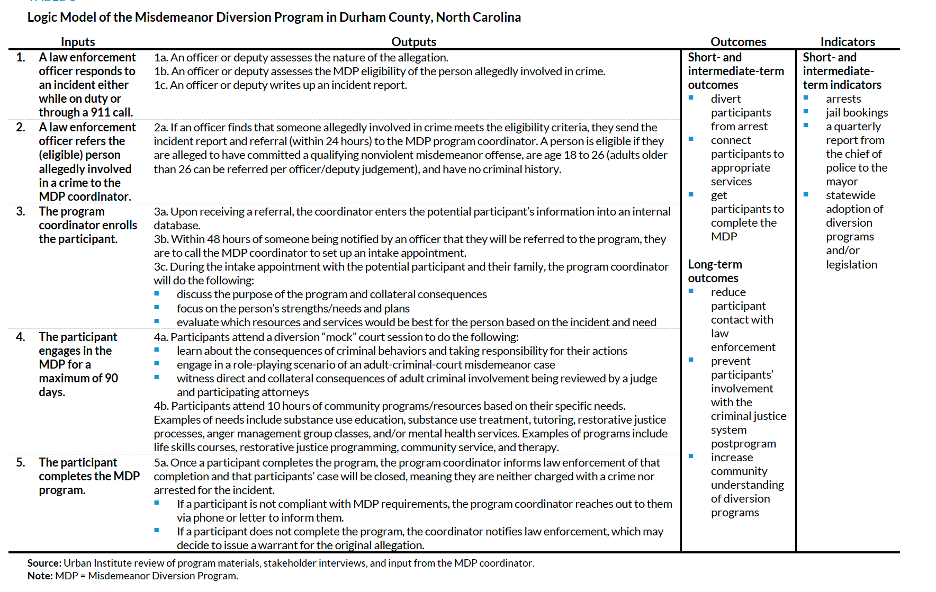
The diversion program shows collaboration between law enforcement and community groups in Durham County, and is the subject of an initial process evaluation by the Urban Institute, which you can download here.

The Urban Institute has not yet completed an accompanying outcome evaluation to see how the perceived impacts reported by relevant stakeholders align with measurable impacts available through local metrics —it is forthcoming in fall of 2021. But the county has been tracking its own numbers and it estimates that just under 800 people have gone through the program since 2014, with 99 percent of participants completing it. Of those, about 95 percent remain out of trouble after a year. Again, the Urban Institute—which is renowned for its rigorous, independent research—has yet to verify those numbers as an independent evaluator of the program. But in the meantime, the county is displaying them on its public-facing website as early evidence of the program’s success.

The Misdemeanor Diversion Program (MDP) began in 2014 to keep children out of the criminal justice system, because North Carolina had such antiquated laws related to minors. Until the ‘Raise the Age’ legislation passed in December, 2019, the state was automatically charging 16 and 17-year-olds as adults in the justice system and giving them adult criminal records.

The program allows law enforcement officers in Durham County to redirect people accused of committing their first misdemeanor crime(s) to community-based services in lieu of citation or arrest. What is unique about the program is that it occurs prearrest and pre-charge, meaning someone law enforcement officers may believe has committed a crime is not arrested or charged and does not formally enter the justice system in any way.

The program expanded to benefit adults up to 26, with older adults at law enforcement discretion. And other jurisdictions have replicated it across the state. It was based on a simple foundational principle: The need to avoid involvement in the justice system, where possible. It aimed to be as unrestrictive as possible while providing participants with the support necessary to move forward positively.

In the first week, the program got just two referrals. But a key element of the program’s success came in 2016 when the Durham Police Chief at the time created an executive order, taking discretion away from Durham Police officers and making referral of eligible individuals to the program mandatory for the Department.

The need for a program like the MDP in Durham County was well articulated by county stakeholders and participants who participated in the process evaluation. All stakeholders feel that people—youth in particular—do not need to be arrested and deserve “a second chance,” as some put it, if they do not pose a threat to public safety. Members of local law enforcement also believe the program has been useful and impactful. However, many local stakeholders believe that the community still needs more prearrest diversion opportunities whenever possible.

The program is cost effective and began with a grant, but it is now part of the county’s regular budget, demonstrating that it is replicable in other jurisdictions, with the right support and buy-in from local authorities.
Racial equity was also discussed during the conception of the program—given the disproportionate numbers of Black people in the county’s jail. Around three quarters of participants in the diversion program have been people of color.

Through interviews, we found that community stakeholders and program participants believe the MDP is impactful, particularly in that it diverts people from being charged with a crime and entering the justice system. Interviewees also generally believe the program was deeply needed in Durham County because too many people were being unnecessarily arrested and incarcerated.

Our process evaluation yielded four key takeaways for jurisdictions interested in replicating the MDP. First, buy-in from law enforcement is critical because it is needed to start the diversion process. Second, support from local leaders, such as elected officials, will help develop local law enforcement buy-in and support. Third, qualified program staff with deep community connections are essential. And fourth, a philosophy of keeping people out of the justice system altogether will lead to increased participant satisfaction and reduce collateral consequences associated with any justice involvement.

None of the interviewed stakeholders expressed resistance to the program, but several noted that when it was being developed, there was notable resistance from law enforcement agencies and law enforcement associations. Most of that resistance involved concern among local law enforcement officers that the program could take away their ability to determine whether an arrest could be made in certain situations, an ongoing concern during the early years of program implementation. In addition, numerous officers believed this type of program would infringe on their ability to perform their duty and would override their power to use discretion. Over time—through trainings, interactions with the program staff and participants, and changes in law enforcement leadership—law enforcement agencies generally became more supportive of the program.

Several stakeholders strongly support the program but believe it does not “do enough” (in the words of one interviewee) to reduce countywide arrests and incarceration. They want it to expand eligibility requirements to include more offenses, including additional misdemeanor charges and some felony charges. Simply put, many stakeholders feel the program has positively impacted participants but that too few people have been able to participate, leaving more people involved in the local justice system than necessary.

Some stakeholders criticized the program for making eligibility requirements too restrictive and not allowing enough access the program, which they consider essential to diverting people from the criminal justice system pre-charge. Many interviewees believe other communities would benefit from implementing similar programs to divert people from the justice system.

We encourage people to read the full process evaluation and to develop their own diversion programs based on what has been learned in North Carolina.


The Push for Racial Equity in Criminal Justice Starts with Asking Ourselves: “Who’s Not Here in the Room?”

By: Gwen Whiting

Community Engagement Pretrial Racial and Ethnic Disparities January 26, 2021

As technical assistance providers to the MacArthur Foundation’s Safety and Justice Challenge, my colleagues and I have worked with several key sites across the country to embed racial equity as an integral part of addressing America’s over-reliance on jails, often through better community engagement, particularly in Black and brown communities.

Our work over the last three years has had some success, and we’re excited to build on it. And a key lesson has been to ask often, when we’re working with decision-makers: Who isn’t here in the room? Why not? And how can we bring them in?

Very often, in our long careers, my colleagues and I have found ourselves brought into rooms of criminal justice decisionmakers who do not look a great deal like the communities in which they’re working. It’s not always constructive to ask a room full of white people in suits to look around themselves and ask “who’s missing?” But there are constructive ways to bring more diversity into the system, and to start that conversation moving.

If a person who’s waiting on their court date were to come into that room of decisionmakers, they’re going to ask themselves: “Do I see people I can trust, to whom I can tell my story without judgment? Do I see people who’ll be supportive of me and help me with my family situation?”

People are fearful, and they don’t know what’s going to happen. When we talk about building trust in communities, we need to honor that fear, and try to understand it.

I started doing this work when the Rodney King incident happened in Los Angeles. I was working with the Department of Justice on its 15 member National Church Burning Response Team when President Bill Clinton was in the White House. We traveled around the U.S. to communities where houses of worship had burned.  Being a part of that experience and my background in conflict management and resolution has afforded me a good sense of what people who are in vulnerable situations are feeling.  There is a lack of trust for systems and players who are perceived to hold power and resources. In this instance my role as a conciliation specialist was to pave the way for federal officers from agencies like the Federal Bureau of Investigtion and the bureau of Alcohol, Tobacco, and Firearms, along with local and state officers, to properly do investigations.

The unjust history and their personal stories are there when you go into communities. Understand: It’s just a lot. The stories that they hold. You need to pay attention to that, it’s not just coming in and saying “we want to work with you” and “we want to help.” When we talk about organizing, we talk about building that trust.

Using our dialogue to change approach, there are checklists we’ll work with, when we’re helping sites to build coalitions to tackle their issues: Does your coalition include people with different racial and ethnic backgrounds, different religious or philosophical views, and different political views? People with lived experience in the criminal justice system? Different ages? People with disabilities? Different professions? From different neighborhoods? People with different viewpoints on criminal justice? Different education levels? Folks with diverse gender identities and socioeconomic status?

Sometimes, it’s simply a question of prompting ourselves as decisionmakers to ask how we are showing up in our communities. What unconscious biases might be impacting our behaviors and decision-making?

As an African American – a Black woman, I have a vivid memory of being brought into a courtroom to observe as a judge was conducting pre-trial arraignment in a major city. Most of the defendants who came into the courtroom were Black or brown, and the judge referred to them by number, not by name. They were often asked if they could make bail, and many of them couldn’t. Then a young white defendant came in. She had been before the same judge, it turned out, although the judge still referred to her by her number. Still, she was sent straight to drug diversion. There was no question of her being asked about bail or staying in jail. I remember my own bias surfacing, and scoffing as I thought, “of course the young white woman is going to diversion.”

I don’t know the details of the young lady’s case. And it may well have been that the judge made the right call in sending her to diversion. The point is that for Black and brown people, our knowledge of the criminal justice system is shaped in the context of the history of our communities, and the history of the United States. When we see something like what I saw, we don’t always have time to think about the ins-and-outs. There’s a reaction to something we feel we’ve seen before.

The incident stuck with me, and I often talk about it with white criminal justice decisionmakers when we talk about how they show up in their communities, and the impact that they’re having.

There’s also a researched and proven tendency that in communities where there are more Black and brown folks, white decisionmakers can tend to micromanage, a little more, than they might do if they are working in communities where more people look like they do.

When it comes to the Safety and Justice Challenge, the sites that have been most successful in tackling racial inequity in the system have tackled it head-on, naming it as an issue and recognizing the role that power dynamics play in addressing it.

Some justice system leaders show up to our trainings curiously willing to ask the hard questions about why so many Black and brown people continue to show up in our jail system and why so many Black and brown people are being arrested.

Such sites have hired Black and brown community engagement managers who know the communities in which they work, and understand what it looks like to build trust, and what that means. These people have the voice of the communities in which they’re working. And that’s where the push for racial equity really starts to move things in the right direction.

Five Things COVID-19 Taught Us About Safety and Justice

By: Wendy Ware

Courts COVID Pretrial December 16, 2020

Necessity is the mother of invention, and cities and counties participating in the Safety and Justice Challenge have learned a great deal from measures taken to save lives during COVID-19. What’s more, many of these lessons will prove valuable in the years ahead, both as the world continues to fight the virus and afterwards.

With strategies to reduce jail populations already in place and key decision-makers already at the table working together, many SJC sites were better positioned to respond to the crisis than jurisdictions not already engaged in these efforts. For example, sites deployed new or existing Population Review Teams to identify those who could be quickly and safely released to prevent spread of COVID-19 in jails and the broader community. The stakeholder collaboration and evidence-based strategies already in place through the SJC allowed many sites a head start in mitigating the spread of COVID-19.

Without exception, all the cities and counties involved in the Safety and Justice Challenge managed to substantially reduce their jail populations during the pandemic, without jeopardizing public safety. In many cases, average daily jail populations reached levels lower than at any point in the last quarter century. For example, Buncombe County in North Carolina reduced its jail population by 42% at its lowest point, San Francisco County, California, by 35% at its lowest point, and Allegheny County in Pennsylvania by more than 30% at its lowest point.

Without exception, all the cities and counties involved in the Safety and Justice Challenge managed to substantially reduce their jail populations during the pandemic, without jeopardizing public safety.

However, local justice systems had varying levels of success in tackling the virus despite testing and control measures. East Baton Rouge Parish in Louisiana, for example, saw only one positive COVID-19 test at its pretrial detention facility. In Buncombe County, there have been no COVID-19 infections in the jail, largely due to a strict initial quarantine program and the ability to keep all incarcerated people in single cells (one person arrived at the jail with COVID-19 but did not pass the virus to others). Among detainees in Cook County, Illinois, a total of 1,096 detainees have tested positive as of December 11, 2020. Many people booked into the jail are coming in with the virus, rather than catching it inside the jail – further demonstrating that reducing jail bookings is critical to preventing spread of the virus.

How did cities and counties in the Safety and Justice Challenge respond to COVID-19? And what have we learned?

1. Reducing Arrests and Jail Bookings, Increasing Releases Helped

In cities and counties participating in the Safety and Justice Challenge across the country, justice system actors worked together to reduce the number of people being booked into jails, and to prioritize case review for people in custody so that they could be released, where possible. They also worked together to prioritize release of people with vulnerable health conditions, who could safely be released pretrial or while serving their sentences. There has been collaboration with police to issue summonses in lieu of arresting people on nonviolent misdemeanor charges, when safe to do so. Many cities and counties even suspended arrests for some felonies and for certain warrants which could be resolved in the field. In Clark County, Nevada, prosecutors aggressively screened cases and quickly diverted or dismissed those that were not likely to go forward or that didn’t present a threat to public safety.

In Multnomah County, Oregon, more people were released on their own recognizance. In New Orleans, the JFA Institute found that defendants released from custody had very high overall success rates — nearly 80% have no “failure to appear” or re-arrest. And 92% of defendants in the lowest risk category attended all required court appearances. In Allegheny County, three-month rates for people reentering the system who had been released at the start of COVID-19 were slightly lower than comparable three-month reentry rates of people released from jail during the same time period in 2019.

In Minnehaha County, South Dakota, justice system actors achieved a 53% reduction in arrests and jail bookings in March 2020, compared to the previous month. They attributed it to increased use of cite and release practices, and to setting lower bonds and operating a lower fine schedule. New Orleans Police Department reduced arrests for non-violent charges by 63% compared to the same period in 2019, with overall arrests down 59%. Lake County, Illinois, reduced arrests by 27%. The Baton Rouge Police Department expanded its cite and release policy to include traffic offenses, nonviolent misdemeanors and low-level felony charges.

2. Changes in Bail Protocols Have Proven Successful in Safely Reducing Jail Populations

Cities and counties across the country made substantial changes to their bail protocols during COVID-19. For example, The Los Angeles County Sheriff, with the support of the Public Defender and other agencies, instituted a policy of releasing anyone with $50,000 bail or less, in specified cases. The State Superior Court also reset bail amounts under the existing bail schedule to $0 bail for designated offenses. While the changes expired as part of the state’s emergency bail order in June 2020, Los Angeles County has extended this order locally to remain in place as part of the ongoing pandemic response. Clark County, Nevada shifted the burden of proof in bail hearings, requiring prosecutors to show why a defendant must be kept in custody. St. Louis County connected people in jail who couldn’t afford their bail with The Bail Project to help secure their release.

Despite some naysayers, we know this type of bail reform does not put the public at greater risk. New academic analysis shows Chicago area bail reform efforts since 2017 have not increased new criminal activity. Creative and evidence-based steps like these paved the way for other jurisdictions to follow suit and respond to the pandemic.

3. Technological Tools Kept Systems Operating

Just as new apps like Zoom, Microsoft Teams and Slack have changed working life during the pandemic, technological innovations have transformed justice systems operations in the era of social distancing. Many sites began holding video and telephone appearances in their courtrooms, rather than in-person hearings. In Palm Beach County, Florida, a new text message court reminder system reduced failure to appear rates from 8% to 3%. St. Louis County bought tablets for the jail so that attorneys could conduct video meetings with their clients more easily, expanding on the Public Defender’s existing initiative to represent people at their first court appearance.  Probation and Parole Departments also instituted virtual check-ins that aided in reduced revocations back to custody.

4. A Focus on Behavioral Health Improved Reentry Success

Cities and counties have continued to invest in keeping people from being rearrested or being arrested in the first place. They have provided housing, food, medication, transportation, and other service referrals for people being released from jail so that they don’t cycle back into the system. Recognizing the importance of meeting these social services—which can be a challenge, particularly in larger jurisdictions—sites are investing more deeply in reentry resources. Palm Beach County, for example, has provided permanent supportive housing with wraparound services for 12 people experiencing homelessness with behavioral health challenges as part of a Safety and Justice Challenge-funded pilot program. In the two-year period before they were housed, these individuals had collectively been arrested 64 times and spent 704 days in jail.

5. Reducing Racial and Ethnic Disparities Will Require Renewed Commitment

COVID-19 further exposed racial inequities in America’s jails. In many cases, we saw racial disparities increase across participating cities and counties as a larger percentage of white people were released from jail than Black people. In Palm Beach County, Florida, for example, white people were twice as likely to be released compared to Black people from February to July 2020. In Buncombe County, the portion of jail population that is Black increased steadily from 23% in February to a high in July of 33%, compared to a county-wide population rate of around 8%.

How We Can Build on Our Momentum

Several cities and counties plan to build on changes they have made during COVID-19 to keep any substantial rebound to a minimum and continue releasing more people with low-level charges. For example, Los Angeles County plans to close its Men’s Central Jail within a year, reducing more than 3,000 beds from its pretrial capacity. San Francisco has already closed one of its jails. Meanwhile, Clark County, Nevada plans to keep its emergency measures in place until July 2021 and use the data collected to move forward from there.

—Wendy Ware is the President of the JFA Institute, which works in partnership to evaluate criminal justice practices and design research-based policy solutions.

Dollars And Sense In Cook County — Examining The Impact Of Bail Reform On Crime And Other Factors

By: Dr. Don Stemen

Bail Pretrial November 19, 2020

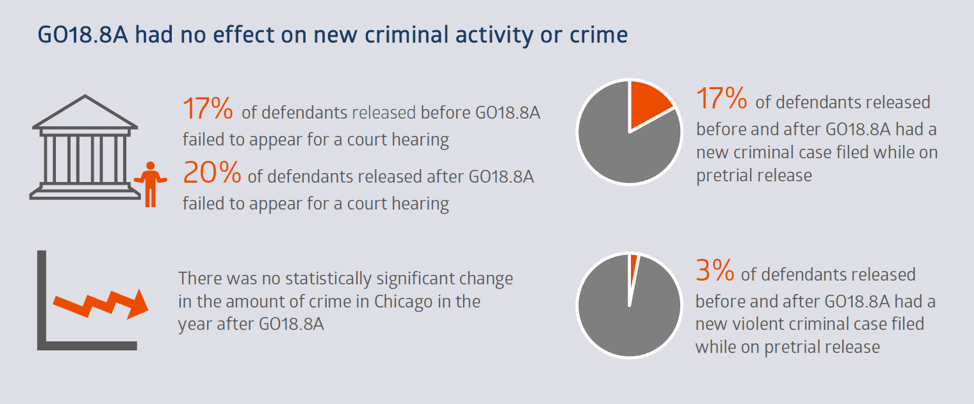
New academic analysis shows Chicago area bail reform efforts since 2017 have had no impact on new criminal activity or new violent criminal activity of those defendants released pretrial.

Overall crimes rates in Chicago, including violent crime rates, were not any higher than expected after the implementation of the effort. The analysis echoes that performed in other areas where similar bail reform efforts have been undertaken such as New York, New Jersey, and Philadelphia.

You can read the full report here. 

Everyone wants safe communities. But our research suggests that releasing people on their own recognizance does not make communities less safe. And taking money away from people to secure their release does not make communities safer. Monetary bail, however, does impose a burden on those individuals and their families who are least able to afford it.

Like bail reform efforts in other cities, Chicago’s initiative demonstrates that it is possible to decrease the use of monetary bail and decrease pretrial detention – and lessen the financial, physical, and psychological harms that come with pretrial detention – without affecting criminal activity or crime rates.

In Chicago, the effort began on September 17, 2017, when the Chief Judge of the Circuit Court of Cook County issued General Order 18.8A (GO18.8A) to reform felony bail practices in Cook County.

GO18.8A established a decision-making process for felony bond court judges. Under the order, bond court judges were to first determine whether a defendant should be released pretrial and, if not, hold the defendant in jail. If the defendant could be released, GO18.8A created a presumption of release without monetary bail; however, if monetary bail was necessary, the order stated that bail should be set at an amount affordable for the defendant. In the end, GO18.8A established a presumption of release without monetary bail for the large majority of felony defendants in Cook County and encouraged the use of lower bail amounts for those required to post monetary bail.

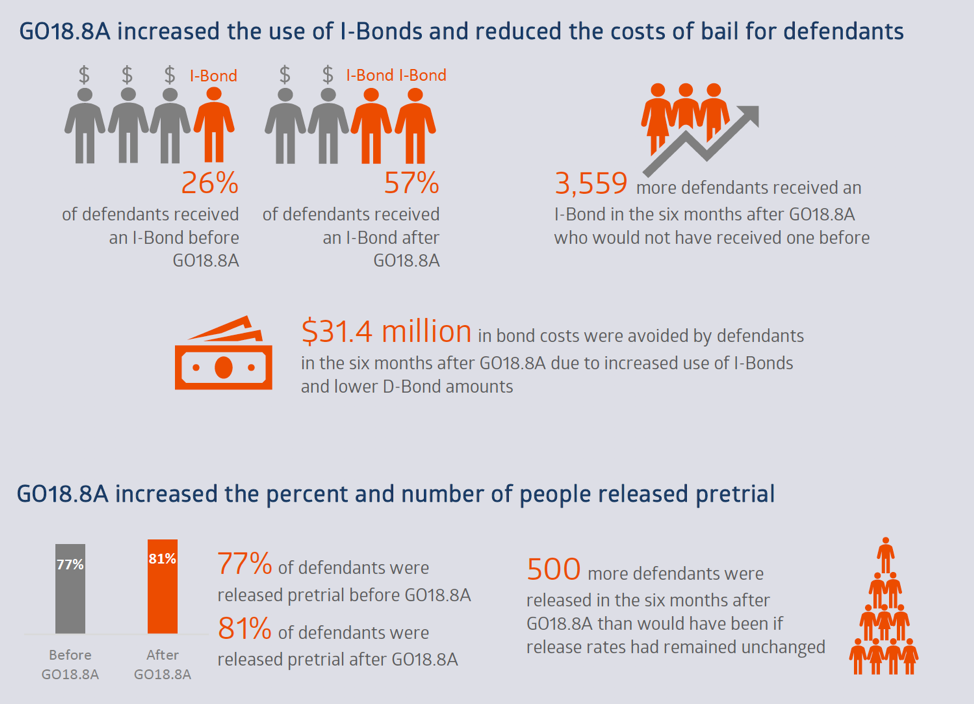
After GO18.8A, there was a significant increase in the use of I-Bonds, or individual recognizance bonds for which defendants are released without having to post monetary bail.

The impact of this shift was dramatic: 3,559 additional people received an I-Bond in the six months after bail reform began. The real impact of this change was that none of these defendants had to post monetary bail to be released pretrial, saving these defendants and their families $13.6 million in avoided bond costs.

D-Bond amounts, where a defendant pays 10% of the bail amount to secure release from jail­–were also lower after bail reform. Before the effort began, the average was $9,316 to secure release, compared to $3,824 afterwards.

Combined with increased I-Bond usage, our analysis showed that Chicago saved defendants and their families more than $31.4 million in the six months after the initiative was introduced. That means bail reform in Chicago allowed defendants and their families to have $31.4 million available to be used for rent, food, and medical care while their cases were being resolved.

Likewise, the initiative did this without affecting new criminal activity of those released or increasing crime.

Bail reform efforts across the United States have accelerated in recent years, driven by concerns about the overuse of monetary bail, the potentially disparate impact of pretrial detention on poor and minority defendants, and the effects of bail decisions on local jail populations.

Proponents of bail reform advocate for reducing or eliminating the use of monetary bail, arguing that many defendants are held in jail pretrial solely because they cannot afford to post bail. Opponents counter that reducing the use of monetary bail or increasing the number of people released pretrial could result in more defendants failing to appear for court.

A debate has also played out in the media regarding the link between GO18.8A and possible diminished safety, but until our analysis, a rigorous, objective, external assessment has been lacking.

Ultimately, we found that money should not be the mechanism by which the court determines which people to hold and which people to release. Opponents of bail reform may continue to argue that reducing the use of monetary bail and increasing the number of people released pretrial will result in more defendants committing more crimes while on pretrial release. But that is not what happened following bail reform in Cook County, consistent with experiences following bail reform in New York, New Jersey, and Philadelphia.

 Dr. Don Stemen is an Associate Professor and Chairperson in the Department of Criminal Justice and Criminology.

Professor David Olson is a Professor in the Department of Criminal Justice and Criminology at Loyola University Chicago and is also the Co-Director (with Diane Geraghty, Loyola School of Law) of Loyola’s interdisciplinary Center for Criminal Justice Research, Policy, and Practice.


Lessons To Be Learned From Remote Court Success During Coronavirus

By: Sue Ferrere

Courts COVID Pretrial August 24, 2020

Court systems around America are learning important lessons about the value of offering remote hearings in response to COVID-19.

We at the Pretrial Justice Institute (PJI) believe the success of these changes shows that courts can provide access to justice in new ways—and it debunks the longstanding myth that the responsibility for court appearance falls only on the shoulders of the accused. Providing more flexibility can go a long way in improving court appearance rates.

Early data from the National Center for State Courts (NCSC) shows that court appearance rates increased with the use of remote hearings during COVID-19:

  • In parts of North Dakota, criminal warrant hearing appearance rates went up from 80 to nearly 100 percent, with failure to appear rates dropping significantly across all hearing types.
  • In New Jersey, appearance rates in criminal cases rose from 80 percent to 99.7 percent since mid-March, when the courts began to conduct virtual hearings.
  • And in Michigan, appearance rates rose across all cases from 89.3 percent in April 2019 to 99.5 percent in April 2020. When asked about this new way of doing business, Michigan Supreme Court Chief Justice Bridget M. McCormack told the NCSC that the expansion of remote hearings has launched a fundamental change in the way courts do business in the state, and said, “we are not going back.”

That said, I worry that as the country reopens, this newfound court flexibility could fade, especially if the volume of arrests returns to pre-COVID levels. Those of us working in systems all have a role to play in ensuring these new ways of operation become standard practice. Court appearance rates are amongst the most relevant, practical and useful measures for success, along with liberty rates and public safety. The early data suggest that more court flexibility could improve all these measures.

Perhaps now is also a good time to ask ourselves: In whose interests were the changes in flexibility predominantly made?

When everything shut down in March due to the pandemic, the judiciary worked around the clock to make the shift to more remote hearings. If we are honest, this decision was likely to ensure the health and safety of court employees—people who have more privilege and power in the legal system than people accused. This shift could have happened pre-COVID to make appearance easier for people impacted by the system, but it didn’t. Why is that?

Is it possible that we didn’t ever push for more remote court hearings because the process is the punishment? Something that would have benefited the accused wasn’t tried until it benefited those working in the system. That’s the teachable moment here.

At PJI, we firmly believe there’s no pretrial justice without racial justice. The more we have reflected on our collective approach to pretrial reform over the years, we realized that we were overly focused on technical fixes and our impact on systems was limited. We weren’t having in-depth, look-at-yourself in the mirror conversations about systemic racism, power and privilege.

Today, as we all examine court practices through these lenses, it’s worth reminding ourselves who has had the power all along to imagine and implement changes that would raise equity and access to justice. It is many of us who are at the table as part of the Safety and Justice Challenge.

Justice systems that view their purpose and practices through an equity lens will keep using remote hearings if requested by the accused, offer court date reminders to all people, and provide flexibility around transportation, childcare and the ability to change a court date if a person has to work. They will ensure that remote hearings don’t have unintended consequences, like limiting access to counsel. However, systems that continue to see their work through a white supremacy lens will focus on the comfort and convenience of the court, measuring the accused’s respect for the law with arriving on time for a court appointment.

We need to move away from viewing pretrial systems as paternalistic, and instead see them as collective and collaborative. We need to innovate so that everyone wins.

—Sue Ferrere is the Director of Impact at the Pretrial Justice Institute