Breaking The Cycle Of Homelessness And Jail

By: Madeline Bailey

Crime Housing Pretrial August 12, 2020

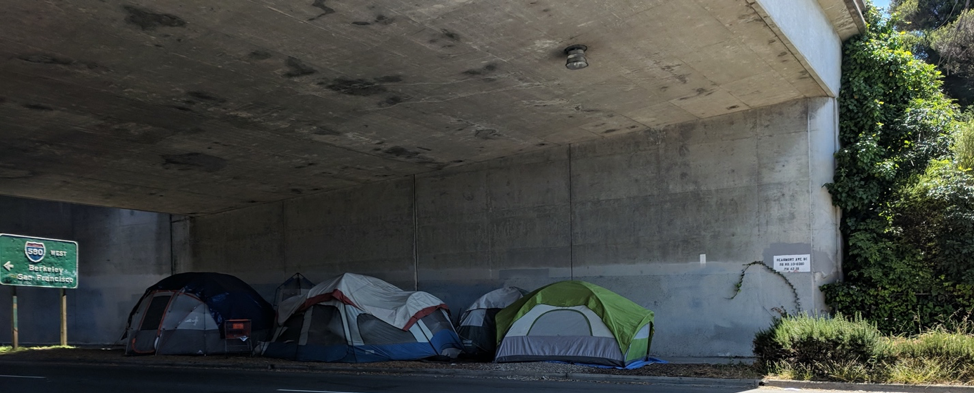
On any given night in the United States, more than 550,000 people are experiencing homelessness. Among these, 96,000 are chronically homeless, meaning they are facing long and repeated episodes of homelessness that make it increasingly difficult to return to housing. This crisis is perpetuated by a legal system that criminalizes survival behaviors associated with homelessness, fails to account for the ways in which people who are homeless face impossible odds within the legal process, and then releases them back into the community with even more obstacles than they faced before.

The time has come for local justice systems to take immediate action to halt the cycle of homelessness and jail incarceration.

This must begin with acknowledging the harms perpetuated by the current system, addressing deepening racial disparities, and enacting urgently needed changes to policies and practices.

That’s the crux of a new evidence brief issued this week by the Vera Institute of Justice—strategic allies to the Safety and Justice Challenge.

In the brief, we examine how the overenforcement and criminalization of homelessness exposes unhoused people to frequent police contact and citations for unavoidable aspects of homelessness, such as camping outside or soliciting help. For people lacking a stable income, housing, or a reliable mailing address, unpaid fines and missed court dates can quickly trigger warrants and arrests. Once caught in the system, people without housing face a higher likelihood of pretrial incarceration and increased vulnerability to conviction, leading to longer periods in jail.

After release from jail, increased obstacles and restrictions make it even harder to find safe housing, employment, and overall stability—leaving many recently released people with no realistic option for avoiding homelessness.

Confirming the cycle, researchers have found that homelessness is between 7.5 and 11.3 times more prevalent among the jail population. Because of punitive laws and enforcement practices, people who are homeless are 11 times more likely to be arrested, nationwide, than those who are housed.

Without legal and policy changes, the cycle of homelessness and jail will persist, and will deepen already existing racial disparities within the criminal legal system. Research has shown that Black people make up more than 40 percent of America’s unhoused population, despite constituting only 13 percent of the general population.

The evidence establishing the link between homelessness and jail incarceration demands further research and highlights the urgent need for alternative approaches.

The most humane way to stop the cycle of homelessness and jail is to provide safe and stable housing for all. But, as some jurisdictions are starting to recognize the urgency of stopping this cycle, local justice system stakeholders have begun implementing smaller solutions that offer people experiencing homelessness a way to avoid the devastating consequences of the criminal legal system, while also allowing communities to free up system resources for other purposes.

Our brief offers several strategies for breaking the cycle of homelessness including:

  • Eliminating harmful city ordinances that target elements of homelessness
  • Halting the issuance of warrants for quality of life offenses
  • Forgiving legal fines and fees for people experiencing homelessness
  • Reforming probation and parole procedures to support people without stable housing
  • Addressing housing and employment restrictions for justice-involved people

Especially in a year when the United States is weathering an unprecedented public health crisis, it is more important than ever to examine the systems that make communities most vulnerable and to implement alternatives that prioritize safety, health, and justice for all.

Madeline Bailey is a Program Associate with the Vera Institute of Justice

Crime Is Down In Chicago After Coronavirus-Related Jail Releases

By: Don Stemen

COVID Crime Incarceration Trends May 21, 2020

Law enforcement policy has too often been decided in a data vacuum, in large part due to a lack of sophistication and transparency in how policing data are publicly released.

At the same time, safety-related jail releases of defendants charged with low-level felonies to protect them from the spread of the Coronavirus offer an unprecedented discrete opportunity to test common assumptions about whether releasing people before trial necessarily leads to an uptick in crime.

In the absence of crime data, such early concerns were raised about a possible crime wave related to Coronavirus jail releases, but it turns out that those fears have not been borne out by actual statistics, which we’ve been tracking in Chicago on a weekly basis and reporting on a website.

Instead, the data in Chicago shows a marked drop in overall crime since Coronavirus jail releases began, with total reported incidents down more than 30 percent.

At the same time, since March 15, the Cook County jail population is also down 28 percent, to a level not seen since the early 1980s:

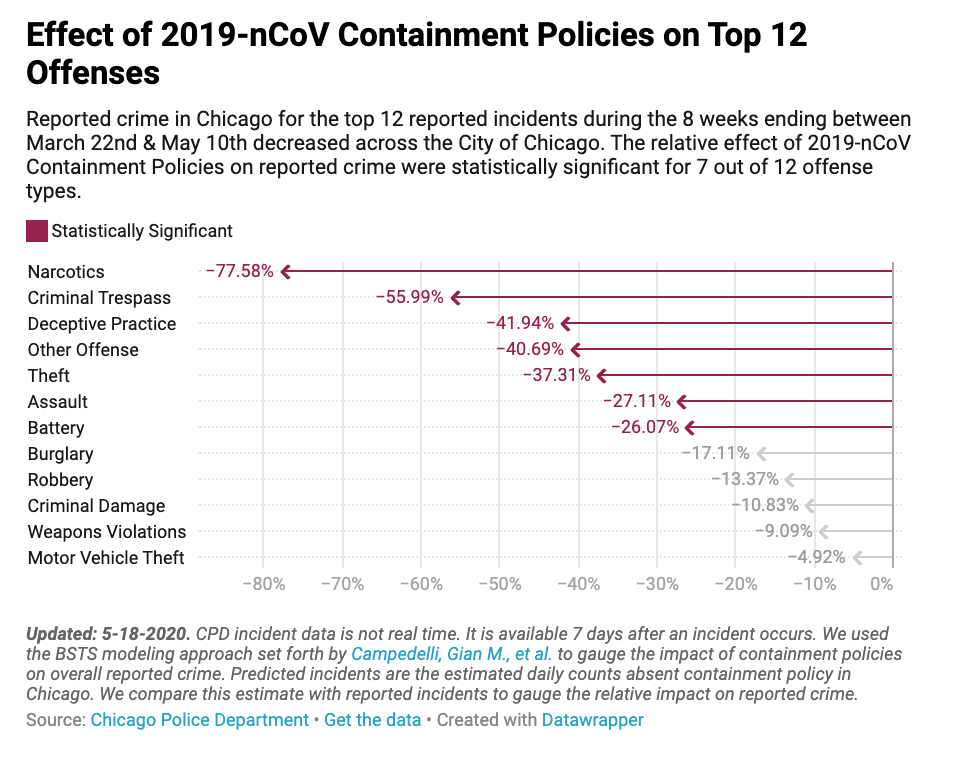
The data also show statistically significant reductions in seven out of 12 of the most frequent offense types, particularly arrests for non-marijuana drug offenses:

Chicago and Cook County Justice agencies began containment policies on March 17, when Cook County began a reassessment of bond for primarily non-violent offenders. On March 24th, the Chicago Police Department directed officers to reduce police stops and issue citations in lieu of low-level misdemeanor arrests.

Concerns of a crime wave have been raised primarily by law enforcement agencies, although early analysis by the Marshall Project suggested the opposite trend, with reported crime down across the country in major cities. And our own analysis bolsters that.

However, there is also interesting nuance in the data that aligns with underlying structural issues that COVID-19 have illustrated in regards to public health.

The Chicago Tribune found, for example, after filing a public records request, that the police department issued more Coronavirus dispersal orders in Chicago’s West Side neighborhoods, which are markedly more populated by African American people on lower incomes. These neighborhoods also have the highest violent crime rates in the city and the most concentrated areas of economic and social disadvantage.

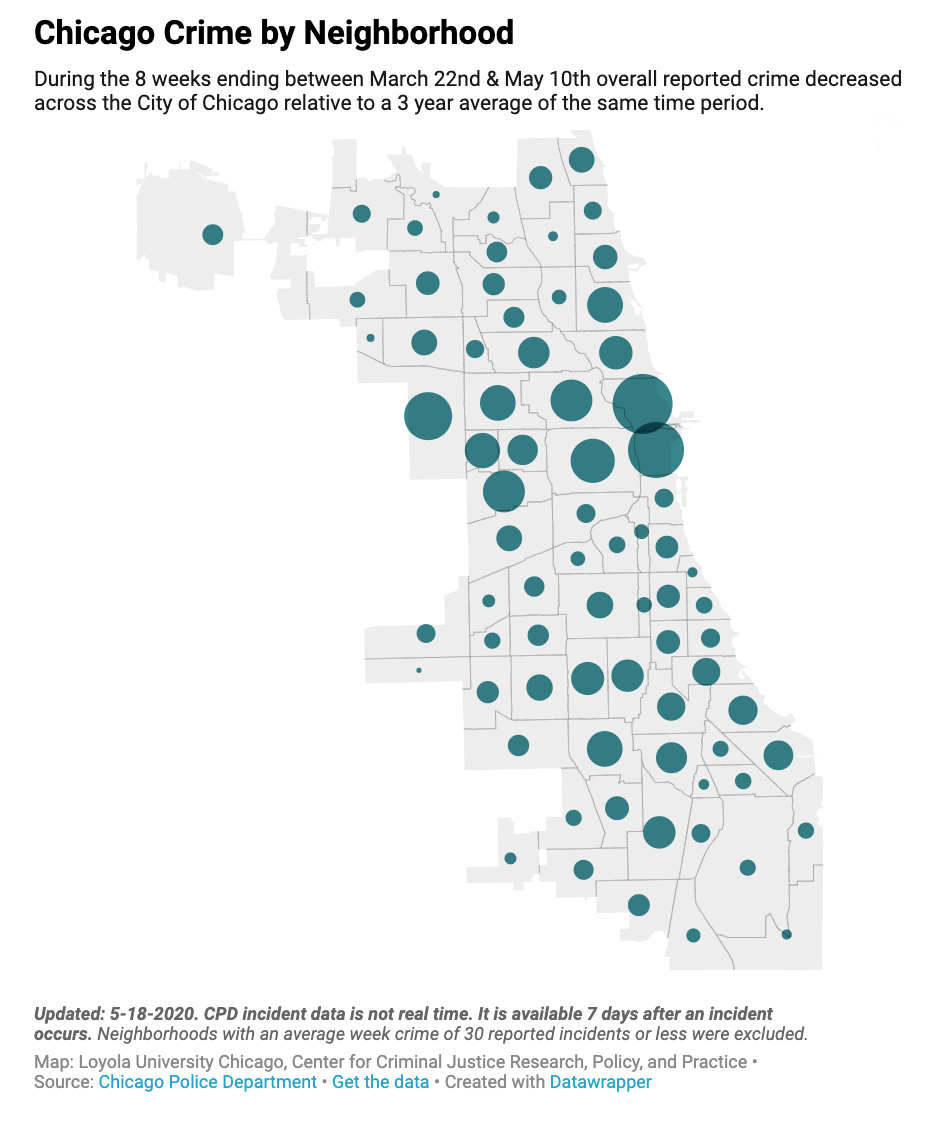
There are structural inequities, including racial inequities, at play in Chicago’s geography. The statistics show a markedly higher reduction in crime in Chicago’s central business district and in many of the more affluent neighborhoods with fewer people of color:

The area where we’ve seen the biggest drop in crime is The Loop—the central business district in downtown Chicago where the businesses, the shopping district, and the financial district are located. And nobody’s there right now—the accountants and attorneys are all working from home, and almost all of the stores are closed to shoppers.

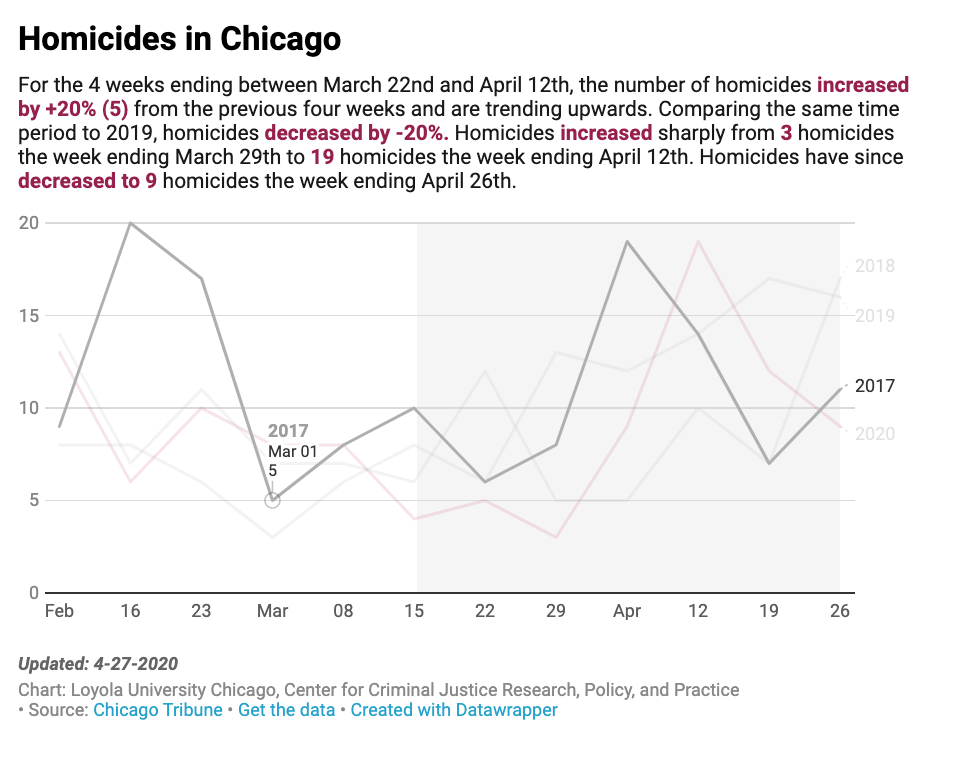
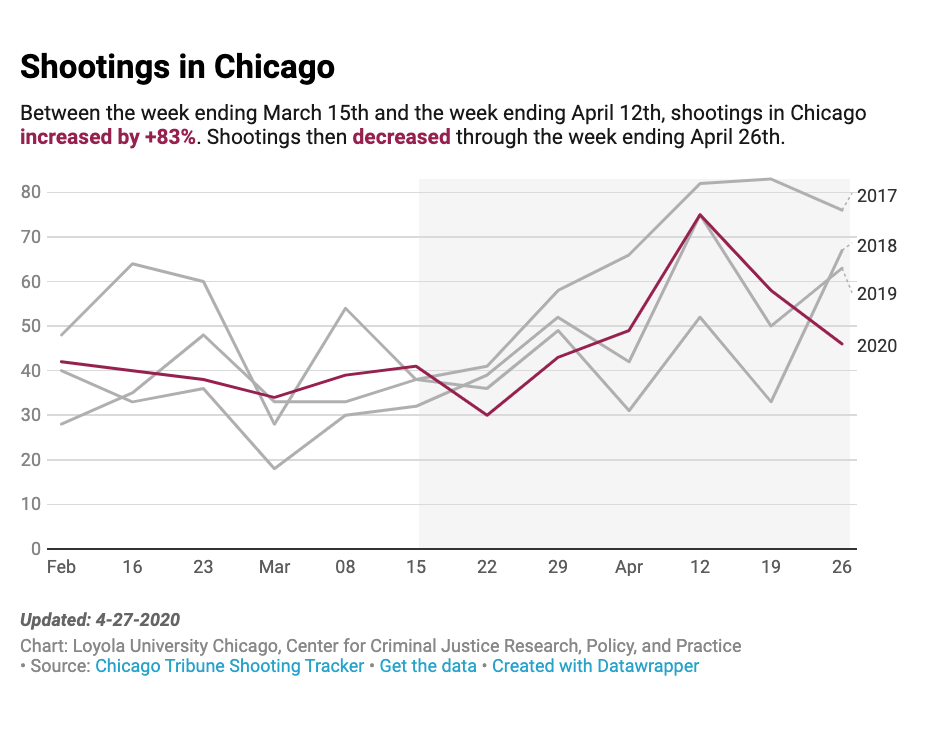
Meanwhile in the areas with higher crime rates, homicides and shootings have been relatively unaffected by the crisis, remaining relatively steady in their week-to-week fluctuations.

The data suggest that we may have reached a statistical baseline, in terms of how much it’s possible to impact crime statistics and the jail population alone.

At this point, if we want to further reduce crime or the jail population, then it’s going to need deeper work from a public health perspective to protect the population at greatest risk for shootings and homicides. There are some more intractable issues at play that aren’t interfered with, even by a pandemic.

So far, there’s been limited replication of this kind of statistical analysis, nationally. But we encourage it because it illustrates the powerful impact of police decision making on the system.

By reducing the number of drug arrests in Chicago, for example, police have had a profound impact on the system, and on the jail. There is a systemwide interconnectedness revealed in the numbers.

The question is, once restrictions have been eased, will the Chicago justice system remember what it’s learning from all this? 

Dr. Don Stemen is an Associate Professor and Chairperson in the Department of Criminal Justice and Criminology and a member of the Graduate Faculty at Loyola University, Chicago.

Professor David Olson is a Professor in the Criminal Justice and Criminology Department at Loyola University Chicago, where he is also the Graduate Program Director, and is also the Co-Director (with Diane Geraghty, Loyola School of Law) of Loyola’s interdisciplinary Center for Criminal Justice Research, Policy and Practice. 


The Covid Blueprint: Crime Stats Are Not Going Up As Jail and Prison Populations Go Down

By: James Austin

COVID Crime Incarceration Trends May 7, 2020

Contrary to what fearmongers would have you believe, the Coronavirus has shown that crime doesn’t rise when jail and prison populations go down. This was well known even before COVID-19 caused cities to rethink their criminal justice policies.

The current COVID-19 crisis provides a real-time blueprint on how to vastly streamline our criminal justice system. Removing misdemeanor and traffic violations from the criminal code would reduce the number of arrests, jail bookings and court filings by at least 50%. Expediting the disposition of criminal charges for those jailed will reduce the jail and prison populations. And we now know that crime rates will be reduced as we shrink the $300 billion criminal justice system footprint.

The press has focused on a few isolated surges in shootings but in fact, a new study by Thomas Abt and Richard Rosenfeld shows that American homicide rates declined dramatically in April and May based on data from 64 U.S. cities: Homicide rates declined by 21.5 percent in April and 9.9 percent in May compared with the previous three-year average for those months. We’ve also seen abrupt drops in theft and burglaries since the Coronavirus took hold, and that’s against a backdrop of crime rates already dropping by over 50% since 1995.

The crime drop has also produced an arrest drop, and that’s been compounded as law enforcement has decided not to pay as much attention to misdemeanor crimes. Those arrests have dropped dramatically, producing reduced jail bookings and fewer people in jail.

As we talk about reducing the footprint and cost of police agencies (over $140 billion a year), the number one thing for us to learn is that we don’t need to physically arrest people for a misdemeanor crime. Instead, police should give them a field citation, with the exception of domestic violence and DUI charges. And police shouldn’t be doing routine traffic stops for the sole purpose of raising money for more policing. As an alternative, we should maximize use of cameras, and develop a corps of traffic officers who aren’t armed with guns but with tablets. If they catch you speeding, they take a picture of your license plate, and then send you the picture and a bill. That’s all.

The big challenge we’re now facing is people’s court appearances being delayed because the criminal courts have been shut down, or are working at a slower pace. Courts need to expedite the processing of cases for those folks who are still in jail. Defenders and prosecutors will have to change their old business practices of delaying sentencing until they get a deal they like. In particular, needless and lengthy court continuances need to be eliminated.

Courts may also need to declare a one-time amnesty for those who fail to appear over coming months on misdemeanor and traffic citations issued during the Coronavirus crisis. Otherwise, there’ll be a sizable backup of failure-to-appear warrants which will clog the courts, increase jail bookings, and do nothing to improve public safety.

—Dr. Austin has over twenty-five years of experience in correctional planning and research. He is the former director of the Institute on Crime, Justice and Corrections at George Washington University in Washington, DC. 

Research Report

Crime Frequent Jail Users Policing August 26, 2019

Arrest, Release, Repeat: How police and jails are misused to respond to social problems

Prison Policy Institute

Police and jails are supposed to promote public safety. Increasingly, however, law enforcement is called upon to respond punitively to medical and economic problems unrelated to public safety issues. As a result, local jails are filled with people who need medical care and social services, many of whom cycle in and out of jail without ever receiving the help they need. Conversations about this problem are becoming more frequent, but until now, these conversations have been missing three fundamental data points: how many people go to jail each year, how many return, and which underlying problems fuel this cycle. This report fills that troubling data gap.

Research Report

Crime Incarceration Trends Policing August 13, 2019

Gatekeepers: The Role of Police in Ending Mass Incarceration

Vera Institute of Justice

Police in America arrest millions of people each year, and the likelihood that arrest will lead to jail incarceration has increased steadily: for every 100 arrests police officers made in 2016, there were 99 jail admissions, up from 70 jail admissions for every 100 arrests in 1994. Ending mass incarceration and repairing its extensive collateral consequences thus must begin by focusing on the front end of the system: police work. Recognizing the roughly 18,000 police agencies around the country as gatekeepers of the system, this report explores the factors driving mass enforcement, particularly of low-level offenses; what police agencies could do instead with the right community investment, national and local leadership, and officer training, incentives, and support; and policies that could shift the policing paradigm away from the reflexive use of enforcement, which unnecessarily criminalizes people and leads directly to the jailhouse door.