Conservative Jurisdictions Champion Pre-Arrest Diversion Strategies

By: Lisel Petis

Collaboration Diversion July 28, 2022

A new R Street Institute report supported by the MacArthur Foundation’s Safety and Justice Challenge explores the successful implementation of pre-arrest diversion strategies in three conservative communities. Such strategies respond to challenges facing law enforcement agencies across the country including staffing shortages, negative public perception, overpopulation in jails, increases in violent crime, and court backlogs.

While criminal justice reform can be a politically charged term, we found that several conservative jurisdictions champion pre-arrest diversion as a way to support law enforcement and to remain fiscally disciplined. These jurisdictions have prioritized police time and resources, enabling law enforcement to deal with serious crimes while simultaneously rebuilding community relationships. They have also effectively diverted low-level offenders while balancing individual rights and public safety. The paper spotlights three jurisdictions that employ at least one diversion strategy, and in so doing, reveals how the traditionally conservative values of public safety, fiscal responsibility, and limited government interference are at the core of such programs. The paper also explores how to overcome challenges around starting diversion programs.

Law Enforcement Assisted Diversion (LEAD)— Cheyenne, Wyoming

Police-initiated diversion gives officers the opportunity to refer someone to intensive case management outside the criminal justice system rather than cite or arrest the individual for a crime.

Laramie County, Wyo., where Cheyenne is located, has been particularly successful in implementing Law Enforcement Assisted Diversion (LEAD). The community explored this option after finding that prosecuting and jailing individuals with behavioral health needs was ineffective in improving public safety. Officials and professionals merely saw a “revolving door” of the same individuals. Further, Cheyenne had seen a steady increase of mental health calls, violent crimes, and overdose related deaths; they needed to try something different.

When the program first began, some officers were hesitant to refer individuals to LEAD. In fact, one lieutenant at the Cheyenne Police Department feared LEAD, “wasn’t holding people accountable and just allow[ed] people to screw up with no consequence.” But many officers gradually saw the positive results. The lieutenant who initially was a skeptic eventually became “all in.” Officers realized that even if individuals were being arrested, they returned to the streets upon release with no support or services in place to help them change behaviors, with many returning to drug use or other destructive activities. LEAD has been a positive step for these individuals. In fact, officers tracked how many contacts they were having with people who were frequently arrested and found after a LEAD referral, officers had not talked to many of these individuals in months. One individual said the LEAD program saved his family member’s life.

Co-responder Model— El Paso County, Colorado

Though police officers generally do not have the training to handle mental health crises, many communities rely upon police to handle such issues. In an effort to support law enforcement in these situations, many communities have implemented co-responder programs. In a co-responder model, a behavioral health clinician (and in some models, emergency medical personnel) accompany law enforcement on patrol.

The sheriff’s office in El Paso County, Co. formed their own co-responder program, the Behavioral Health Connect Unit (BHCON), in 2017 after realizing they needed to reduce jail intake rates. When researching how to reduce the jail population, they realized that a high number of incarcerated individuals suffered from mental health issues. The BHCON team now responds to mental health crisis calls as well as low-level crimes in which it is clear that the individual’s mental health crisis—rather than criminal intent—is the cause for the criminal act.

This immediate response to someone in crisis has resulted in a reduction of expensive arrests and jail admissions as well as a reduction in mandatory psychiatric holds (often referred to as a “72-hour hold”) that are often done in hospitals. In 2021, BHCON responded to 1,154 calls for service. From those calls, BHCON diverted 99 percent from jail and 85 percent from the emergency department. At a time when hospitals are having to divert patients (due largely to COVID-19), saving hospital space is essential. BHCON has also relieved law enforcement of having to rely on the jail as a de facto mental health facility when an individual does not meet the threshold for a mandatory psychiatric hold.

Community Responders— St. Petersburg, Florida

Too often, law enforcement is responding to noncriminal calls where their presence is not necessary. Community Responders (or Civilian Response) takes the co-responder model and removes the police officer entirely. That is, community responders divert individuals from the criminal justice system by having trained, non-law enforcement professionals respond to certain calls for service that do not require a gun and a badge.

This model is the most effective at reserving police resources for the most dangerous crimes while also lowering the potential of escalating a situation by removing the presence of law enforcement. Instead, dispatch alerts community responders who have backgrounds and specific training to help in situations where behavioral health and/or social concerns are the prominent issue.

In 2019, St. Petersburg’s police department partnered with a local nonprofit to form Community Assistance and Life Liaison (CALL). Under the CALL model, clinical staff and community navigators respond to calls such as panhandling, truancy, welfare checks, mental health holds, and disputes between neighbors. When initiating the program, the St. Petersburg Police Department believed such a program could respond to approximately 12,700 calls, diverting individuals from the criminal justice system.

Overcoming Challenges to Diversion

While law enforcement agencies and local elected officials seem to be open to the idea of diversion, many jurisdictions face hurdles when it comes to implementation. Even with proven success, available funding, and law enforcement buy-in, concerns of logistics, safety, and cost can create hurdles. The report focuses on ways these communities have overcome such challenges and shows it is time for other communities, of any political leaning, to support law enforcement in shutting down the inefficient revolving door of the criminal justice system. Ultimately, these pre-arrest diversion programs can and should be implemented to increase public safety, protect personal rights, and save taxpayer dollars.


A New “Tap In Center” Aims To Restore Community Trust

By: Miranda Gibson, Beth Huebner

Collaboration Community Engagement Courts Diversion April 14, 2022

There is new hope in St. Louis County for people afraid to move on with their lives or engage with the criminal justice system because of unresolved warrants, municipal code violations, or having missed a court date.

The center, which is part of a national effort to lower jail populations in jurisdictions across the country as part of the Safety and Justice Challenge (SJC), aids in responding to concerns raised by the Department of Justice (DOJ) about racial injustice related to municipal court practices in its 2015 investigation into the Ferguson Police Department—which is located in the northern part of St. Louis County.

The DOJ commissioned a report in the wake of the 2015 police killing of Michael Brown, which spawned a series of racial justice protests in Ferguson, attracting international attention. The report found that police practices were often unconstitutional and that municipal court practices imposed substantial barriers to the challenge or resolution of municipal code violations. The court also imposed “unduly harsh penalties for missed payments or appearances,” the report said. It also said the law enforcement practices in Ferguson were driven in part by racial bias and that they disproportionately harmed African American residents. So, it is evident that in St. Louis County any efforts to lower the jail population must go hand in hand with intentional efforts towards racial equity.

Minor legal issues are often part of the reason people “tap out” of trusting the criminal justice system. They stop people feeling proactively and collectively engaged with their community’s safety and security. But the new “Tap In Center” aims to rebuild trust between community members and the criminal justice system, with racial equity at its core. The goal is to help people to have a brief conversation and to help them re-engage with court cases and, more importantly, legal assistance.

Data helped with identifying the location for Tap In. It is taking place in the zip code where most African American people in the county’s jail system live. It is also located in a neighborhood that has historically been underserved in transit access, social services, and community supports. The center aims to take a humanitarian approach to the issues that people face when they must go to a court date every month, often for an extended period of time, until their case might be resolved.

The “Tap In Center” is more than just a place for people to resolve warrants. People can also meet with an attorney, learn their case status, apply for help from a public defender, or even access a cellphone. The center also connects people with other wrap-around services to help them with various challenges in their lives, from temporary housing to clothing to help with food.

Residents have spoken positively about their experience with the center, saying it allows them to continue their lives without fear of bench warrants or fear of arrest for this. Wakesha Cook told St. Louis Public Radio that after getting connected with a public defender and setting up a new court date, “I feel free.”

“When I first got to the center, I was a little nervous since I had this warrant on me, but when I started talking with the people, I was relieved,” said Earnest Holt, another person who visited the center, in an interview with the St. Louis American.

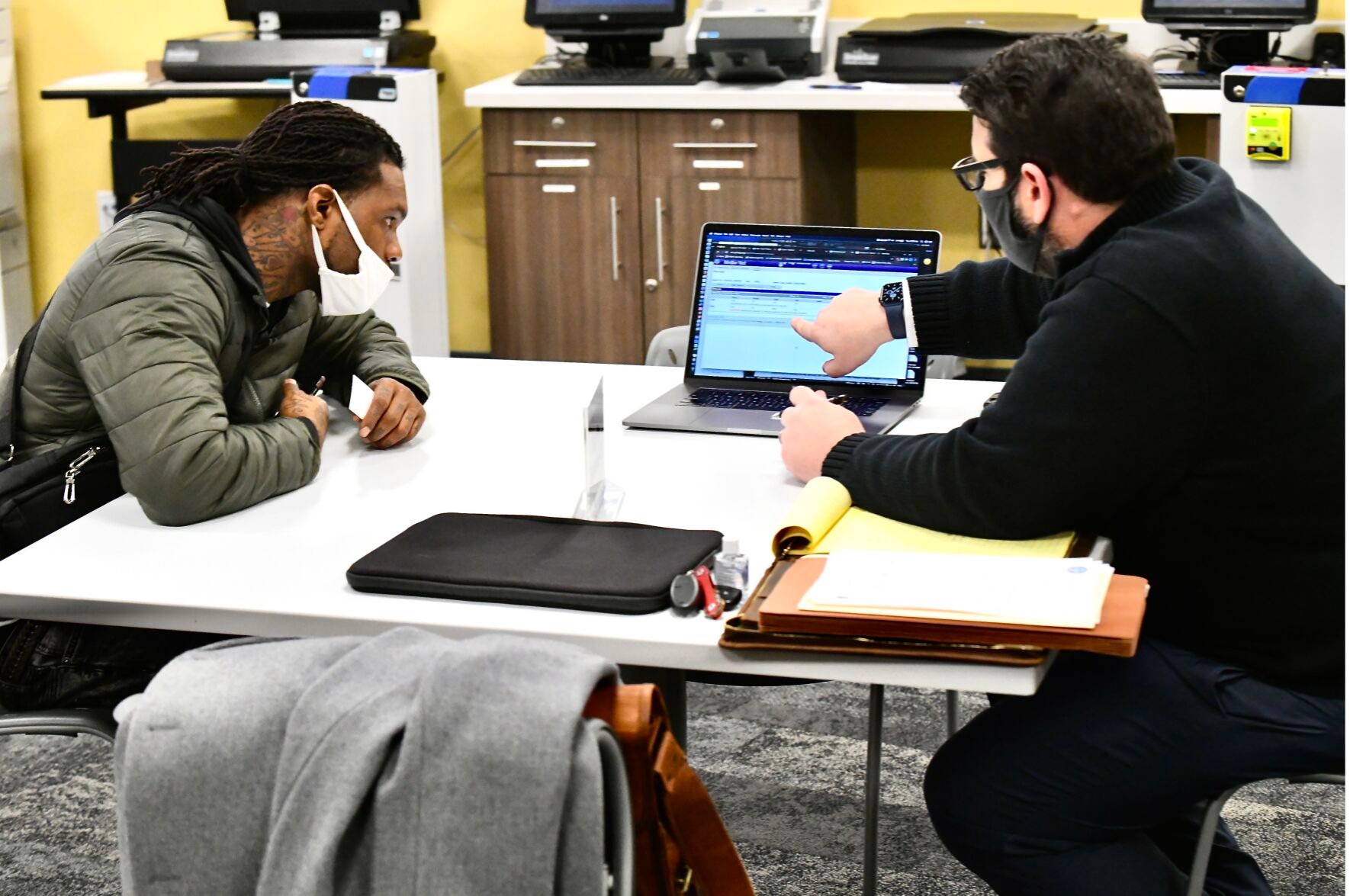
The Tap In Center is a community-based space in a public library. It’s located in a safe, neutral, calm, welcoming spot and is designed to remove barriers and worries that a person might have about going into a courthouse. It welcomes people who come in with warrant issues—people who have historically been wary about engaging with the justice system because they are afraid of, for example, serving jail time.

The center is the result of a partnership between the St. Louis County Library system, The Bail Project, the Missouri State Public Defender, and the St. Louis County Prosecutor, with support from the St. Louis County Courts 21st Judicial Circuit.

Criminal Justice reform strategies in St. Louis County go beyond the Tap In Center. They have focused on systemic case processing, including a population review team, enhanced pretrial reform, pretrial assessment, legal representation, and expedited probation handling. Each of the county’s reform strategies is meant to decrease the disproportionate burden that people of color face in the criminal justice system. St. Louis County is also advised by its own Ethnic and Racial Disparities committee, made up of criminal justice stakeholders, representatives from community advocacy groups, and individuals with lived experiences.

At the time of writing, St. Louis County had reduced the average daily population of its jail by 24% since joining the Safety and Justice Challenge in 2016. Nevertheless, racial disparities do persist. The average daily population of Black people in the jail has reduced by 15% from 2016 to 2021, according to the numbers, and the average daily population of White people has reduced by 41%. Length of stay has reduced for Black individuals who are seeing a 44% decline in the length of stay compared with 41% for White individuals. COVID has slowed progress because of court closures and other related delays. Now that things are reopening, the county is ready to continue its work.

The Tap In Center represents progress and provides motivation for the continued work to be done to address long-standing issues. We hope that other communities across the country will learn from the Tap In Center as they attempt to address their own racial equity issues and more.

Issue Brief

Behavioral Health Diversion March 3, 2022

Peer Support Roles Across the Sequential Intercept Model

This two-page graphic details examples of potential peer support roles across various points of the criminal justice system and community. It also highlights example peer-based programs in multiple jurisdictions.

Middlesex County, MA

Action Areas Behavioral Health Diversion

Last Updated

Background & Approach

The Middlesex County Restoration Center Commission was created by the Massachusetts Criminal Justice Reform Act of 2018 with the goal of researching and developing a model for diverting people with behavioral health conditions from arrest or unnecessary emergency department utilization. The Commission found that disproportionate numbers of people with mental health and substance use needs are (1) interacting with police, (2) incarcerated or detained, (3) utilizing emergency departments for behavioral health assessments even when inpatient hospitalization is not the outcome, and (4) “boarding” (waiting more than 72 hours) in emergency departments while awaiting psychiatric inpatient beds.

As a result of these findings, the Commission designed a model for a Restoration Center pilot in Middlesex County. The model seeks to address the identified gaps and needs in Middlesex County, drawing on best practices and evidence-based programming from around the country. A Restoration Center pilot in Middlesex County will seek to provide urgent and crisis care with core components including triage and assessment with medical clearance, crisis stabilization for both mental health and substance use, respite, and aftercare planning including case management and social determinants of health navigation. The Commission and its partner, Commonwealth Medicine, now seek to identify additional sources of funding and procure a vendor to launch a pilot Restoration Center.

Lead Agency

Middlesex Sheriff’s Office and Massachusetts Association for Mental Health

Contact Information

Chelsea Thomson
Health and Justice Policy Associate, ForHealth Consulting/Middlesex County
Chelsea.Thomson@umassmed.edu

Partners

Massachusetts State Senate Office of Senator Cindy Friedman; Massachusetts State General Court Office of State Representative Kenneth Gordon; Massachusetts Association for Behavioral Healthcare; Bedford MA Police Department; MA Office of the Trial Court; the National Alliance for Mental Illness (NAMI) Massachusetts; Massachusetts Executive Office for Health and Human Services; Massachusetts Department of Mental Health; Massachusetts Bureau of Substance Addiction Services

West Texas Centers, TX

Action Areas Behavioral Health Diversion

Last Updated

Background & Approach

West Texas Centers (WTC) is a community mental health center located in Big Spring, Texas. Since its inception in 1997, WTC has provided mental health services for individuals in 23 counties covering an area of 25,000 square miles.

West Texas Centers is committed to working with local governments to decrease the population of people with mental illness in our jails.

There has been much progress so far in this effort by the implementation of our Mental Health Deputy program and our Community Mental Health Grant: Jail Caseworker program. These two programs are unique in that our mental health staff have partnered up with local Sheriff’s departments and are integrated into each other’s systems. The staff in these programs are able to be the intercepts between Mental Health and Criminal Justice.

However there are still many challenges with not having a place to divert people with mental illness away from the jails.

West Texas Centers recognizes the lack of resources in our rural communities. This challenge has created our drive to work harder with local partners and continue our quarterly Jail Diversion Committees. Our Jail Diversion Committee includes; local Sheriff’s, Jail leadership, Parole/Probation, West Texas Centers mental health and IDD key staff, Hospital representatives, local County Judges, people with lived experience (Peers), State hospital representative and VA representative. Our strategies while working with the IMPACT Network sites are to implement new programs within the intercept model to divert people with mental illness from the jails. By learning from others in the network, we can create something that fits our smaller communities.

Specifically having more specialized court dockets with training for the judges on mental health and SUD issues. West Texas Centers also would like to work with local partners to design and implement a diversion center for law enforcement to utilize when they only have one choice; the jails.

Lead Agency

West Texas Centers

Contact Information

Stephanie Tran Mental Health Counselor, Howard County Detention Center
stephanie.tran@howardcountytx.gov

Partners

Members of our Jail Diversion committees