
Research Report

Frequent Jail Users Housing Reentry November 22, 2021

Funding Housing Solutions to Reduce Jail Incarceration

Madeline Brown, Jessica Perez, Matthew Eldridge, and Kelly Walsh at The Urban Institute

As counties across the United States search for ways to reduce the oversized and racially disproportionate footprint of our criminal justice system, many are looking upstream—to housing and the evidence that connects it to economic stability and overall well-being. This report presents four approaches to housing programs and policies that show promise to reduce jail incarceration and address structural barriers, as well as funding options for such approaches. The findings are based on an extensive literature review and three private roundtables held in 2020 with practitioners, people with lived experience of jail incarceration, and subject matter experts across housing, behavioral health, and criminal justice sectors. We identified the following investment-ready approaches that should guide the use of resources—public or private—aimed at reducing the impact of the jail system: (1) provide housing without (or with few) conditions, (2) support the whole person to achieve housing stability, (3) fund multiple pathways to promote housing stability, and (4) plan for release before release.

Local Communities Are Better Placed Than Governments To Define Public Safety

By: Renita Francois

Community Engagement Housing February 15, 2021

As we consider the role of law enforcement in our communities, we must acknowledge that the police are not a one-size-fits-all solution to the myriad problems they have been empowered to solve.

Police officers should not be first responders when our loved one’s mental health is compromised, when our child has a bad day at school, when our teenager rebels, when a member of our community is unhoused, or when our neighbor is battling the sickness of substance abuse. Organizations rooted in the community already know that person by name, and we have a responsibility to invest in those organizations’ ability to respond.

In New York City, where I lead the Mayor’s Action Plan for Neighborhood Safety, (also known as MAP) we’ve had demonstrable success doing just that. I work with residents in the city’s most disenfranchised neighborhoods to develop solutions that will make them safe.

True safety lies in networks of strong community leaders, well-resourced local organizations, complete access to opportunity, a responsive government, and the realization of justice. That’s why in New York City, we’ve spent the past four years developing NeighborhoodStat, or NStat.

NStat is a process that brings together neighbors, community organizations, and agencies to support safer, more vibrant communities. The approach is grounded in the belief that public safety cannot exist without the trust and participation of the public. NStat involves these parties meeting regularly and rebuilding trust.

I have sat in on dozens and dozens of NStat conversations with Black and Brown communities, and while there are those for whom safety is very much about law and order, what is more commonly affirmed in those conversations is that safety isn’t about the absence of crime — it’s about the presence of opportunity. This video demonstrates how the process has worked in New York, and gives direct voice to those people’s concerns:

An example of the NStat process at work is in Brownsville Brooklyn, home to the most densely concentrated area of public housing in the United States. It is a vibrant, tight-knit community with a strong sense of pride, and it produces powerful and profoundly committed organizers. Conversely, residents have had to fight against deeply entrenched inequity and disinvestment, and the violence that is a by-product of that condition.

The 73rd Precinct area that includes Brownsville consistently ranks among the top precincts for crime, yet despite what’s happening around it, the Brownsville Houses, arguably through the leadership of its residents and community partners, have continued to buck the trend.

In 2019, as part of NStat, residents of Brownsville Houses noted concern with critical hotspots in their community that they deemed underutilized, poorly taken care of, and vulnerable to negative activity. They also dug into high poverty and high unemployment at Brownsville Houses that make young people vulnerable to crime. In response, residents created B-Lit, an innovative lighting series that included activating public spaces at night-time.

Here’s a picture of the B-Lit project:

The series also offered programming that included a community poetry night titled Poetic Justice; a roller-skating event called Swervin; an employment expo for residents; and a performance of “King Lear” followed by an interactive, guided conversation on about caregiving and death. In each case, the community activated the shared space for a neighborhood event.

Overall, Brownsville Houses have experienced notable declines in major and violent crime and exhibited an almost 87% decline in shootings — the most significant decrease of all developments that are part of the Mayor’s Action Plan for Neighborhood Safety since its launch in 2014.

The NStat process is not a perfect solution to every public safety challenge, but it does strive to serve as a mechanism for residents to achieve their vision of safety for their own communities.

Behind the strategy is the belief that if we really want to understand how to undo the structural damage that has destabilized communities of color, then the government must come down from its ivory tower and take a seat at the people’s table.

A 2019 report from the Center for American Progress noted about NStat that “while this approach may seem like a radical departure from traditional policing-focused methods of crime reduction, the model is firmly grounded in evidence on the factors that influence neighborhood safety.” It also found that because NStat focuses on “micro-level communities,” jurisdictions of all sizes seeking to address public safety through community investment can learn from it.

Crime is an outcome. It’s the product of centuries-long, government-backed structural inequity, disinvestment, and dehumanization. It should not be a surprise that neighborhoods with the least amount of government dollars flowing into the community, the lowest rates of educational attainment, minimal access to fresh food, and the highest rates of incarceration and chronic disease also have the highest crime rates. This is what systemic inequity looks like.

The days of using conditions that the government helped create as an excuse to over police neighborhoods are over. We can no longer strip entire neighborhoods of resources and tell residents to build a future with broken tools. It’s past time to divest from punitive enforcement and invest in well-being and opportunity. The time for communities to self-determine their own safety is now.

Renita Francois is the Executive Director, Mayor’s Action Plan for Neighborhood Safety in New York City


Breaking The Cycle Of Homelessness And Jail

By: Madeline Bailey

Crime Housing Pretrial August 12, 2020

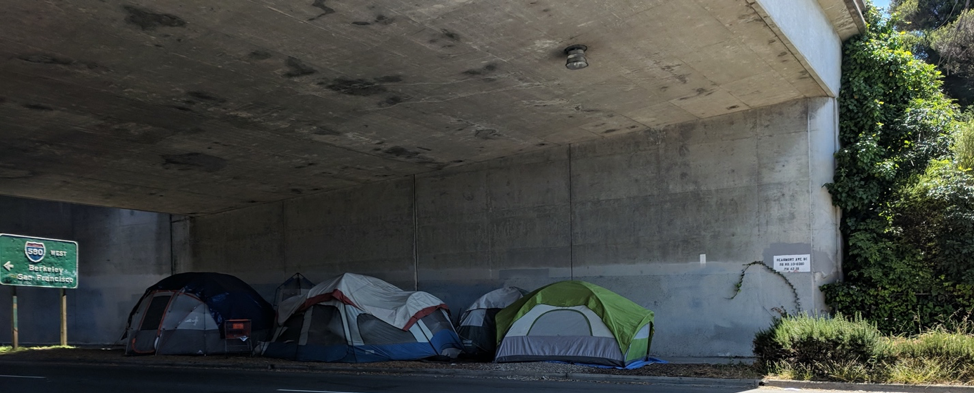
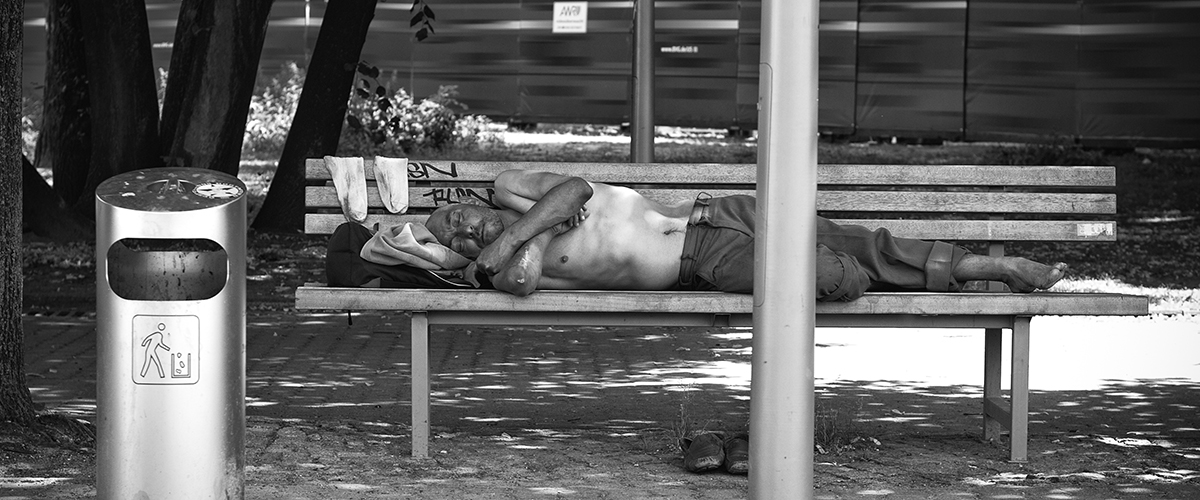
On any given night in the United States, more than 550,000 people are experiencing homelessness. Among these, 96,000 are chronically homeless, meaning they are facing long and repeated episodes of homelessness that make it increasingly difficult to return to housing. This crisis is perpetuated by a legal system that criminalizes survival behaviors associated with homelessness, fails to account for the ways in which people who are homeless face impossible odds within the legal process, and then releases them back into the community with even more obstacles than they faced before.

The time has come for local justice systems to take immediate action to halt the cycle of homelessness and jail incarceration.

This must begin with acknowledging the harms perpetuated by the current system, addressing deepening racial disparities, and enacting urgently needed changes to policies and practices.

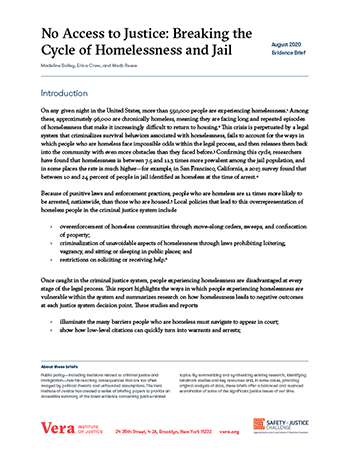
That’s the crux of a new evidence brief issued this week by the Vera Institute of Justice—strategic allies to the Safety and Justice Challenge.

In the brief, we examine how the overenforcement and criminalization of homelessness exposes unhoused people to frequent police contact and citations for unavoidable aspects of homelessness, such as camping outside or soliciting help. For people lacking a stable income, housing, or a reliable mailing address, unpaid fines and missed court dates can quickly trigger warrants and arrests. Once caught in the system, people without housing face a higher likelihood of pretrial incarceration and increased vulnerability to conviction, leading to longer periods in jail.

After release from jail, increased obstacles and restrictions make it even harder to find safe housing, employment, and overall stability—leaving many recently released people with no realistic option for avoiding homelessness.

Confirming the cycle, researchers have found that homelessness is between 7.5 and 11.3 times more prevalent among the jail population. Because of punitive laws and enforcement practices, people who are homeless are 11 times more likely to be arrested, nationwide, than those who are housed.

Without legal and policy changes, the cycle of homelessness and jail will persist, and will deepen already existing racial disparities within the criminal legal system. Research has shown that Black people make up more than 40 percent of America’s unhoused population, despite constituting only 13 percent of the general population.

The evidence establishing the link between homelessness and jail incarceration demands further research and highlights the urgent need for alternative approaches.

The most humane way to stop the cycle of homelessness and jail is to provide safe and stable housing for all. But, as some jurisdictions are starting to recognize the urgency of stopping this cycle, local justice system stakeholders have begun implementing smaller solutions that offer people experiencing homelessness a way to avoid the devastating consequences of the criminal legal system, while also allowing communities to free up system resources for other purposes.

Our brief offers several strategies for breaking the cycle of homelessness including:

  • Eliminating harmful city ordinances that target elements of homelessness
  • Halting the issuance of warrants for quality of life offenses
  • Forgiving legal fines and fees for people experiencing homelessness
  • Reforming probation and parole procedures to support people without stable housing
  • Addressing housing and employment restrictions for justice-involved people

Especially in a year when the United States is weathering an unprecedented public health crisis, it is more important than ever to examine the systems that make communities most vulnerable and to implement alternatives that prioritize safety, health, and justice for all.

Madeline Bailey is a Program Associate with the Vera Institute of Justice

Research Report

Housing August 12, 2020

No Access to Justice: Breaking the Cycle of Homelessness and Jail

Madeline Bailey, Erica Crew, and Madz Reeve (The Vera Institute of Justice)

The time has come for local justice systems to take immediate action to halt the cycle of homelessness and jail incarceration.

Breaking the Cycle of Incarceration and Homelessness

By: Bert Winkler

Collaboration Courts Housing March 2, 2018

Palm Beach County, like many jurisdictions across the country, faces numerous challenges as it seeks to safely reduce its jail population. One of these challenges is addressing the “frequent users” of our system—people who cycle in and out of our county’s jail, hospital, and behavioral health systems. Many of these people are experiencing their own challenges, including housing instability and mental health problems. County leaders recognize that without addressing these issues—poverty, instability, and untreated mental health conditions—we will never address overuse of our local jail.

Palm Beach County also has a long history of collaboration in addressing challenges within the criminal justice system. Our Criminal Justice Commission was created in 1988 and has regularly gathered key system players around the table to bring meaningful improvement and reform to areas such as pretrial services, pretrial diversion, and reentry, among others. We were able to draw upon this history of collaboration as we worked together to develop responses to our county’s frequent system users. Through this process, we created the Palm Beach County FUSE Project (PBC FUSE), which we plan to implement this year.

FUSE is an acronym for Frequent Users System Engagement, a model for addressing homelessness among our most vulnerable individuals. It was developed by the Corporation for Supportive Housing (CSH), a national organization based in New York City, and has now been adopted by more than 20 jurisdictions around the country, including Mecklenburg County, North Carolina and Harris County, Texas, which are also part of the Challenge Network. The goal of FUSE is to break the cycle of incarceration and homelessness by providing stable housing to people who are identified as the most frequent users of jails, homeless shelters, behavioral health crisis services, and hospitals in Palm Beach County.

Implementation of PBC FUSE will reduce our local jail population by decreasing recidivism among program participants. Concurrently, it will lead to an increase in housing stability and a decrease in reliance on multiple crisis services. Permanent supportive housing is a key factor in decreasing a person’s  involvement with the criminal justice system. Nothing stabilizes a person in crisis more than having a home—particularly when necessary services are provided as well.

FUSE participants are identified through data matching. The PBC FUSE Policy Team will develop a list of individuals who were arrested three or more times in the past year. We will then match that list with our homeless and behavioral health crisis centers’ patient lists. (Hospital data will be added later.) After an initial list is developed, these people will be located through a process of “inreach” (homeless shelters, jails, and hospitals) and outreach (streets and parks). Case managers will enlist and engage participants and place them in permanent supportive housing. The managers will then coordinate the procurement of any necessary services. This may include physical and behavioral healthcare (including therapy and treatment), transportation, job training, obtaining identification documents, and accessing benefits.

There has been strong support for PBC FUSE throughout the community from the beginning. Participating organizations are enthusiastic about the project and committed to its success. These include the Criminal Justice Commission, PBC Human Services Department, City of West Palm Beach, Public Defender, State Attorney, Southeast Florida Behavioral Health Network, individual behavioral healthcare providers, agencies that provide housing and services for the homeless, and two of our local hospitals. In addition to the generous funding we’ve received from the John D. and Catherine T. MacArthur Foundation’s Safety and Justice Challenge, we are working with a local foundation which is supportive of the project. We have also been the recipient of local and federal government dollars. The Lord’s Place, a leading agency working with the homeless in our county, recently received a major HUD grant providing for fifteen individual housing units which will be prioritized for our FUSE participants. We will have an initial pilot project serving 25 individuals in 2018 with plans to expand to 100 individuals within two years.

All our stakeholders are working together to identify PBC FUSE participants and help them stabilize and improve their health and their lives. The unique nature of the FUSE project is a key factor in enabling us to maintain collaboration, enthusiasm, and commitment. FUSE cuts across four major crisis systems: criminal justice, homelessness, behavioral health, and physical health. A successful FUSE project can help numerous individuals reclaim their lives. But there is an additional benefit which makes FUSE attractive to stakeholders. It can produce tremendous cost savings. If participants are able to be housed and stabilized, then jails, hospitals, behavioral health crisis centers, and homeless agencies can save a great deal of money as these individuals will no longer be cycling through their doors.

After months of planning, PBC FUSE is nearing the implementation phase. We are optimistic that our efforts will lead to success for both individuals and the community at large.