Polk County, IA

Action Areas Behavioral Health Community Engagement Diversion

Last Updated

Background & Approach

Polk County in south-central Iowa is the state’s most populous county and the home of the state capitol, Des Moines. Polk County expanded the Crisis Intervention Team (CIT) training program to better prepare patrol officers to respond to mental health crises and divert people to treatment, rather than arresting them. Officers were trained to be CIT trainers, several sessions were held to train seasoned officers, and new officers received training at the Iowa Law Enforcement Academy Basic Academy to better understand mental health symptoms and available community resources. The Ankeny Police Department also implemented a Community Engagement Team where CIT-trained officers could follow up on all mental health calls for service. They now check in with individuals and provide a warm hand-off to mental health services and supports. Polk County’s quarterly meeting brought together law enforcement agencies, behavioral health providers, and crisis services providers to discuss successes, resources, and barriers. It also allowed trusting relationships to grow between all of these agencies working together to redirect people away from the criminal justice system and toward the services they need.

Polk County continues to engage with the Safety and Justice Challenge Network to rethink and redesign its criminal justice system so that it is more fair, just, and equitable for all.

Lead Agency

Polk County Health Services

Contact Information

Annie Uetz

Partners

Polk County Sheriff's Office, Ankeny Police Department, Des Moines Police Department, Des Moines Fire Department, Broadlawns Medical Center, NAMI of Greater Des Moines, Primary Health Care, Community Support Advocates, Polk County IT, Polk County Board of Supervisors, Polk County Criminal Justice Coordinating Council

Follow @PolkCounty_Iowa

Blog Posts

Dane County, WI

Action Areas Community Engagement Diversion Young Adults

Last Updated

Background & Approach

p>Dane County, located in the southern part of the state, is the second-most-populous county in Wisconsin and encompasses the city of Madison and the surrounding region. Dane County increased the use of restorative justice through its Community Restorative Court (CRC), whose mission is “Repair Harm, Reduce Risk, and Rebuild the Community.” The CRC focused specifically on diverting more youth ages 17-25 from the traditional criminal justice system. Participating in the program provides a young person who has committed a low-level offense the opportunity to work with community members (who are trained as peacemakers) to ensure accountability, determine restitution, and repair the harm done. The CRC also provides wraparound social services to respondents and a voice to victims. Dane County expanded the CRC by training and onboarding more community peacemakers and law enforcement departments.

The Criminal Justice Council also hosted community meals and conversations for individuals interested in learning more about the pretrial justice system in order to create a necessary link between criminal justice leaders and those with lived experience. Not only did this bring together members of the community and criminal justice stakeholders to share a meal, but it also helped community members have a voice in work moving forward. Their questions provided critical insight into the creation of a pretrial data model.

To meet the needs of individuals with behavioral health challenges within the criminal justice system, Dane County also developed a Sequential Intercept Model (SIM) project to find opportunities for services and ways to divert those individuals out of the criminal justice system.

Dane County also found ways to collaborate and share data across the Dane County criminal justice system, ensuring that policy makers could use accurate data to inform better decision-making. In addition to the executive level Criminal Justice Council, the county supports three subcommittees to better tackle their goals: the Racial Disparities Subcommittee, the Pretrial Reform Subcommittee, and the Behavioral Health Subcommittee.

Dane County continues to engage with the Safety and Justice Challenge Network to rethink and redesign its criminal justice system so that it is more fair, just, and equitable for all.

Lead Agency

Dane County Criminal Justice Council and Community Restorative Court

Contact Information

Colleen Clark-Bernhardt

Partners

Community Peacemakers, CRC Advisory Board, Peacemaker Committee, CJC-Racial Disparities Subcommittee

Follow us:

Blog Posts

Camden County, NJ

Action Areas Collaboration Community Engagement Reentry

Last Updated

Background & Approach

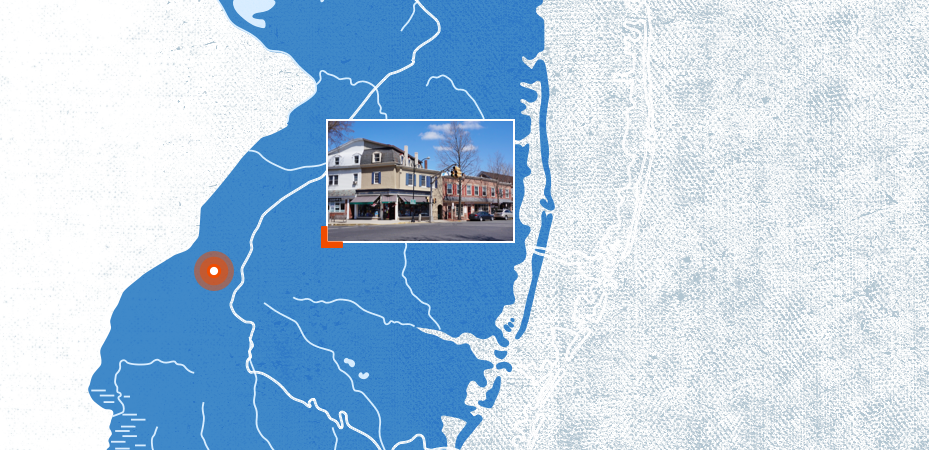
Camden County, located in southwestern New Jersey, built a comprehensive community engagement strategy that links and coordinates criminal justice, public health, social services, private entities, and formerly incarcerated people to address the needs of the jail reentry population. The team of NuEntry Opportunity Specialists (NOS), made up of people with lived experience, now successfully bridges the divide between the system and the community. From “meet them at the gate” initiatives to helping people find IDs, clothes, furniture, and other essentials, NuEntry Opportunity Specialists serve at every step of helping people return home to the community and prevent recidivism.

Camden County continues to engage with the Safety and Justice Challenge Network to rethink and redesign its criminal justice system so that it is more fair, just, and equitable for all.

Lead Agency

Camden County Department of Corrections

Contact Information

Sharon Bean
sharon.bean@camdencounty.com

Rosy Arroyo
rosy.arroyo@camdencounty.com

Partners

NuEntry Opportunity Specialists (NOS) and the Camden County Reentry Committee

Follow us:

Data Shows Violent Crime Is Down and Decarceration Works

By: Wendy Ware

Community Engagement Data Analysis Diversion June 22, 2021

The Safety and Justice Challenge (SJC) has been making considerable, steady progress in safely reducing jail populations over the last few years. But the recent COVID-19 pandemic put a lot of these initiatives into overdrive, creating historic, sudden drops in jail populations all over the country.

Recently, you may have been reading in the press that there is a “crime wave” going on, and that it is related to either the COVID-19 pandemic, related lockdowns, protests, defunding the police, or social unrest.

These articles contain a lot of misinformation about crime rates, whether they are increasing or not, and what is causing them to change.

First, it is important to note, there is no “crime wave”. Second, while there has been a short-term increase in homicides, those increases cannot be linked to drops in the jail populations.

It is incorrect to link de-incarceration efforts to short-term crime trends.

Too often in criminal justice reform, people have a pre-determined narrative in their heads. It is easy for some people to push a “lock-‘em-up” agenda because it stokes fear, sells headlines, and baits clicks. These narratives often rely on cherry-picked data to fit their needs.

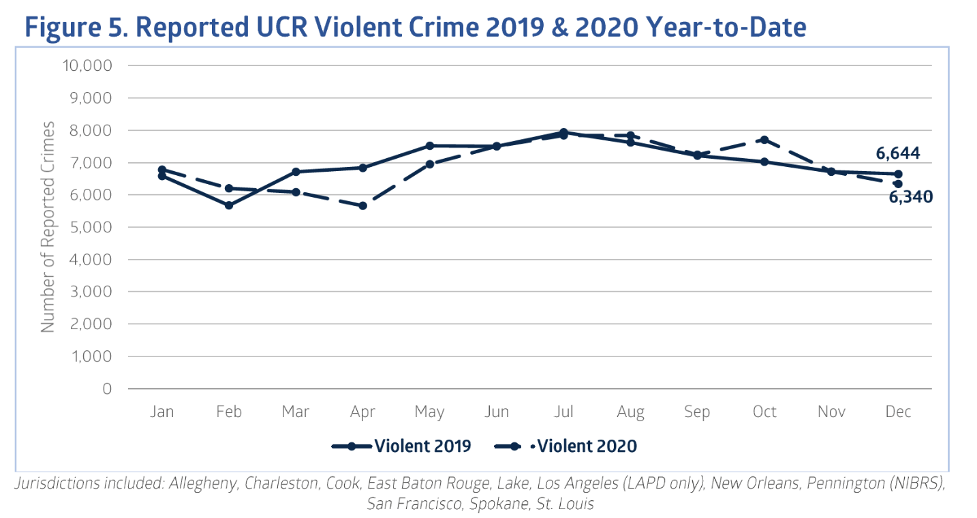
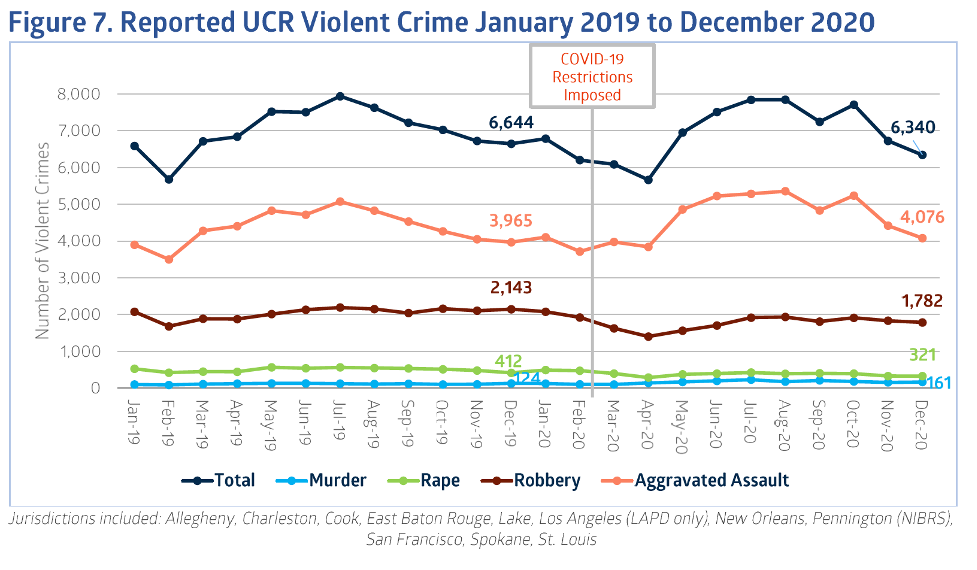
But the SJC has always been a data-driven initiative. It is important to always let the data speak first, investigate causation, and then, and only then, develop policy. A recent JFA Institute report, based on data from 11 SJC cities and counties, draws some key conclusions regarding recent jail population and crime trends. Amongst our conclusions is that crime as reported to police in general and violent crime in particular are not up across those jurisdictions.

It is wrong, therefore, to say “violent crime is spiking”.

“Violent crime” as categorized by the FBI under the UCR system (Uniform Crime Report) is made up of four crime types: homicide, rape, robbery, and aggravated assault. In our report on 11 cities and counties, there was a short-term increase in homicides reported, representing a 45% increase from 2019 to 2020. This on the surface seems dramatic, but it is important to put this finding in context. Homicide is the rarest of all crimes and represents a small portion of the totality of violent crime. Homicides represent an even smaller portion of total crime, making up only .05% of the total crimes reported in December 2020. Further, in terms of the context of historical crime rates, the number of crimes committed each year are way down over the long term:

Much more time is needed before any credible scientist would say there is a trend.

Perhaps more important, it’s clear that jail de-incarceration has no causal link to crime trends.

Among our key findings:

  • Analysis of the eleven cities and counties studied revealed jail populations declined, yet crime and arrests declined as well, giving indication that declining jail populations did not compromise public safety.
  • Overall, total reported crime was 22% lower in December 2020 when compared to December 2019 and 14% lower for the total number of reported crimes for Calendar Year (CY) 2020 versus CY 2019.
  • When combining all jurisdictions. there was an average 39% decrease in jail bookings, which equates to over 130,000 fewer jail bookings in a one-year time frame. Jail booking decreases were fueled by the decrease in property crime and arrests, primarily for misdemeanor and lower-level felony charges.
  • As a result of the change in jail bookings, the composition of the jail populations changed post-COVID-19, with a higher proportion being male and charged with violent felony and non-drug felony crimes.
  • The length of stay for people in jail has increased due to the changing make-up of the jail populations and a slowdown in court case processing.
  • After the historic initial decrease, jail populations rebounded somewhat, but stabilized in October 2020. During this time, there was no substantial increase in overall crime.

The report expands on our preliminary report issued in December 2020, which focused on the Impact of COVID-19 on crime.

COVID-19 created the most dramatic decrease in jail populations, over the shortest amount of time in modern history. The pandemic gave us an opportunity to rethink old practices and consider changes for the longer term.

The data we produced should be used to start a conversation on how and why some specific crime types did increase in the time frame studied. And we should consider how to combat that, smartly. Answers include improving community relationships and cohesion, better community policing, and violence de-escalation initiatives.

At this time, we must resist short-term narratives that do not match the data. It critically important now and should be a lesson learned we can apply to the future sustainability of criminal justice reforms, both within the Safety and Justice Challenge and elsewhere.

Jail Decarceration and Public Safety: Preliminary Findings from the Safety and Justice Challenge

By: Reagan Daly

Community Engagement Diversion Jail Costs June 22, 2021

America’s over-incarceration problem begins in our local jails. Each year, there are close to 11 million jail admissions in the United States, nearly 18 times the number of yearly admissions to state and federal prisons. In many regions, jail populations have reached crisis levels.

The primary purpose of jails is to detain people who are awaiting court proceedings and are considered a flight risk or public safety threat. Many people admitted to jail cannot afford to post bail and may remain behind bars for weeks, months, or even years awaiting trial or case resolution. Our over-reliance on jails has negative consequences for people who are incarcerated, their families, and communities. Burdens of jail fall disproportionately on communities of color. Black Americans, for example, are jailed at five times the rate of white Americans and comprise a proportion of the jail population that is three times their representation in the general population.

In response, the MacArthur Foundation launched the Safety and Justice Challenge (SJC) in 2015, and has so far invested $252 million in the effort. Its aim is to help create fairer, more effective justice systems on a large scale.

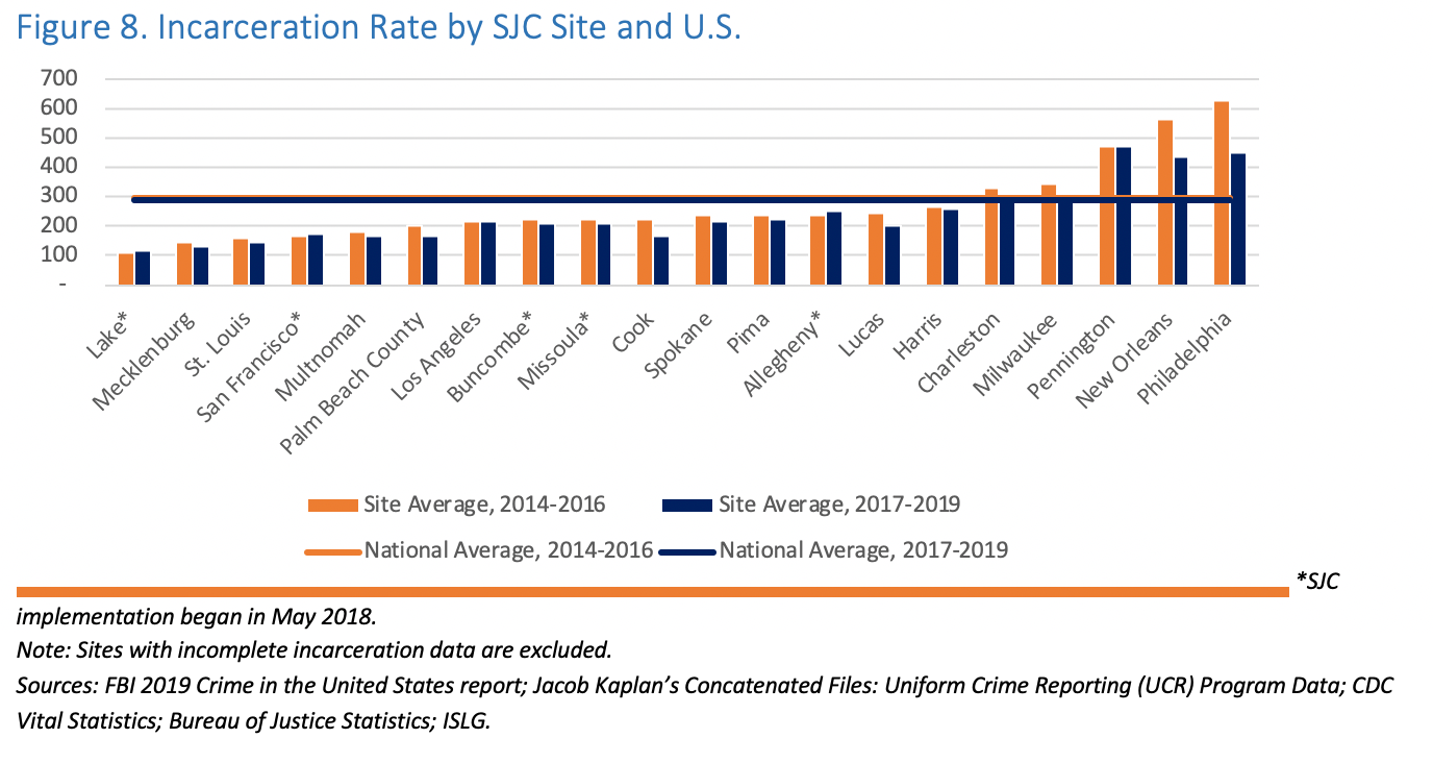
The goal of the SJC is not just to reduce jail populations, but to do it safely – this has been a pillar of the initiative since its inception. Our previous research has highlighted the substantial reductions made in jail populations across SJC sites since 2015. But our new report provides an initial look at those decarceration strategies through a safety lens. More specifically, it explores how both aggregate crime rates and returns to custody among people released from jail changed after the launch of the SJC and the implementation of decarceration strategies in sites through 2019.

Reducing Jail Populations Without Compromising Public Safety  

Our latest analysis runs through 2019 and explores how crime rates changed after the launch of the SJC. It also analyzes returns to custody among people released from jail. We will explore COVID-19’s impact in future briefs.

Our analysis should be viewed as a first step towards assessing decarceration and public safety. Our measures rely on administrative data from criminal justice agencies, and as a result are reflective of the justice system’s responses. Future stages of our work will aim to explore public safety in a much more nuanced manner. For now, our goal is to lay a broad foundation of understanding about the trends we are seeing.

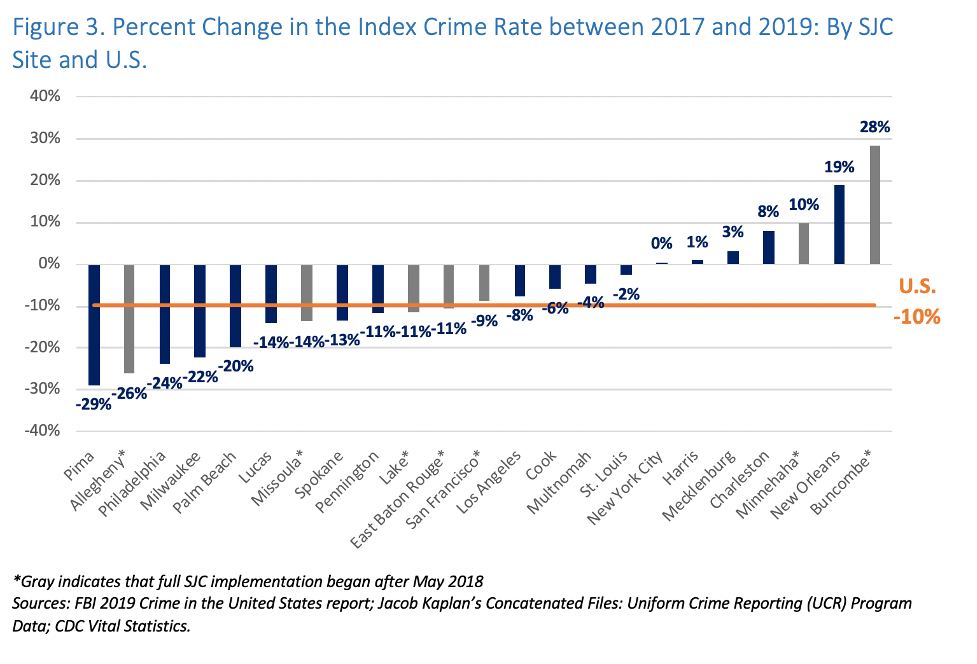
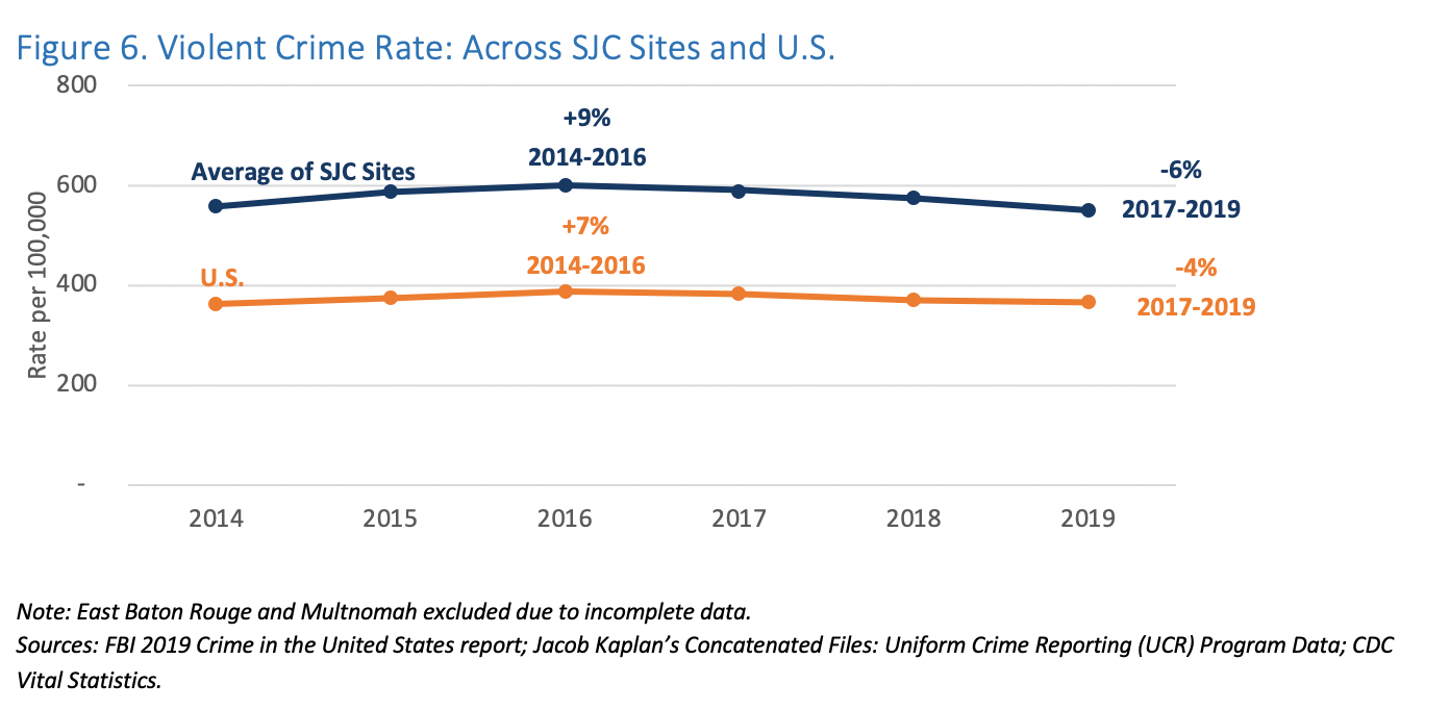
Findings suggest it is possible to craft decarceration strategies without compromising public safety. In fact, our measures of public safety across SJC sites remained about the same before and after reforms were implemented to reduce local jail populations.

Local Crime Trends Remained Stable or Decreased in Most SJC Sites
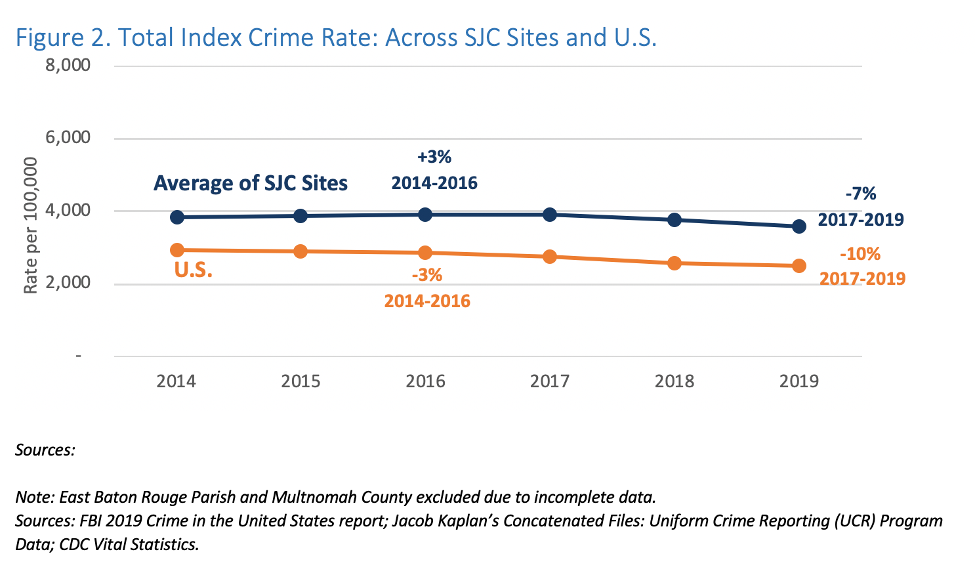
During the first few years of SJC implementation, 11 sites experienced a reduction in index crimes greater than 10 percent. The majority (19) either experienced some decrease or remained the same.
The Rate of Returning to Jail Custody Was About the Same

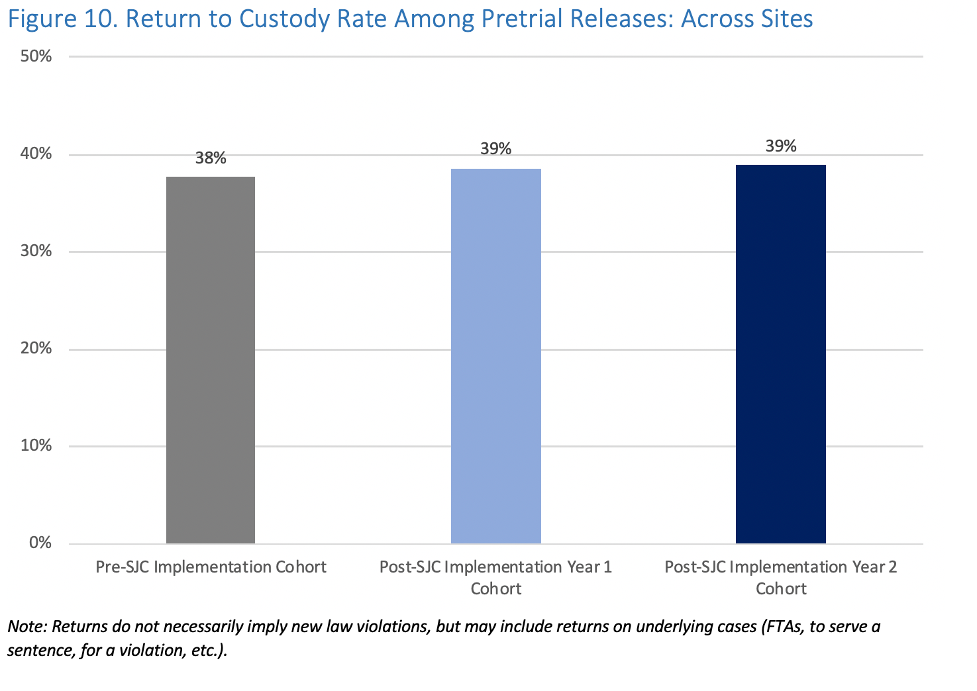
Among individuals released from jail pretrial, return to custody rates for felonies, misdemeanors, property crimes, and violent crimes within a year remained about the same.

Being returned to custody on a violent charge was rare before and after SJC implementation; being returned on a homicide was very rare. Most individuals who returned to custody within a year did not return on a more serious charge.

Regardless of the specific charge type, return to custody rates among those released pretrial did not change after the implementation of decarceration reforms began.

Prior to the implementation of SJC jail population reduction strategies, 38 percent of people released on pretrial status were returned to custody within 12 months of their release. (Note that our return to custody measure includes returns for reasons other than a new criminal charge—future work will focus more narrowly on returns that involve new charges.) This remained true in the years following SJC implementation – of those released pretrial in the second year of the SJC implementation, 39 percent returned to custody within a year. The vast majority of sites did not experience an increase in the return to custody rate after SJC implementation began.
Conclusions

The findings of this analysis suggest that decarceration efforts in SJC sites did not endanger public safety as measured by crime rates and returns to custody. As incarceration rates declined during the SJC, crime and violent crime rates also dropped or remained the same in most sites, mirroring national crime rate trends. When examining individuals who were returned to jail custody within a year of release, the rates of return were about the same before and after the SJC – suggesting that decarceration efforts, especially among the pretrial population, do not lead to a higher rate of returns. Importantly, returns to custody for violent crime charges and homicide charges were rare before and after the SJC. Of course, our measures are not inclusive of all definitions of public safety. Future work will examine the public safety implications of the SJC more comprehensively.

More on the Data

SJC sites share jail population data once a month with the Institute for State and Local Governance (ISLG) at the City University of New York (CUNY). A subset of sites submit detailed case-level jail data to ISLG once a year. We sourced crime data from the FBI 2019 Crime in the United States report.