
Implementation Guide

Behavioral Health Data Analysis Frequent Jail Users Incarceration Trends March 3, 2024

Creating Data-Informed Strategies to Understand the Needs of People in Your Jail

This publication delineates the importance of collecting and analyzing health-related and other disaggregated data within jails to address the complex needs of incarcerated individuals. As a how-to for jurisdictions seeking to improve outcomes through these means, the guide outline steps for integrating data from jail management and healthcare systems, conducting landscape scans, and developing data-sharing agreements to inform policies and improve outcomes.

Issue Brief

Behavioral Health Disability Frequent Jail Users Housing July 25, 2023

Recommendations To Reduce Frequent Jail Contact

Sarah L. Desmarais, Brandon Morrissey, Lisa Callahan, Samantha A. Zottola, Jen Elder, Kristin Lupfer, Elan C. Hope, & Richard A. Van Dorn

Although most jail admissions represent the only contact a person will have with the criminal legal system, there is a small group of people who experience more frequent jail contact and who represent a disproportionate number of both jail admissions and expenditures.1,2 People with frequent jail contact experience complex, interconnected social, economic, and behavioral health needs that may exacerbate (or be exacerbated by) their frequent jail contact. This group also experiences frequent contact with other services in the community, such as emergency rooms, homeless shelters, and treatment facilities. Strategies to implement services that meet complex needs and address structural barriers are critical to meaningfully and sustainably reduce system involvement among the population of people who experience frequent jail contact.

Effective change for people with frequent jail contact must proceed simultaneously on a systemic, policy level and on the individual services level. The population discussed in this policy brief typically has complicated behavioral and medical health needs, extensive criminal legal encounters, and significant social deficits such as poverty, isolation, and elevated risk of being unhoused. Many of their needs can be addressed with intensive, person-centered treatment in a coordinated continuum of care. The success of community-based solutions is supported by three foundational elements:

  1. A systemwide examination of structural barriers and opportunities,
  2. A focus on policies to effectively implement and support evidence-based interventions, and
  3. A re-envisioning of how the behavioral health and criminal legal systems can coordinate trauma-informed responses for people with frequent jail contact.

-----

1 Elsa Augustine and Evan White, High Utilizers of Multiple Systems in Sonoma County 1-31 (2020), https://www.capolicylab.org/wp-content/ uploads/2020/07/High-Utilizers-of-Multiple-Systems-in-Sonoma-County.pdf.

2 Ross MacDonald, Fatos Kaba, Zachary Rosner, Allison Vise, David Weiss, Mindy Brittner, Molly Skerker, Nathaniel Dickey, and Homer Venters, The Rikers Island Hot Spotters: Defining the Needs of the Most Frequently Incarcerated, 105 American Journal of Public Health 2262–2268 (2015), https://doi.org/10.2105/AJPH.2015.302785.

Additional Downloads

Reducing Frequent Jail Contact to Lower Jail Populations

By: Sarah Desmarais, Samantha Zottola

Data Analysis Frequent Jail Users Incarceration Trends July 25, 2023

If they go to jail at all, most people in America only do so once. But in communities across the country, there is often a small group of people who account for a large number of jail admissions. They also account for a large portion of total jail expenditures. A new two-year research project sought to better understand this population in three communities and makes policy recommendations from which others can learn. The John D. and Catherine T. MacArthur Foundation funded the study as part of their Safety and Justice Challenge, which seeks to reduce jail populations.

How Did the Researchers Work and What Did They Find?

The study incorporated quantitative and qualitative methods. Researchers drilled into at least eight years’-worth of data from each of three communities to identify and describe the population of people with frequent jail contact. They also conducted interviews with 27 practitioners across a range of service sectors and 23 people with lived experience. Finally, they used both the quantitative and qualitative data to examine the strategies used by each community participating in the study to reduce jail contact.

The research found people with frequent bookings accounted for about one-half of all the bookings that occurred during the study period. Across communities participating in the study, people with frequent jail contact account for a majority of bookings, but account for a minority of the people booked. People of color and people with behavioral health needs are overrepresented. The study’s findings also emphasize complex interrelationships between race and ethnicity, gender, and behavioral health needs. They point to potential disconnects between the perceived and actual characteristics of people with frequent jail contact.

Different communities used different strategies to aid people with frequent jail contact but most did not have strategies intended for that exclusive purpose. Rather, they implemented strategies intended to aid everyone. All participating communities selected diversion strategies for people with behavioral health conditions as their primary intervention for the study’s focus. And the study found that behavioral health diversion strategies may improve outcomes for people with frequent jail contact. More broadly, the study findings underscore the importance of comprehensive community-based resources to support the success of behavioral health diversion programs. Findings also show the need for strategies that cross many systems and levels of policy and practice.

Policy Recommendations

Based upon the study findings, the researchers have nine policy recommendations:

  1. Create a Data Sharing Ecosystem

To meet the complex needs of people with frequent jail contact—especially individuals with behavioral health challenges—criminal legal and behavioral health systems need a common data sharing language and platform. Ideally, the common language and platform would extend to other systems as well, such as social and emergency services.

  1. Establish Formal, Jurisdiction-Specific Definitions

Jurisdictions should develop formal definitions or criteria to support the consistent operationalization and identification of people with frequent jail contact. These definitions should drive the development and implementation of related policies.

  1. Use Validated Behavioral Health Screening Tools

Consistent with the standards for health services in jails and prisons, universal screening using validated screening tools should take place during the intake process at each door into and away from the criminal legal system.

  1. Implement Psychiatric Advanced Directives

Psychiatric advance directives are intended to enable self-determined treatment, and effective and clear communication from a past and competent self, for individuals who are at risk of losing decisional capacity at some point in the future.

  1. Facilitate Jail In-Reach Programs

Trust and engagement are key to successful reentry for people with frequent jail contact. Jail in-reach programs allow practitioners to meet with people in the jail before release, assess their needs when back in the community, develop a plan to meet those needs, identify how community providers can assist, and provide coordinated support as people transition into the community.

  1. Increase Peer Support Programs

Peer support programs should be a key feature of policies designed to reduce frequent jail contact. While the focus is typically on lived experience with behavioral health systems, people with lived experience of the criminal legal system, specifically, share a common understanding of the challenges and resources necessary for successful reentry.

  1. Improve Access to Housing

Affordable housing is scarce in most communities. Providing safe, sustainable, and supportive housing for people involved in the criminal legal system with behavioral health conditions can be a challenge, but it is critical to reducing frequent jail contact.

  1. Increase Utilization of Community-Based Services

When possible, people should be given the necessary supports in navigating the continuum of care. In addition to warm handoffs from one service provider or program to another, other examples include a shared video chat with a new provider or engaging peer support services during transitions.

  1. Center and Evaluate Efforts for Racial Equity 

Evaluations suggest that efforts to reduce frequent jail contact have had limited success in improving racial equity in this population, likely due to multiple, intersecting factors. Communities should work to mitigate systemic racism through the operations of their criminal legal and behavioral health services for people with frequent jail contact and examine the success of these efforts through formal evaluations.


Issue Brief

Collaboration Frequent Jail Users Racial and Ethnic Disparities March 3, 2023

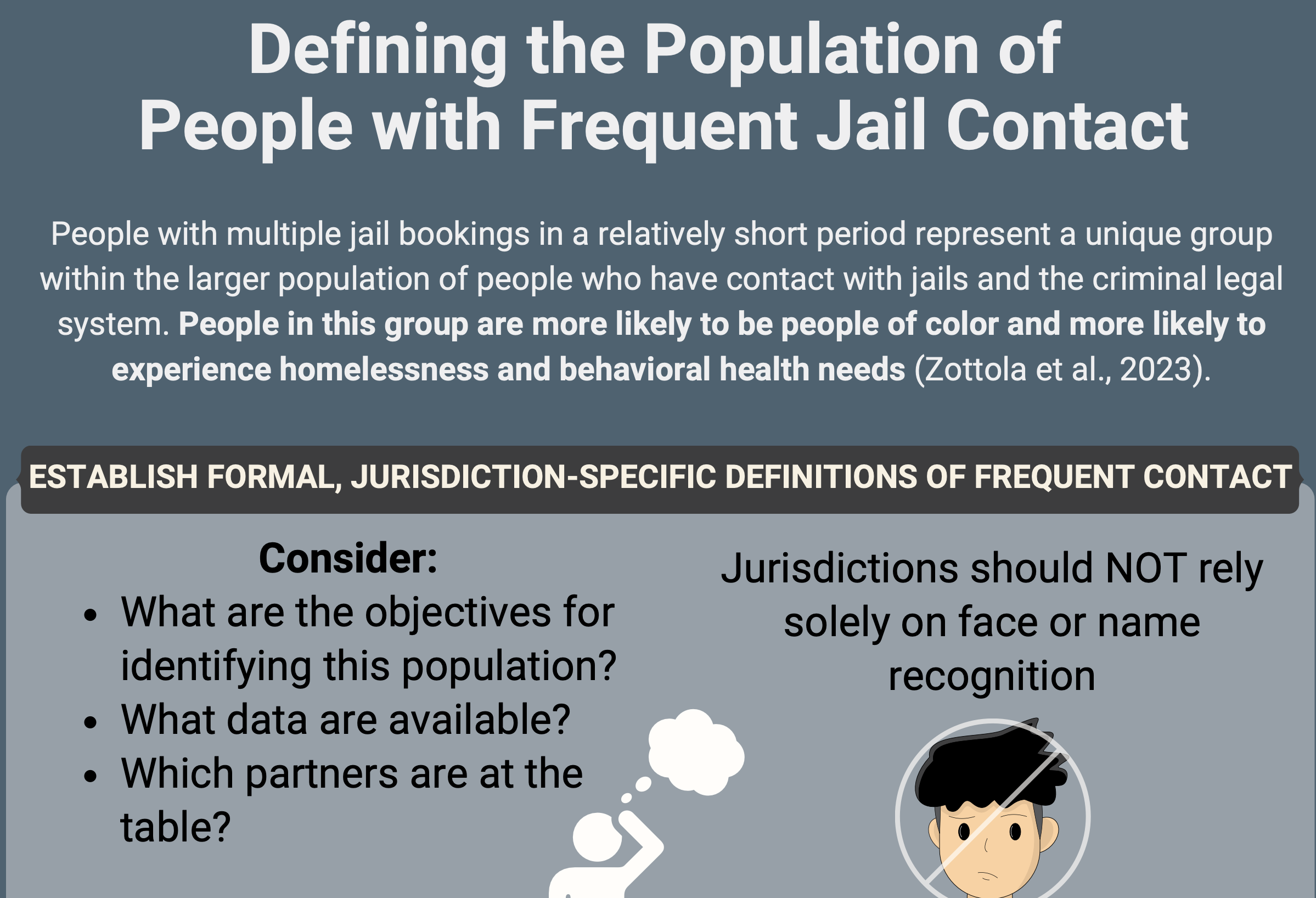
Infographic: Defining the Population of People with Frequent Jail Contact

This infographic highlights the distinct characteristics of individuals with frequent jail contact, including overrepresentation of people of color, homelessness, and behavioral health needs.

Research Report

Frequent Jail Users Incarceration Trends Probation Racial and Ethnic Disparities January 12, 2023

Probation Violations as Drivers of Jail Incarceration in St. Louis County, Missouri

Beth M. Huebner, Lee Ann Slocum, Andrea Giuffre, Kimberly Kras, and Bobby Boxerman

Many have argued that we are in the era of mass probation, as more people are under probation supervision than under any other correctional sanction. Although there have been declines in the national probation population over the past decade, one in 84 adult US residents is currently on probation. Nationwide, local jail populations have also grown—from 184,000 in 1980 to 741,900 in 2019. The increased use of probation inflates the population at risk of subsequent confinement in jail or prison. Individuals who violate their probation, in some states, are detained in jail and await a hearing. Despite the growth in probation revocations and the increased use of jail stays as a response to technical violations, however, there is little evidence to suggest that short-term stays of incarceration reduce recidivism.

Adding to the growing rate of probation is the problem of racial disparity in incarceration. People of color are disproportionately represented among the probation population. In 2018, Black people represented 30% of the US probation population, twice their proportion in the national population. Further, almost half of all young Black men (24 to 32 years old) with no high school degree reported having been on probation at some point. Black individuals, particularly young men, are also more likely than White individuals to struggle on probation and to be given multiple conditions of supervision. Although there is evidence that Black individuals are more likely to have their probation revoked, less is known about how revocation to jail influences trajectories and outcomes for this group.

Jail stays also have deleterious effects in the short and long term. For example, Harding and colleagues found that short terms of jail incarceration resulting from technical violations suppressed the earnings of individuals by about 13% in the nine months after release from custody. The churn of multiple jail stays, even if short in length, also causes strain and instability among families, leaving them feeling hopeless under the constant eye of supervision. Yet, the unique needs of jail populations overall, and those of individuals who violate probation terms, are rarely considered in correctional reforms.

Additional Downloads