City & County San Francisco, CA

Change in Jail Population 8%

Action Areas Collaboration Courts Data Analysis Diversion Racial and Ethnic Disparities

Last Updated

Background

San Francisco partners joined the Safety and Justice Challenge with a specific goal in mind: safely reduce the jail population by 16% to allow County Jail #4, long known to be seismically unsafe, to close. Prior to joining the network, San Francisco had implemented years of reforms resulting in a relatively low jail population for a jurisdiction its size. Further reducing the jail population required thoughtful partnership among criminal justice stakeholders and community leaders to address serious challenges.

In San Francisco, over 75% of people in jail have serious mental illness and/or a history of substance use, and many people cycle in and out of custody. Others end up waiting in jail pretrial for long periods of time due to delays in case processing or while awaiting referral to treatment. In 2017, individuals regularly spent up to 120 additional days in jail waiting for a treatment bed at a residential behavioral health facility in the community — five times longer than individuals who are not incarcerated. A snapshot of the jail population from 2018 showed an average length of stay of 317 days, with most individuals held pretrial.

San Francisco’s jail population was also characterized by racial disparities, with the per capita incarceration rate of Black people 17 times that of white people. Young men of color also had significantly longer stays in jail compared to white people.

Strategies

The City and County of San Francisco is advancing a number of strategies to rethink the use of jail and design a criminal justice system that is more fair, just, and equitable for all.

01

RACIAL DISPARITIES

San Francisco seeks to focus all strategies on disparities reduction. Partners convene a racial equity workgroup, develop tools to monitor disparities, and adjust strategies as needed — including new efforts to reduce pretrial detention, expand diversion, and launch a fellowship to partner with people who have lived experience.

02

SHARED FOCUS

San Francisco established a jail population review team composed of system stakeholders and community partners who meet on a regular basis to discuss case types that drive the jail population and racial disparities and identify pathways for community-based support.

03

HEALTHY CONNECTIONS

San Francisco partners have increased access to community-based supports through new positions and community partnerships and through new housing resources. Partners seek opportunities for diversion and focus on supporting people who cycle frequently in and out of jail.

04

CASE PROCESSING

Partners are working to reduce lengthy pretrial jail stays where people wait for the next step in the system. Efforts include training on case processing best practices, development of dashboards for Superior Court judges, and creation of case management tools and plans.

05

ENHANCED DATA

All efforts to make the justice system fairer and more equitable depend on data. San Francisco works to enhance transparency and data sharing across criminal justice agencies, developing public tools and reports to monitor progress across its efforts.

Results

As a result of the strategies above, the City and County of San Francisco has made progress towards its goal of rethinking and redesigning the use of its jail.

Quartery ADP for San Francisco (2018-2026)

8.4% from baseline

More Results

San Francisco has been able to reduce its jail population since joining the Safety and Justice Challenge while keeping the community safe.

As a result of these reductions, San Francisco was able to close the seismically unfit County Jail #4. The Safety and Justice Challenge partnership laid the foundation for this success and provided a space for community advocates and system partners to engage with the closure process.

The Safety and Justice Challenge has shown San Francisco what we can accomplish through shared focus, good data, strong coordination, connection to community-based supports, and close partnership with people most affected by the criminal justice system.

Remaining Challenges

San Francisco partners know there is more work to do. Partners must work to sustain jail population reductions amid the ongoing COVID-19 pandemic. System partners and community members are also committed to ending persistent racial disparities in jail, which have remained constant despite overall reductions. Partners believe that change is possible in San Francisco. Guided by ongoing analysis of data and partnership with people who have lived experience, San Francisco will continue to refine the strategies above and develop new strategies to meet shared goals.

Lead Agency

San Francisco District Attorney’s Office

Contact Information

Josie Halpern Finnerty
josie.halpern-finnerty@sfgov.org)

Tara Anderson
tara.anderson@sfgov.org

Partners

San Francisco Superior Court, The Sheriff’s Office, The Department of Public Health, The Adult Probation Department, The Public Defender’s Office, San Francisco Pretrial Diversion Project

Follow @SFDAOffice

Blog Posts

State of Connecticut

Action Areas Behavioral Health Diversion Racial and Ethnic Disparities

Last Updated

Background

Connecticut is one of a handful of states that fund and administer jails and other core criminal justice functions at the state rather than the local level. Jails in Connecticut were taking a particularly heavy toll on people of color. The state saw wide racial and ethnic disparities within its population—in New Haven, African Americans made up 33% of the population but 56% of custodial arrests. Similar disparities were found in Bridgeport and Hartford.

Another concern for the state was the average length of pretrial detention, which averaged six weeks. Detention disrupts the lives of people’s families and communities. It leads to higher re-arrest rates and produces worse case outcomes, including future episodes of being held in jail.

Strategies

The State of Connecticut advanced a number of strategies to rethink and redesign its criminal justice system so that it is more fair, just, and equitable for all. Specifically, the state implemented initiatives in the three largest cities, which had the highest rates of custodial arrests and concentration of communities of color: Bridgeport, Hartford, and New Haven.

01

IMPLICIT BIAS TRAININGS

In order to better address the racial disparities in Connecticut’s jails, the state expanded its implicit bias training program in New Haven, Bridgeport, and Hartford. The state also evaluated current racial and ethnic disparities to establish a baseline for improvement and identify additional reforms needed to reduce disparities.

02

PRETRIAL SERVICES

The Collaborative Ongoing Review Team is a pretrial court processing pilot in New Haven aimed at diverting people from jail to community-based programming.

03

SCREENING AND REFERRALS

The Hartford Alternative to Arrest Project provided screening and referrals to detention alternatives for individuals with mental health, substance abuse, and housing needs.

04

SUBSTANCE USE DIVERSION

The expanded Jail Diversion Substance Abuse program aimed to provide people with substance use disorders with access to court-based diversion to detox and residential treatment to avoid pretrial detention.

More Results

The pretrial court processing pilot in New Haven increased the number of defendants who are diverted to a community-based program instead of jail, and it reduced the length of stay by two weeks.

The Hartford Alternative to Arrest Project helped support roughly 800 individuals with mental health, substance abuse, and housing needs. These individuals were redirected to alternative services instead of jail.

Because of the expanded Jail Diversion Substance Abuse program, people with substance use disorders were provided with access to court-based diversion to detox and residential treatment to avoid pretrial detention.

Lead Agency

Connecticut Office of Policy and Management Criminal Justice Policy and Planning Division

Partners

Department of Correction, Judicial Branch Courts, Judicial Branch Court Support Services Division, Division of Public Defender Services, Division of Criminal Justice (Prosecutors), Department of Mental Health and Addiction Services Forensic Division, Connecticut Police Chiefs Association, City of Bridgeport Police, and the MALTA Justice Initiative.

Blog Posts

St. Louis County, MO

Change in Jail Population 2%

Action Areas Collaboration Community Engagement Diversion Racial and Ethnic Disparities

Last Updated

Background

Prior to joining the Safety and Justice Challenge, St. Louis County’s jail population had been either near or over capacity for over a decade. The county’s original goal was both to keep more people out of jail, and to reduce the overrepresentation of people of color in the jail population.

After the killing of Michael Brown by a police officer in Ferguson, in the northern part of St. Louis County, the county aimed to rise to the challenge of the resulting calls for reform. The Safety and Justice Challenge was how stakeholders from across the system came together with the goal of making bold systemic justice reform possible.

St. Louis County’s interventions required changes from many in the criminal justice system. Most of the work has focused on systematic case processing and access to justice.

Strategies

St. Louis County advanced a number of strategies to rethink and redesign its criminal justice system so that it is more fair, just, and equitable for all.

01

POPULATION REVIEW TEAM

A multi-disciplinary Population Review Team has been tasked with examining the jail population and the racial and ethnic composition of the jail, identifying factors related to long stays in jail, and improving case processing at every level: from the individual, to agencies, to entire systems. The team serves as a voice for reform and a laboratory for innovative solutions for the criminal justice community.

02

ENHANCED PRETRIAL REFORM

Two Justice Services case managers currently provide enhanced pretrial supervision and support, as well as connect people with the substance abuse and mental health services they need. Additionally, a team of social workers from a local mental health treatment provider is embedded in the jail to assess residents’ needs and work with jail staff to establish discharge plans based on what each individual needs most.

03

PRETRIAL ASSESSMENT

The Public Safety Assessment tool was designed to more accurately identify people who can be safely released and supervised in the community, using rigorously evidence-based criteria. The tool was rolled out in November 2019 and was officially launched in January 2020.

04

LEGAL REPRESENTATION

SJC funds support two MacArthur attorneys who provide limited legal representation at arraignment and bond reduction hearings, where they can advocate for reduced bond or release on recognizance. Funds also support an Indigence Specialist to work with the Public Defender’s office to expedite application reviews and efficient case processing.

05

EXPEDITED PROBATION HANDLING

In order to decrease the average length of stay for individuals awaiting probation violation proceedings, individuals are screened in the jail to help identify the nature of the violation, get them reconnected with probation, and fast-track the hearing process.

06

COMMUNITY ENGAGEMENT

Through a partnership between the criminal justice system and the community, the need for a new initiative – the Tap In Center — was identified. Launched in September 2020 in partnership with the St. Louis County Library and The Bail Project, this community-based space helps justice-involved individuals handle legal matters, address outstanding warrants, and connect with much-needed local services and supports.

Results

As a result of the strategies above, St. Louis County has made progress towards its goal of rethinking and redesigning its criminal justice system. A 2019 analysis by CUNY-ISLG demonstrated that the strategies used by the county as part of its engagement in the Safety and Justice Challenge were instrumental in sustaining the decline of the jail population.

Quartery ADP for St. Louis (2016-2026)

2.4% from baseline

More Results

Strategies including the launch of the Initial Appearance Program have proved successful. Between April 2019 and early 2021, over 900 individuals have been supported with legal representation. Before the program, 53% of individuals were held on no bond or a cash-only bond at initial appearance. When people came to the initial appearance with legal representation, 78% of individuals had a reduction in bond or negotiated a release on recognizance, without paying bail.

As a result of the expedited probation program, the average length of stay for individuals decreased from 99 days to just 12 days during the period of 2017 to 2019. Because of the success of the program, the Missouri Probation and Parole department now fully funds the program and has hired staff to work at the county jail to fully institutionalize it.

Each of the county’s strategies is meant to decrease the disproportionate burden that people of color face in the criminal justice system. St. Louis County is also advised by the Ethnic and Racial Disparities committee, made up of criminal justice stakeholders, representatives from community advocacy groups, and individuals with lived experiences. As a result, the county is also seeing a sustained decline in racial and ethnic inequities in its justice system. As of Fall 2020, the population of Black people detained in jail has declined 37% during the Safety and Justice Challenge grant period, compared with 31% among white people. Length of stay has also declined, with Black individuals experiencing a 44% decline in the length of stay compared with 41% for white individuals.

The Population Review Team (PRT) has been meeting regularly since June 2018 to identify people who do not need to be in jail and can be safely released pretrial. As a result of the work of the PRT, there has since been a substantial decline in the Average Daily Population of people in the jail. Overall, the PRT has become a laboratory for innovation with committed stakeholders at the table who are committed to advancing the goals of SJC and beyond.

The newest St. Louis County initiative, the Tap In Center, has proved especially popular. For example, one individual visited the Tap In Center in January 2021 to get a public defender and a new court date. She said, “I am just very pleased with this program, I’ve felt stuck all my life with these warrants. To know that this program is available to help people, it’s a real reliever! Now that I don’t have a warrant I am about to be getting a job thanks to the Tap In Center!”

Remaining Challenges

St. Louis County is focused on addressing its remaining challenges in its local justice system.

While progress has been made in reducing racial and ethnic disparities, there is still work to be done in advancing equity in St. Louis County’s jails. The county will continue to work with the local community to develop initiatives that are responsive to the need for reform and assess any possible negative outcomes that could happen as a result.

St. Louis County has also developed a comprehensive plan for additional strategies and initiatives to invest in a safer, more effective, and more equitable system. The county will work with community service providers to expand access to mental health and substance abuse treatment, expand warrant resolution efforts, and continue to build the technological infrastructure and data capacity needed to sustain this work.

Finally, the COVID-19 pandemic has had a significant impact on local justice systems and continues to uniquely affect those incarcerated in local jails. The foundation of collaborative, data-driven strategies, including the necessary structures and collaboration from local stakeholders that are in place to support these strategies, has set the county up well to respond to the pandemic swiftly and effectively.

Lead Agency

St. Louis County

Contact Information

Beth Huebner
SJC Project Director
huebnerb@umsl.edu

Miranda Gibson
SJC Project Manager
mgibson@stlouisco.com

Partners

21st Judicial Circuit Court, St. Louis County Department of Justice Services, Office of the County Executive of St. Louis County, Missouri State Public Defenders, Missouri Division of Probation and Parole, St. Louis County Prosecuting Attorney’s Office, St. Louis County Police, The Bail Project, Places for People, St. Louis County Library, Queen of Peace

Blog Posts

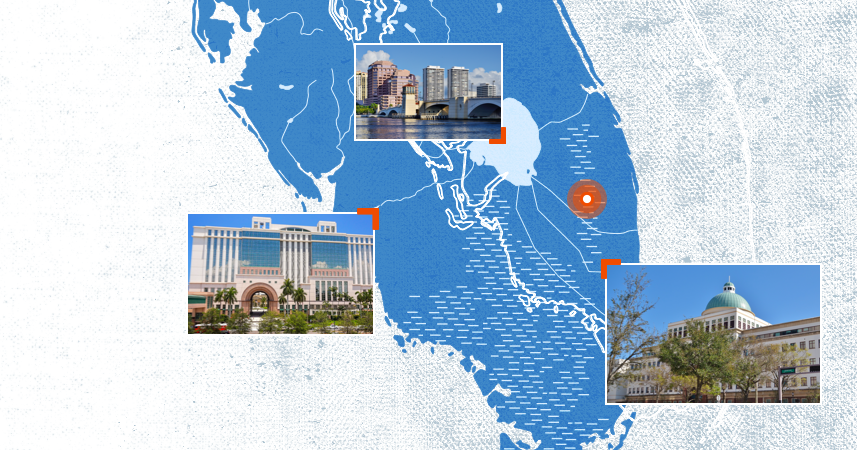
Palm Beach County, FL

Change in Jail Population 1%

Action Areas Community Engagement Courts Defense Counsel Racial and Ethnic Disparities

Last Updated

Background

While Palm Beach County’s jail has not been overcrowded, too many individuals with low-level offenses who pose minimal risk to public safety are incarcerated. In addition, significant racial and ethnic disparities persist in the jail population. Specifically, jail admissions and length of stay are both disproportionate for people of color.

Palm Beach County’s jail is the biggest mental health care provider in the county. People with behavioral health issues, many of whom are homeless, regularly cycle in and out of the jail with no clear path for ending that cycle.

Strategies

Palm Beach County has advanced a number of strategies to rethink and redesign its criminal justice system so that it is more fair, just, and equitable for all.

01

COURT REMINDERS

To reduce failures to appear in court and at mandatory appointments for individuals on pretrial supervision and probation, the county started a program to send text message reminders to defendants for court dates and required appointments.

02

HOLISTIC DEFENSE

The Public Defender’s Office established new positions including a client navigator and social services coordinator, who are responsible for identifying individuals with behavioral health or housing needs at first appearance and connecting them with community-based services to facilitate pretrial success and reduce recidivism.

03

COMMUNITY ENGAGEMENT

Palm Beach County has been engaging the local community with a series of policing forums and “Dialogue To Change” meetings. Specific policy proposals stemming from these community forums will be presented to stakeholders for consideration and implementation.

04

REDUCING RACIAL DISPARITIES

In an effort to meaningfully reduce racial and ethnic disparities in its justice system, the county sought to infuse all its strategies with a racial equity lens. This started with establishing a Racial Equity Team, which is responsible for identifying areas of disparity and generating strategies to combat inequities.

05

FREQUENT UTILIZERS PROGRAM

The PalmFUSE (Frequent Users Systems Engagement) project was a pilot program to provide housing and case management for unhoused individuals with behavioral health issues who were frequently arrested and cycled in and out of the jail. The program is being expanded in 2021.

06

CASE PROCESSING

The county has worked to increase efficiencies in case processing by bringing individuals who are incarcerated while awaiting trial into court sooner for hearings. The goal was to resolve cases more quickly and reduce unnecessarily long stays in the jail.

07

ENHANCED DATA

The county collaborated with the local Clerk and Palm Beach County Sheriff to gain more robust and efficient access to court and jail data. Enhanced data will allow the county to better address challenges in its justice system. A public-facing criminal justice data dashboard is in development.

Results

As a result of the above strategies, Palm Beach County has made progress towards its goal of rethinking and redesigning its criminal justice system.

Quartery ADP for Palm Beach County (2016-2026)

1.4% from baseline

More Results

Since joining the Safety and Justice Challenge, the jail population in Palm Beach County has been significantly reduced while keeping the community safe.

The county’s PalmFUSE program has demonstrated that housing frequent utilizers and providing them with wraparound services creates stability and ensures that people with behavioral health issues do not cycle in and out of jail. Launched as a pilot, the initial PalmFUSE project provided housing and case management for 12 unhoused individuals with behavioral health issues who were frequently arrested and cycled in and out of jail. Before the program, the 12 participants had been arrested 64 times collectively in the two years before they were housed. The pilot was completed in 2020. All participants have remained in housing, and no one has been rearrested since joining the program. A new contract has been signed to expand the program to 25 participants in 2021.

The county’s text message court date reminder system has successfully reduced the number of warrants issued for failure to appear by 62% for Public Defender clients, as of December 2020.

Initial Case Conference (ICC) hearings are designed to decrease the average length of stay for incarcerated individuals charged with second- and third-degree felonies. COVID-19 has unfortunately affected the program by increasing length of stay. Further research is being conducted to measure the program’s impact as court schedules return to normal.

There is productive collaboration among key stakeholders, including judges, prosecutors, law enforcement, public defenders, and community members, which has contributed to the progress to achieve a more fair and equitable use of jails.

Remaining Challenges

Palm Beach County is focused on addressing its remaining challenges in its local justice system.

The major challenge the county faces is significantly reducing racial and ethnic disparities in the justice system. The county is doubling down on the work to address disparities moving forward.

A second challenge is to examine changes the county has made in response to the COVID-19 pandemic to determine if they are effective and should be continued after the pandemic has subsided. These changes include amending the administrative bond schedule and scheduling bond hearings more quickly.

Lead Agency

Criminal Justice Commission

Contact Information

Katherine Shover
KShover@pbc.gov

Partners

Judges of the Fifteenth Judicial Circuit, State Attorney, Public Defender, Palm Beach County Sheriff’s Office, Multiple municipal police departments, Felony and misdemeanor probation departments, Pretrial Services, Clerk and Comptroller, Community Partners of Southeast Florida, Local hospitals, The Lord’s Place, Gulfstream Goodwill, Healthier Neighbors

Blog Posts

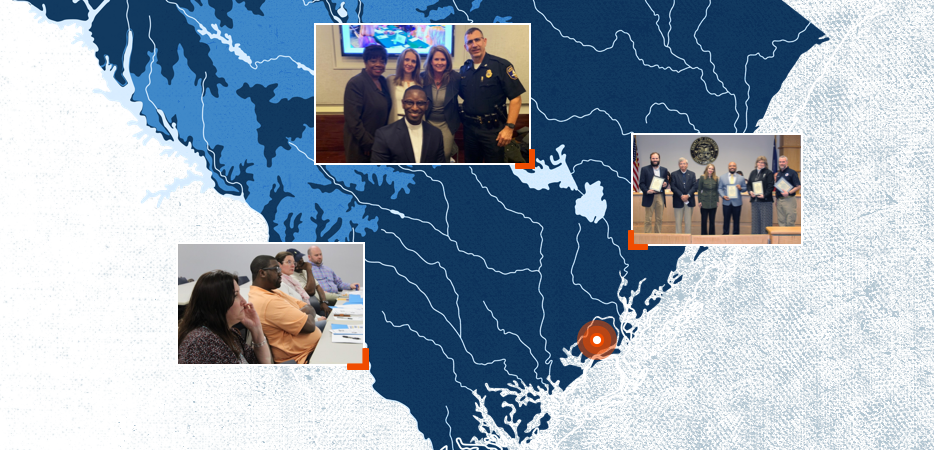
Charleston County, SC

Change in Jail Population 16%

Action Areas Community Engagement Courts Diversion Racial and Ethnic Disparities

Last Updated

Background

In 2014, there were nearly 25,000 local admissions to Charleston County’s jail. The most frequent charges resulting in jail use were municipal and magistrate charges (e.g., simple possession of marijuana) that also disproportionately impacted the county’s Black community. Individuals living with mental illness, substance use disorders, and/or homelessness were among the most frequent users of the jail, often cycling through repeatedly.

In the courtroom, defendants in bond court rarely had representation, and judges had minimal information when making decisions at initial appearance. Judges ordered financial bonds routinely. If they were not able to get released, people often remained in jail for long periods while waiting for their cases to resolve.

Delays in the earliest stages of a case (while evidence was transferred from law enforcement to prosecution, for example, or attorneys for defense or prosecution were assigned) added to the time it took to bring cases to justice.

Strategies

Since joining the Safety and Justice Challenge in 2015, Charleston County has advanced a number of strategies to rethink and redesign its criminal justice system so that it is more fair, just, and equitable for all.

01

INCREASED COLLABORATION

The county’s Criminal Justice Coordinating Council (CJCC) formed in 2015 to make sustainable, data-driven improvements to the local criminal justice system, as well as improve public safety and community well-being. The CJCC is a collaboration of elected and senior county officials, law enforcement leaders, judicial and court leadership, behavioral health professionals, victim and legal advocates, and community leaders.

02

COMMUNITY ENGAGEMENT

The CJCC aimed to use data alongside expanded community engagement as it developed its strategic plan, using the idea of a “dialogue to change.” This included a particular focus on those most impacted. The CJCC engaged people through a series of events, roundtable dialogues, and surveys, which helped involve the community in setting the course for the next strategic plan.

03

ENHANCED DATA

Charleston County strengthened its commitment to transforming the local criminal justice system using a variety of data-based strategies. To make sure the county could track progress, a centralized database was developed to track progress across the criminal justice system and study trends.

04

DIVERSION TO SERVICES

Charleston County set out to divert people from jail on municipal and magistrate charges when appropriate. The program expanded the options that law enforcement could use beyond jail, offering alternatives that helped individuals get the help they need and reduce the number of people cycling repeatedly through the jail.

05

IMPROVED COURT RESOURCES

More resources were set up for individuals within the courts. For the first time, public defenders were available at Centralized Bond Court for defendants who qualified. Docket management was transferred from the Solicitor to the Court, and people were able to get through the early stages of case processing faster through new, more efficient processes (e.g., transferring evidence and assigning attorneys faster).

06

JAIL POPULATION REVIEW

Charleston County instituted regular reviews of the jail population to identify pretrial defendants that are not a threat to safety or flight risk and remain in jail on financial bonds in an effort to expedite case movement and reduce how long they stay in jail before the trial.

Results

As a result of the strategies above, Charleston County has made progress towards its goal of rethinking and redesigning its local criminal justice system.

Quartery ADP for Charleston County (2016-2026)

15.6% from baseline

More Results

By 2020, jail use in Charleston County was returning to its intended purpose, reducing the harms of unnecessary incarceration on people, families, and communities. This included a reduction in the jail population, local bookings, individuals booked, and charges.

The centralized database, launched in 2017, and now provides access from across the criminal justice system to see results, conduct analysis, and evaluate how the local criminal justice system is functioning and allows for identification of areas with the opportunity for improvement. This reporting shows that the municipal and magistrate charges brought to the jail declined by 78% from 2014 – 2020.

Five single-charge bookings, including simple possession of marijuana, open container, misdemeanor shoplifting, trespassing, and public intoxication, were specifically targeted as part of the county’s Safety and Justice Challenge efforts, and as a result, were reduced by 84% from 2014 – 2020. The number of people regularly cycling through the jail who were booked and released between 2014 – 2020 decreased by 63%.

The county made significant progress in diverting people from jail to alternatives to help get the help they need. In 2019, law enforcement referred 74 individuals to the Tri-County Crisis Stabilization Center, conducted 473 law enforcement consultations with embedded clinicians, and executed 152 law enforcement drop-offs to the Charleston Dorchester Mental Health Center.

Bond court representations by public defender attorneys started in 2016, gradually increasing from zero in 2015, to 2,128 in 2020. Bond court judges also became involved as partners, getting more information on setting bonds that are fair, just, and meaningful. As part of this, Pretrial Service Reports were set up in 2018 to better inform bond setting judges. These reports offered a consistent, objective, and reliable way to assess for risk of rearrests and/or missing court. By 2020, the reports became available to over 90% of bond hearings in the Centralized Bond Court.

The average number of days in the early stages of case processing improved from 2015 to 2020. This included improvements in the time it took to be assigned a public defender, assigned a solicitor, and how long it took for initial evidence from law enforcement to be provided to prosecutors.

While analyzing the relative rates of incarceration between racial and ethnic groups helped the county improve inequities in the criminal justice system, there is still more work to do. Disproportionately, Black people were booked into the local jail on low-level target charges as well as overall charges, although the gap had shrunk between 2014 and 2017.

The Criminal Justice Coordinating Council (CJCC) efforts to engage the community in the development of the strategic plan brought together over 1,200 community members, including many with direct experience of the justice system. Together, community members and system stakeholders (i.e., judges, public defenders, prosecutors, etc.) created the CJCC’s strategic plan in 2020, focusing on identifying data trends and community priorities to advance change for the next three years (FY2021 – FY2023).

Remaining Challenges

Charleston County is focused on addressing its remaining challenges in its local justice system.

The county’s current strategic plan aims to do more to help protect public safety, minimize harm, and more efficiently use limited system resources—all to create an effective, just, and equitable local criminal justice system.

The strategic plan includes a focus on community engagement, to keep people involved and provide more ways to engage in improving its criminal justice system. It also includes a planned update on the data around racial and ethnic disproportionality and disparities. Beyond data, a race equity fellowship proposal is in the works to create effective agents of change in building consciousness and reducing disparities among criminal justice system actors and people who are leading efforts to address racial and ethnic inequities throughout the community.

Regular reviews of the local jail population continue to be necessary, helping make sure that people who are not a threat to public safety or a flight risk are not detained pretrial unnecessarily. Continued General Sessions court reminders continue to remind defendants of their upcoming court events to increase court appearances and help make sure that the system doesn’t lose contact with people while their cases are pending.

The county must also continue to work on options for diverting and deflecting people from jail. This will include inter-agency case conferencing with service providers, law enforcement, and judicial stakeholders to improve outcomes for those who are most frequently booked into the local jail in an effort to break the cycle of repeated jail use; research on how diversion and deflection from the criminal justice system and into diversionary options impacts arrests, jail population, and behavioral health outcomes; and stronger county-wide tracking on crime and jail use.

The county will also continue to focus on bond hearings in Centralized Bond Court are fair, just, and meaningful. Regardless of the type of bond set, within the state there is currently minimal oversight of the conditions of the bond setting, let alone feedback about pretrial outcomes or a continuum of pretrial options available to help maximize safety and improve the rate of appearances. The strategic plan includes developing a proposal to help address these challenges.

The CJCC, in partnership with Trident United Way 211, is working to strengthen the directory of services for justice-involved people that will help ensure they know which services are available and who they can help.

Last, the COVID-19 pandemic has had a significant impact on every aspect of the county’s local justice system and continues to uniquely affect those incarcerated in jail. More research is needed on the impacts of the pandemic on the justice system, and what lessons can be learned in the long-term.

Lead Agency

Criminal Justice Coordinating Council
3831 Leeds Avenue
North Charleston, SC 29405

Contact Information

Ellen S. Steinberg
Project Director
essteinberg@charlestoncounty.org
843-554-2476

Partners

Charleston County Council, Charleston Sheriff's Office, Charleston Police Department, North Charleston Police Department, Mount Pleasant Police Department, Ninth Circuit Defender, Ninth Circuit Solicitor, Charleston County Clerk of Court, Judiciary, including Circuit, Probate, Magistrate and Municipal Court Leadership, Charleston Dorchester Mental Health Center, Charleston Center, Probation, Parole and Pardon Services, Victim Advocacy, Veteran Justice Outreach, American Civil Liberties Union, One80 Place, 12 diverse community representatives

Follow @ChsCJCC

Blog Posts