730 Days Later: Safety and Justice Lessons from Two Years of COVID-19

By: Matt Davis

Collaboration COVID Racial and Ethnic Disparities March 15, 2022

It’s been two years since the United States began to shut down to prevent the spread of COVID-19. As we continue in our mission to reduce jail populations across the United States, the Safety and Justice Challenge (SJC) asked some of our strategic allies to reflect on lessons learned from the pandemic.

Systems Adapted to Release More People and Take on New Challenges

Criminal justice systems across the country adapted to keep people safe. “They worked in partnership to reduce arrests and bookings, and they increased releases,” said Wendy Ware, vice president of the JFA Institute. Some jurisdictions made changes to their bail protocols. Others relied on technology to keep operating. Where possible, they also focused on behavioral health to improve reentry success.

But COVID-19 also further exposed racial inequities in jails across the country. “In many cases, we saw racial disparities increase across participating cities and counties as a larger percentage of White people were released from jail than Black people,” Wendy said. You can read Wendy’s December 2020 blog, “Five Things COVID-19 Taught Us About Safety and Justice.”

“The pandemic exposed and exacerbated existing inefficiencies and inequities in the justice system,” said Marc Levin, Chief Policy Counsel at the Council on Criminal Justice. “But it also inspired innovations such as remote check-ins for people under supervision that should remain a component of the system as we enter a ‘new normal.’”

Marc said it is now a critical task to deliver on the constitutional promise of a speedy trial. There have been “staggering delays stemming from court closures in systems that were already backlogged to some extent before COVID-19,” he said. Fortunately, “many SJC sites are leading the way in addressing this,” he said. “For instance, by diverting trivial cases, such as those involving warrants for unpaid fines and fees and low-level drug possession, as well as investing in holistic indigent defense so more individuals can be connected with treatment resources, mediation, and other off-ramps earlier in the process.”

Racial Disparities Persisted

Christopher James is a Racial Justice & Well-Being Associate with a Specialization in Criminal Justice at the W. Haywood Burns Institute. He also saw racial and ethnic disparities persist despite policy and practice changes during COVID-19, which led to overall population reductions. “This could mean that Black and Latinx populations which have been most susceptible to COVID-19 due to healthcare disparities have needs that are not sufficiently met by system changes,” he said. “In addition to that, many changes, such as allowing for hearings via Zoom or changes to the bond schedule, are being rolled back, and we must fight to show that these types of changes should remain to make the system and its processes more equitable for everyone.”

Christopher said legal systems were all capable of making many of the changes that took place during COVID-19. But it took the pandemic crisis to make them happen. He wants to keep the pressure up to keep valuable changes in place. “We must continue to hold systems accountable to keep these changes and not to wait until another crisis to begin thinking differently about what accountability can look like outside of secure custody,” he said.

“The arrival of the COVID-19 has only exposed the systemic inequities and racism in this country’s incarceration and detention policies,” said Ronald Simpson-Bey Executive Vice President, JustLeadershipUSA. “Even before the nation’s correctional facilities showed COVID-19 infection rates more than 150 times higher than the general population, correctional facilities were in a state of crisis.”

COVID-19 revealed prisons had “no real plan to deal with the outbreak,” Ronald said. In fact, most prisons do not have plans in place to deal with any kind of emergency. At the height of the crisis, Ronald wrote a blog about why jails need better emergency planning. Policymakers’ gross lack of foresight, care, and attention to protect people in prison and jails during this crisis, and all the ones that have preceded it, is reprehensible,” Ronald said. “The refusal to save the lives of the people behind bars, disproportionately Black and Brown, reflects the idea that these people are disposable.”

Ronald points out that people in jails and prisons are our mothers, fathers, teachers, and community members. They are human beings and their lives matter. Policymakers have fallen behind the curve, relying on “arbitrary standards” to release people and leave them waiting too long for release even when plans are in place, Ronald said.

Reframing Jail Populations as A Public Health Issue

“COVID-19 only affirmed a rapid need to decarcerate,” said Evie Lopoo, Project Manager at The Square One Project at Columbia University.  She added that the rapid spread of the virus in jails and surrounding communities showed the “profound” connection between the health of people in jails and prisons and the health of entire communities. “Reducing jail and prison populations is a matter of public health and should be framed as such,” she said.

County and City Governments Found a New Role in Making Change

“County governments have served on the front lines of the nation’s response to the pandemic,” said Larry Johnson, President of the National Association of Counties. Larry is also a County Commissioner in DeKalb County, Georgia. He said counties have been using new resources from the American Rescue Plan to shape their response. “We are investing in building healthier, safer counties where all our residents have opportunities to thrive,” he said. That means pursuing innovative practices with community partners to reduce the misuse and overuse of jails. It also means “improving outcomes for individuals involved in the justice system, especially residents with behavioral health conditions,” Larry said.

Kirby Gaherty is a Program Manager for Justice Initiatives at the Institute for Youth, Education and Families at the National League of Cities. The pandemic has meant “a lot of long days for the team at NLC,” she said. “We are happy to now see, after months of advocacy from members of the team, that cities are taking advantage of the American Rescue Plan to invest in much needed justice transformation projects like violence prevention strategies, alternative response models and more, in addition to other important investments.”

Kirby also said that much of her organization’s justice and public safety work shifted after the murder of George Floyd and the subsequent demonstrations. “While manifesting out of tragedy, the results were a much-needed refresh for our Justice Initiatives team here at NLC,” she said. “Our work with Mayors and Councilmembers across the country via the the Reimagining Public Safety Task Force resulted in two strong reports that we hope to advance through our SJC network and beyond. Unfortunately, narratives around violence and crime throw somewhat of a wrench in that work. But we are still hopeful to see cities make the changes that they committed to back in 2020.”

Moving Beyond What We Have Always Done

Kirby said the pandemic offered new perspectives for many people working on justice reform. It provoked a “new intentionality” around the work, she said. “It is unfortunate that it took a global pandemic slowing us down to get here,” she said. “But the results brought a stronger connection with local and national partners, more intentional engagement of people with lived experience and members of the community, and the ability to move beyond what we have always done.”


A Deeper Look at Racial Disparity Data in Jails

By: Reagan Daly, Stephanie Rosoff

Data Analysis Incarceration Trends Racial and Ethnic Disparities January 19, 2022

Cities and counties participating in the Safety and Justice Challenge (SJC) significantly reduced their jail populations over the past few years – both prior to and following the COVID-19 pandemic. Despite that progress, racial and ethnic disparities in jails persist.

Today the SJC has selected four jurisdictions to join a new Racial Equity Cohort based on proposals that explicitly focus on racial and ethnic equity in the criminal justice system; center lived experiences of Black, Indigenous, Latinx, and other people of color; and emphasize the SJC Community Engagement Pillars of authenticity, accessibility and transparency, respect for diversity, and commitment to ongoing engagement.

The four cities and counties selected to participate in the Racial Equity Cohort are Cook County (IL), New Orleans (LA), Philadelphia (PA), and Pima County (AZ).

The funding will provide training and technical assistance focused on racial equity and authentic community engagement, peer-to-peer support from other cohort members, and qualitative and quantitative data and analytic support. The new funding and support announced is part of that commitment to learning and investing in more intentional and effective strategies to eliminate institutional and systemic racism within the justice system.

In that context, let’s take a deeper look at the data on racial disparities in jails and why there is such a great need for this work.

Jail Populations Can Be Successfully Reduced

Data collected by ISLG show significant declines in overall and pretrial jail populations, and reduced jail populations for people of color across SJC sites. Jail bookings are down, particularly for people charged with misdemeanors.

Since the start of the SJC, participating cities and counties collectively reduced their jail populations by 26% as of November 2021. This equates to almost 19,765 fewer people held in jail in SJC communities since we began collecting data. The decline in the confined pretrial/awaiting action population accounted for 52% of the overall decline in jail populations across SJC cities and counties.

Despite Improved Outcomes, Disparities Persist

Though jail populations are down across racial and ethnic groups, disparities persist in jail populations. While many people admitted to jail are released within hours or days of their booking, many cannot afford to post bail and may remain behind bars for weeks or even months. These and other burdens of jail fall disproportionately on communities of color.

Following the COVID-19 pandemic, jail populations declined dramatically across the country and in cities and counties participating in SJC. Though declines in jail populations and bookings were prevalent across racial and ethnic groups, the declines were more pronounced for White people than for Black, Latinx, and Indigenous people. As a result, racial and ethnic disparities persisted or worsened in many SJC communities between February 2020 and October 2020. The disparities were particularly deep for Black and Indigenous people.

More SJC Communities Reduced Jail Populations for White People

Though jail populations have rebounded somewhat since the early months of the COVID-19 pandemic, jail populations are still below February 2020 levels in many sites.

Still, in most sites the reductions for white people were greater than the reductions for people of color, resulting in persistent disparities.

From when communities joined the SJC through November 2021:

  • Jail population declines for Black people equalled or exceeded declines for White people in only 3 of 17 reporting sites.
  • White jail populations declined more than Latinx jail populations in all 12 reporting sites.
  • Indigenous jail populations out-declined White jail populations in 2 of 4 reporting sites.

Trends in Individual SJC Communities

Data on the four racial equity cohort sites–New Orleans, Cook County, Pima County, and Philadelphia–further illustrate the persistent disparities that exist, even among sites that have made significant progress in reducing overall jail populations.

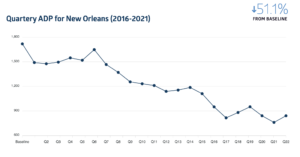
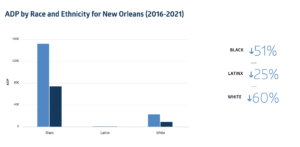
In New Orleans, Louisiana, the overall jail population declined by more than half since their baseline, but the reduction was more pronounced for white people (60% drop) relative to Black people (51% drop) and Latinx people (25% drop).

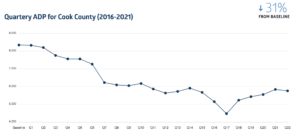
In Cook County, Illinois, the trends are similar. The t jail population ticked up slightly following the pandemic but remains significantly lower than baseline (down by 31%).. Still, the reductions in ADP for White people far outpaced reductions for Black and Latinx people.

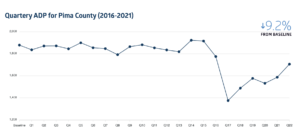
In Pima County, Arizona, race and ethnicity trends are unclear–local partners will be working on expanding their capacity to track this data as part of their reform work. Overall, however, the jurisdiction’s jail population trends show a 9% decline from their baseline and an upticksince the initial months of the pandemic.

Philadelphia, like Pima, does not yet fully report race population breakdowns, but has seen an overall jail population decline of 39%, up slightly from a pandemic-era low.

Work to Eliminate Disparities Continues

As cities and counties continue to implement strategies to safely reduce jail populations, more work remains to eliminate racial and ethnic disparities. The new SJC racial equity cohort in select sites across the country is an opportunity to further reduce harm and implement best practices.

The SJC has engaged the Institute for State and Local Governance (ISLG) at the City University of New York (CUNY) to track data across participating cities and counties.

A Dozen Blogs on Racial Justice to Mark MLK Day

By: Matt Davis

Community Engagement Racial and Ethnic Disparities January 17, 2022

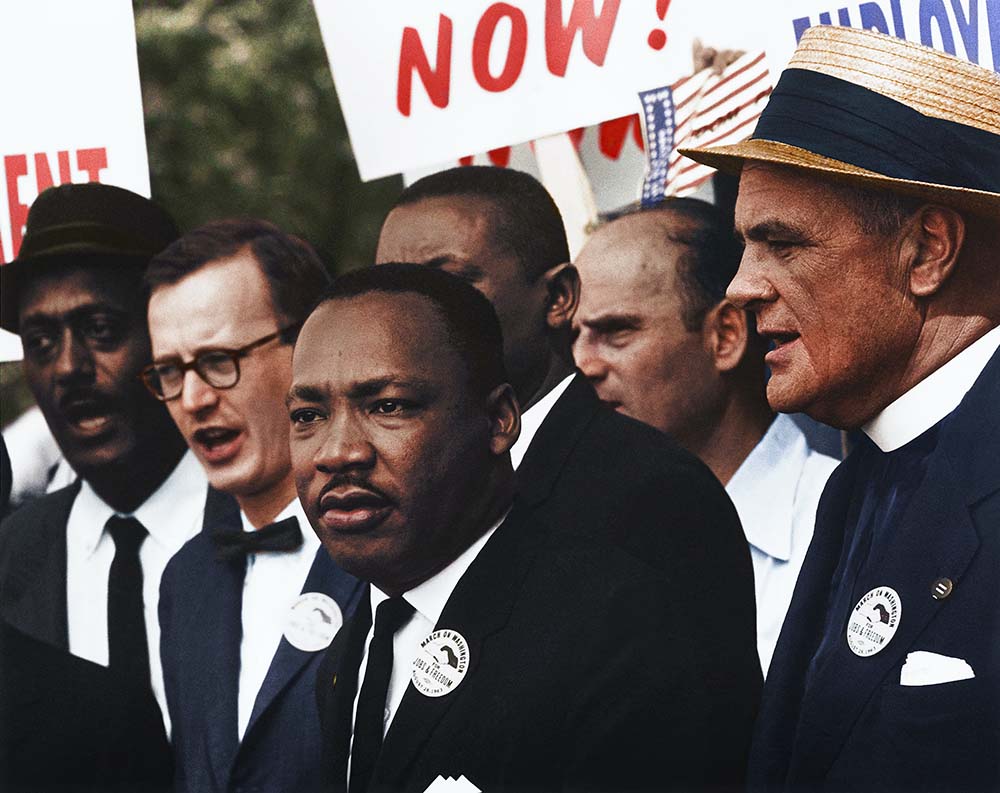
Today is Martin Luther King, Jr. Day, but the commitment of the Safety and Justice Challenge to improving racial equity in the jail system runs year-round.

With that in mind, here are a dozen blogs on racial justice written by members of the effort and featured over the last year.

  1. Exploring the Difference Between Racial Equality and Racial Equity. Christopher James with the Haywood Burns Institute defined the terms of the debate: “To start treating, say, the Black community ‘the same as everyone else’ at this point in history will not go far enough in terms of achieving true equality,” he wrote.
  2. The Catalyzing Impact of George Floyd’s Death on Criminal Justice Reform. A year after the murder of George Floyd in Minneapolis, we asked how community leaders, organizers and activists have continued to champion criminal justice reform and call for an end to police violence.
  3. Here’s Why Jails Need Better Emergency Planning. Ronald Simpson Bey from Just Leadership USA reflected on the racial disparities in the jail system, and how they have impacted Black and Brown people, particularly through COVID. “We show that Black and Brown people are disposable in the United States when we fail to plan for emergencies,” he wrote.
  4. How Prisons and Jails Might Function if Addressing Trauma Was a First Priority. Nneka Jones Tapia with the Square One Project focused on healing the trauma of over-policing in Black and Brown communities, a topic rooted in the experience of seeing her father arrested for marijuana possession when she was growing up as a child in North Carolina. “As a child, you never forget the experience of police officers hauling your father off,” she wrote. “You do not forget having to interact with your father through a piece of glass. They are links in the chain of trauma that lie embedded within a person. And it radiates through communities.”
  5. Failing to Track Ethnicity Accurately. Troublingly, many jails across the United States are still failing to adequately track race and ethnicity, particularly of Latino people, says Nancy Rodriguez, a Professor at the University of California, Irvine.
  6. Overrepresentation of Indigenous People in Jails. We also spoke with Indigenous people about their experience with the jail system. “Systemic biases in America’s government and legal systems are rooted in historic genocide perpetrated against Native people,” said Dr. Selso Villegas. “We’re invisible to people because that’s the way many in society want it,” he said.
  7. Meaningfully Engaging People with Lived Experience. Aminah Elster is an SJC Fellow and Campaign and Policy Coordinator at the California Coalition for Women Prisoners. She wrote a piece about efforts by the District Attorney’s office in San Francisco to meaningfully incorporate people with direct experience of the criminal justice system in the office’s decision-making. She wrote, “efforts by criminal legal system leaders to engage community members with lived experiences of incarceration are often brief, centered on one-way, top-down information exchange or focused on asking for general input.”
  8. Pathways to Collective Healing: Law Enforcement and the Communities They Serve. Aviva Kurash with the International Association of Chiefs of Police wrote about a four-year Collective Healing initiative led by the association to focus on how police agencies can build and maintain trust and legitimacy with the communities they serve.
  9. Asking Ourselves: “Who’s Not Here in the Room?” Gwen Whiting is Director of Training and Leadership Development at Everyday Democracy. She’s worked with several cities and counties participating in SJC to embed racial equity, often through better community engagement. In this piece, she shares a key lesson for those across the country looking to do the same.
  10. Local Communities Are Better Placed Than Governments to Determine Public Safety. Renita Francois with the City of New York focused on community-centered design principles. She wrote about the Mayor’s Action Plan for Neighborhood Safety and its work in Brownsville, Brooklyn, home to the most densely concentrated area of public housing in the United States. Its work included offering a community poetry night called Poetic Justice, a roller-skating event called Swervin; an employment expo for residents; and a performance of “King Lear” followed by an interactive, guided conversation about caregiving and death.
  11. From the Barbershop to the Bakery, What Makes You Feel Safe? Emily Rhodes, a member of the Community Advisory Group in New Orleans, focused on community art projects designed to get residents discussing what they understand as public safety.
  12. A Twitter Chat on Reducing Racial Disparities. Marshall Project Staff Writer Jamiles Lartey hosted a Twitter chat on strategies for addressing racial equity in our criminal justice system as part of the Safety and Justice Challenge’s commemoration of Black History Month. From ending cash bail to empowering impacted communities in criminal justice reform, to replacing police with community response models for crimes better handled without a law enforcement response, the conversation emphasized ways to hold the system more accountable for racial disparities.

A Path Toward Safe and Equitable Cities

By: Kirby Gaherty

Collaboration Community Engagement Racial and Ethnic Disparities November 18, 2021

Historically and up to today, Black, Latinx, and Indigenous communities, and people residing in neighborhoods of historic divestment, are more likely to be harmed by public safety systems.

To truly reimagine public safety, cities must acknowledge these harms and take actionable steps, alongside their residents, toward transformation. In 2020 the names of people lost to police violence became synonymous with the movement toward justice. These tragic losses prompted a long overdue conversation with local leaders. They realized they could no longer treat public safety as solely a function of law enforcement.

The recent upticks in violent crime in many cities, despite low crime rates overall, reinforce the importance of city leaders having guidance and support as they think differently about public safety. Losing momentum toward transformation could lead cities back toward strictly enforcement and punishment-based levers for safety.

In this context, the National League of Cities Reimagining Public Safety Task Force held meetings and listening sessions hoping to collectively set a new vision for what it means to keep residents safe. Meeting from February to August of 2021, Mayors and Councilmembers from more than 20 cities, alongside national partners and community stakeholders, developed five high-level recommendations that support the movement toward safety for everyone.

Through collaboration with their peers, national organizations, and most importantly, their communities, elected officials can innovate and replicate policies and initiatives using these recommendations as a guide. Within each recommendation there is a strong focus on both moving away from policing as the only option and on centering the equitable engagement and involvement of residents in every step of the process.

Captured in the report “A Path Toward Safe & Equitable Cities”, the recommendations provide an initial framework for city action:

  1. Direct municipal government leadership toward providing safety and well-being for all. This recommendation guides local leaders towards broader definitions of safety and new ways to measure what it is that makes people feel safe. A focus on wellbeing and public health leads cities toward expansive safety visions.
  2. Balance the respective roles of government agencies, residents, and partners. Non-traditional stakeholders need to be involved in safety conversations, planning, and budgeting. Specifically, this inclusion centers members of the community who are often left out but most impacted by the harms of current systems.
  3. Significantly expand the use of civilian-led and community-based well-being and prevention-focused strategies. Building on the momentum around community responder models and the amplification of credible messengers as key for any safety plan, this recommendation highlights public health response options to both crisis and violence.
  4. Embrace full and transparent oversight and accountability for law enforcement. While the report does not center law enforcement in reimagining public safety, it is important for cities leaders to recognize and embrace their role in the oversight of their local police force. Accountability and transparency matter.
  5. Seek guidance and support from peers and experts with the assistance of the National League of Cities. Local elected officials face scrutiny daily. In 2020, they also faced both a global pandemic and a reckoning around policing. Support from their peers and access to other resources is necessary as they take a journey toward community centered safety.

During NLC’s annual City Summit in November 2021, a Municipal Toolkit was released to dig deeper into what cities are doing and can do to bring these recommendations to life. The toolkit takes each recommendation and explains it in depth, draws out local examples where it has worked, and describes what implementing policies and initiatives could look like in communities across the country.

NLC, and the Task Force, recognizes that no city has this figured out completely and that much of what we have seen thus far has been smaller in scale and less equitable than we would like. However, by taking these steps, evaluating them, enhancing them and taking them to scale, transformation is possible. In addition, the American Rescue Plan offers an opportunity for cities to invest in ways not possible before. Not all cities are the same and not every city leader will act in the same way. But, through collaboration with residents, local stakeholders, and national partners, we can move from harm to wellness.

“We are talking about wellness. We are talking about holistic health in our communities. That is what public safety is all about—not just the absence of violence—but the presence of wellness,” said Mayor Ras J. Baraka of Newark, New Jersey. “We need more than the police department to create wellness. Public safety has to be expanded and put in the hands of other folks.”

How Probation Supervision Contributes to Jail Populations

By: Alex Roth, Sandhya Kajeepeta

Incarceration Trends Probation Racial and Ethnic Disparities October 28, 2021

Probation is the most common sentence in the United States. In 2019, one in 73 adults was on probation, and there were almost 1.5 million more people on probation than in jails and prisons combined. Although the problems of “mass supervision,” particularly the way probation violations contribute to state prison populations, have begun to draw greater critical attention, there is very little information about how probation contributes to local jail populations.

A new report released by the Vera Institute of Justice, with support from the Safety and Justice Challenge, focuses on the ways probation can affect jail populations and what can be done differently.

Research shows people are frequently sentenced to overly long terms of probation and have to comply with an average of 10 to 20 conditions, which are often vague and sometimes conflict with each other. The difficulty of complying with all of these conditions for long periods of time frequently leads to “technical” violations (violations of supervision conditions that are not based on new criminal conduct) and can lead to revocation of probation and imposition of a jail or prison sentence. Nationally, only around 60 percent of people under supervision complete probation successfully.

Probation is also marked by significant racial disparities. Despite being more likely to be sentenced to jail or prison than probation, Black people are still over 2.6 times more likely than white people to be on probation. When they are sentenced to probation, Black people tend to be given more conditions and to be on probation for longer terms than similarly situated white people. They are also more likely to have violations filed against them, to be sanctioned with incarceration, and to have probation revoked and be sentenced to incarceration.

There are multiple ways probation supervision can result in jail incarceration, such as detention of people waiting for court hearings on violations alleged by a probation officer or sentencing of people to jail for probation violations. There is some evidence that increasing numbers of people are choosing to accept a jail sentence up front to avoid probation, as they view probation as too difficult to comply with and likely to result in eventual incarceration anyway.

National data provides almost no details on how probation contributes to jail populations. To begin to remedy this gap, we analyzed jail data from nine jurisdictions participating in the Safety and Justice Challenge. This analysis showed admissions to jail for probation violations vary from a low of 3.9 percent to a high of 23.8 percent. The data also showed that length of stay (LOS) for people with probation violations was much longer than for those held in jail for other reasons. Because of this extended LOS, on any given day, the proportion of people in jail for probation violations greatly exceeded their share of jail admissions. The probation violation ADP ranged from 9.1 percent to just over 50 percent. Our analysis also confirmed significant racial disparities: across the sites for which race data was available, Black and Native American people were held in jail for probation violations at rates far higher than their representation in the general public.

We also highlight strategies in two SJC sites to reduce probation violation populations in jail. For example, St. Louis County placed three full-time probation staff members in their jail to meet right away with people who come in on violations and work on release plans and recommendations that can be delivered directly to judges. This has led to more judges ordering release based on a probation officer’s written recommendations rather than waiting to hold a preliminary hearing.

Allegheny County, meanwhile, adopted multiple strategies to try to prevent people from going to jail on probation detainers and to get those who are jailed released more quickly. A new policy makes probation detainers an option of last resort, as probation officers in most cases must exhaust all other options for keeping people in the community before issuing detainers, while also requiring earlier release planning and regular follow up for people who do get detained. Allegheny County also developed procedures to ensure that probation violations and new charges are resolved at the same hearing, rather than waiting an average of two months between separate hearings. Finally, the County adopted criteria for termination of probation agreed on by the public defender’s and district attorney’s offices, which led to judges ending probation early for more people who were doing well under supervision.

To better understand how probation affects jail populations, probation agencies and local jails should work together to combine data, disaggregated by race and ethnicity, to ensure that they can determine who is in jail for probation violations; whether the violations are all technical or include new charges; whether people are being detained pending a violation hearing, serving a sentence as a direct sanction for a violation, or serving a previously imposed jail sentence after probation has been revoked; and how long people are spending in jail pending hearings and/or after being sentenced for violations.

Because probation can be a significant driver of jail populations, jurisdictions should work to reduce the number of people detained for violations as well as the time they stay in jail for those violations. Sites should consider using alternative non-carceral sentences instead of probation, limiting the length of probation, reducing and tailoring the number of probation conditions, reducing the frequency of reporting and allowing remote reporting, using summonses instead of warrants for violations, eliminating or severely restricting the use of detainers, and using only non-carceral sanctions for technical violations.